How ‘N100 A Day’ School Is Redefining Affordable Education In Abuja
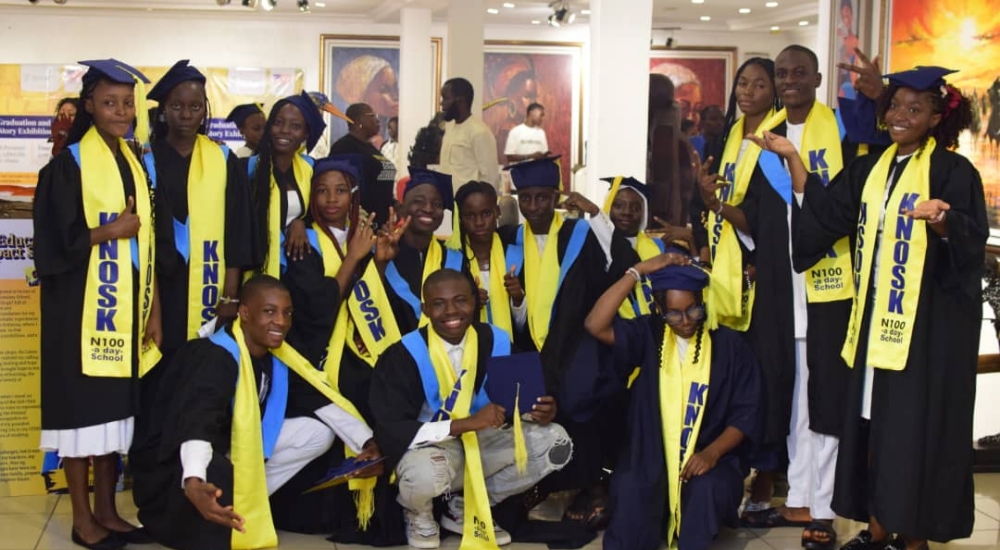
On the outskirts of Abuja, nestled in Kuje, lies the KNOwledge and SKills (KNOSK) School, a place where parents can pay just N100 per day for their children’s education. From the moment it opened, the school’s story has captured the heart of everyone who hears it. Seven years on, KNOSK still stands, a testament to determination and resilience, and a community’s unwavering belief that quality education can be both affordable and transformative.
“The school started in July 2019 with only 30 students,” the Vice Principal, Administration of the school, Isaac Iyogun, who joined the school as a corps member in 2021, told THE WHISTLER during a visit to the school.
The institution, a vision of a couple, Kinsley and Irene Bangwell, head of fundraising and strategy and head of learning respectively, has grown from a modest fundraising and awareness campaign into a thriving institution now serving 180 students.
“That awareness, reaching out to primary schools, principals, organisations, and churches, informing them of the initiative and what it would entail, allowed us to collect applications, conduct entrance exams, and admit the students who passed. Those first 30 students became our pioneer cohort,” he explained.
Even though the school is one of the most affordable in the country, the procedure for entry isn’t easy because the management ensure that deserving students whose parents cannot afford their education, are selected, Iyogun explained.
Breaking down the procedure, he said, “First, they must be from low‑income families, parents who are financially vulnerable and whose children are at risk of missing out on education. That is the only category we’re looking for; anyone outside that profile isn’t eligible for admission.
Advertisement
“The admission process starts with a free application form. Parents fill in their details, provide the child’s birth certificate (the child must be about 11 years old for JSS 1), and submit proof of primary‑school completion. They also attach recent bank statements (within the past six months). We don’t just look at the balance; we examine income flow, what money comes in, what goes out, and how it is spent.
“After this initial screening, eligible applicants are invited to sit a written exam. The pass mark is 50; anyone scoring below that isn’t considered.
“For those who meet the exam threshold, we conduct a home‑visit. Two staff members verify the family’s residence and living conditions. If everything matches the low‑income profile, we give the green light and proceed with admission.”
According to him, each child gets free uniforms, books and lunch meals daily, with the girls getting free sanitary pads.
“Currently, due to the limited fund available, we are only able to do the meal three times in a week, but that is still sufficient,” he stated.
Advertisement
But how does the school stay afloat even after providing these essentials for the students, Iyogun’s response was candid, “The students pay N100 a day, but it is not a mandatory fee. Many families can’t afford that amount, and for term after term we have families that are owing.”
To protect learning, the school follows a “no‑fee‑drive” policy, guaranteeing education even when payments lapse. The financial reality, however, goes far beyond daily contributions.
“The N100 a day doesn’t even support our operations. Our monthly wage bill alone is about N3.8 million, and salaries are just one part of the overall cost,” he explained.
To bridge the gap, the vice principal explained that KNOSK relies on a mix of fundraising, corporate sponsorships, and individual donations.
“Sponsorship for a child is N80,000 per term, which translates to N240,000 a year. From the start of the school, 2019 till now, we have had individuals, organisations and corporate bodies come to support our work. We have also had grants from MacArthur,” he noted.
Iyogun noted that the school does not compromise on standards, even as it pushes the boundaries of traditional education.
Advertisement
“One thing I can say is that you can call this place an innovation lab. We are keen on innovation—it’s part of our culture,” he said.
At the end of each term, he added, rather than a simple closing ceremony, KNOSK runs an Innovation Academy for its students.
“ We want them to become problem solvers, not just learners who pass exams. We want them to take what they have learned, look at their society and environment, identify problems, and then solve them,” he said.
He explains further that the school serves only students who live in Kuje and does not have a dedicated boarding facility, but he noted that there is an exception for six students whose circumstances require them to stay on campus.
“One of those six students was brought from Makoko in Lagos. Makoko is taking care of the feeding expenses and we are taking care of the academics. Another case involves a girl who excelled academically and was in JSS 3 when her family relocated, leaving her out of school. We had to just reach out and get her. So, that is all we can do,” the vice principal added.
The school successfully graduated its first batch of students last September. Although they started with 30, only 15 made it to graduation. Iyogun explained, “Yes, some students dropped out. Working with this kind of audience, you get cases where students return to their villages and we lose contact. We have had families we couldn’t reach, and we don’t know why they stopped, and we can’t even trace them.”
He added that the 15 graduates are not left on their own; stating that they are now in a nine‑month pathway program that prepares them for life after school, even if they don’t go on to tertiary education.
“We are keeping tabs on all of them. Currently, three are in admission, two are already in school, and the rest are in this space. Instead of staying at home and waiting for a job, we bring them back here so they can prepare for work while learning skills. After nine months, they’ll have something sustainable even without a degree,” he said.
Speaking on the skills the students are learning , he added, “It is a mix of digital and hard skills. Some students enrolled in ALX, an initiative by Fred Swaniker, where they learned AI Career Essentials—using AI for professional growth. Others took courses in Forex, Excel, barbing, and makeup.
“These are easily convertible skills; you can start a small business with barbing or makeup, and the digital skills help them earn part‑time while they study. The idea is to give them practical tools they can use right away, without needing huge capital.”
On the school’s plan for the future, Iyogun disclosed that with a solid foundation and a clear vision, expansion is firmly on the horizon.
He noted that the school’s 2025 to 2030 plan will see a broader reach, ensuring that more young people from Kuje can benefit from the same transformative education and skills training.
As Iyogun puts it, “Expansion is in the plan. We are in that phase where we want to grow, but first we are tightening our internal systems.”