
Nigerian Households Need 334% Of Minimum Wage For One Healthy Meal Daily
…One Meal Alone Gulps Two-Thirds Of Minimum Wage Earnings
…Ekiti Worker Must Spend 90% Of Earnings For Healthy Diet
…South-East Workers Spend 81% Earnings On Food
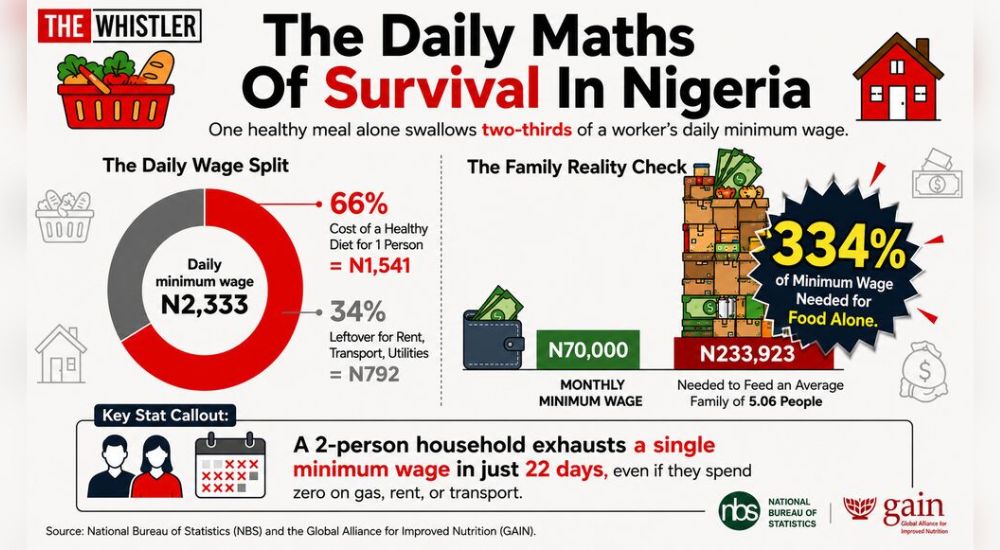
An average Nigerian family needs more than three times (334 per cent) the current national minimum wage to afford a healthy diet.
This is according to THE WHISTLER’s analysis of 15-month Cost of a Healthy Diet (CoHD) data sourced from the National Bureau of Statistics (NBS) and the Global Alliance for Improved Nutrition (GAIN).
Advertisement
A Nigerian worker earning the national minimum wage of N70,000 a month takes home N2,333 a day.
At the national average, the raw ingredients needed for one person’s healthy diet cost N1,541.
This leaves N792 for rent, school fees, transport, and the firewood or cooking gas needed to prepare the food, among other expenses.
According to the NBS, the average household size in Nigeria is 5.06 persons per family. In rural areas, the size is larger at 5.42 individuals and 4.50 persons in urban areas.
The highest household size is in Jigawa state at 8.15 persons, and the lowest is in Ekiti state, where an average household comprises 3.50 family members.
Advertisement
The Cost of a Healthy Diet (CoHD), developed by the NBS in partnership with the Global Alliance for Improved Nutrition, measures the least expensive combination of locally available foods required to meet internationally recognised dietary recommendations.
The estimate covers only food ingredients and excludes transportation to markets, cooking fuel, water and other meal preparation costs.
At the national average of N1,541, the CoHD consumes two-thirds of a minimum wage earner’s daily pay. For a single adult, the national average cost of a healthy diet translates to N46,230 per month, leaving N23,770 from the minimum wage for other expenses.
In a household of two persons supported by one person’s income, the CoHD cost is N92,460 monthly. This exceeds the N70,000 wage by N22,460. Even if the worker spent nothing on rent, transport, or cooking fuel, their income is exhausted after 22 days.
To feed an average Nigerian household, the cheapest diet that meets global nutritional standards, a worker would need N233,923 a month. This represents 334% of the current minimum wage, according to the CoHD data analysed by THE WHISTLER.
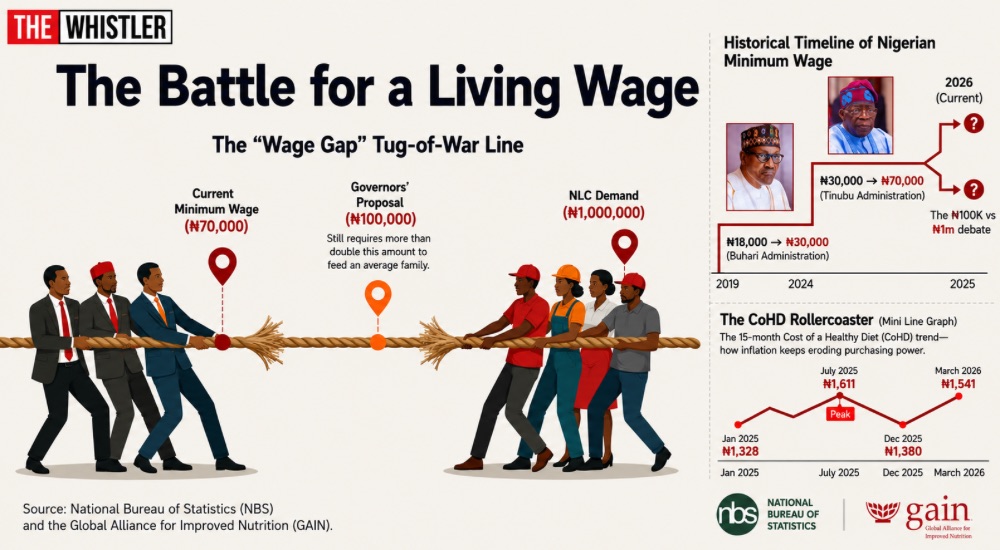
On May 30, the Nigeria Governors’ Forum (NGF) proposed raising the minimum wage from N70,000 to N100,000.
Advertisement
The Nigeria Labour Congress, however, rejected the figure and demanded N1m as new minimum wage.
The CoHD data indicates that even at the proposed N100,000 minimum wage, feeding an average family would require more than twice the amount.
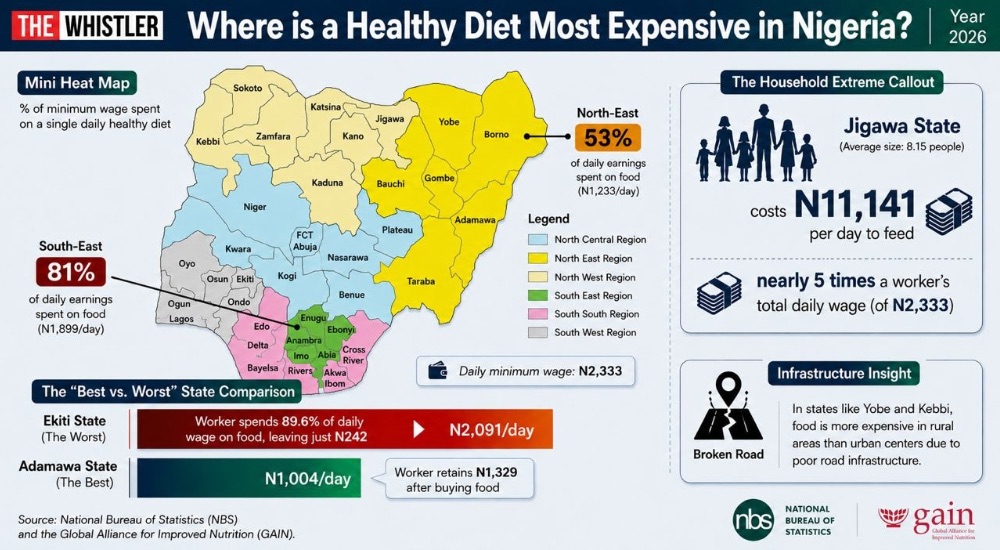
THE WHISTLER’s analysis shows that the CoHD consumes nearly all of a minimum wage earner’s income in Ekiti State.
The March 2026 data put Ekiti’s daily CoHD at N2,091, the highest for any state in Nigeria.
A worker who earns a minimum wage of N2,333 per day in the state will spend 89.6 per cent of their daily wage on raw food for one person.
This leaves the worker with N242 to cover the cost of cooking the food and other expenses.
In Adamawa, which has the most affordable cost of a healthy diet at N1,004 daily, a minimum wage earner would be left with N1,329 after purchasing ingredients for one person’s healthy diet.
The South-East recorded the highest zonal average cost of a healthy diet at N1,899 per adult per day, meaning a minimum wage worker would spend more than 81 per cent of daily earnings on food alone.
The North-East recorded the lowest zonal average at N1,233 per day, equivalent to about 53 per cent of daily minimum wage earnings.
If the daily CoHD rate is adjusted for a household of two adults and three children, with the children consuming roughly 70 per cent of the adults’ quantities, the monthly estimate for the family comes to about N180,000 (257 per cent of the minimum wage).
In Jigawa State, where the average household size is 8.15 people (the largest in any state), feeding a family costs nearly five times the daily minimum wage at N11,141 per day based on the state’s March 2026 CoHD of N1,367.
In Yobe State, a healthy diet costs more in rural markets than in towns. The March 2026 data put the rural CoHD at N1,470, compared with N1,381 in urban areas.
In Kebbi, the CoHD is N1,465 in rural markets against N1,429 in towns. The NBS report attributes this to poor road infrastructure.
PROTEIN COSTS
Animal-source foods, including meat, fish, eggs and dairy products, accounted for 39 per cent of the total cost of a healthy diet while providing only 13 per cent of calories.
The NBS data shows that their prices rose 34.15 per cent in one year. It also shows that a worker in the South-East spending N1,899 on food daily pays roughly N741 for protein.
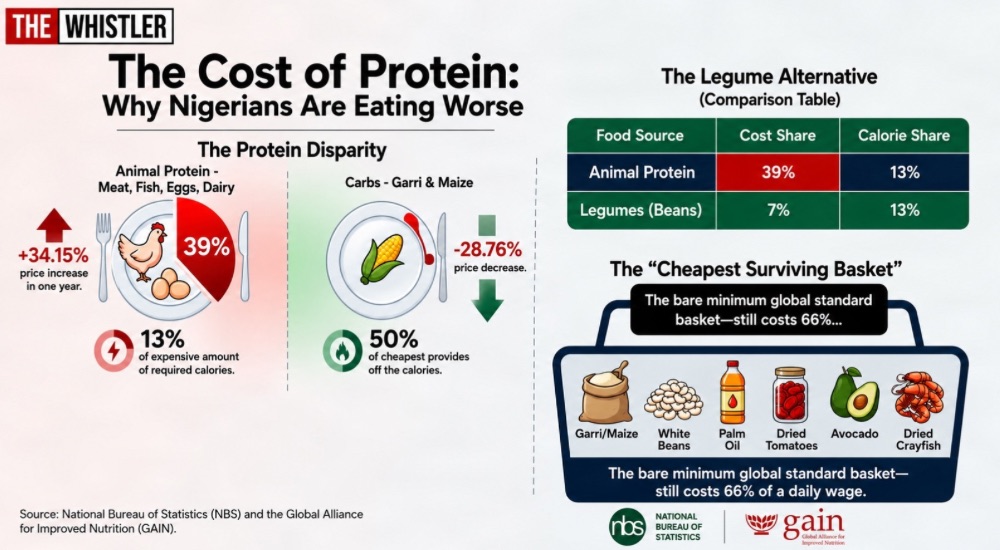
Meanwhile, garri and maize grains, which provide 50 per cent of the CoHD’s calories, fell 28.76 per cent over the same period.
Legumes such as white beans contribute the same share of the CoHD’s total calories as animal source foods (13 per cent), but account for only seven per cent of the daily cost, compared to 39 per cent for meat, fish, eggs, and dairy.
The CoHD, however, is not purely a calorie measure. It was designed to meet various nutritional requirements that legumes alone do not cover.
A minimum wage earner who substitutes animal protein with beans may spend less, but their diet no longer meets the standard that the CoHD measures.
According to the March 2026 CoHD data, the cheapest food basket that still meets global nutritional guidelines consists of garri or white maize, white beans, palm oil, dried tomatoes, avocado, and dried crayfish. But this will still cost 66 per cent of a minimum wage earner’s daily income.
CoHD TREND/NGF’S PROPOSAL
In January 2025, the national CoHD was N1,328. It climbed 11.3 per cent by March 2025, peaked at N1,611 in July 2025, then fell to N1,380 in December 2025. By March 2026, it had risen by 16 per cent to N1,541.
The Nigerian Governors Forum Chairman, Governor AbdulRahman AbdulRazaq, during a Sallah homage visit to President Bola Tinubu on May 29, said state governors were proposing N100,000 as minimum wage to improve workers’ purchasing power.
He said, “I urge your excellency, let’s have a discussion on moving the minimum wage to a minimum of 100,000.
“We know we’ll get support from you as we go ahead to implement that.”
The NLC spokesperson, Benson Upah, in a recent interview with THE PUNCH, said, “Given the realities around the exchange rate, inflation, raised tariffs, the surge in the pump price of petrol and associated costs, the decline in the purchasing power of the average worker, and the effects of the new tax regime on our cost of living, the realistic figure, subject to status quo maintenance, would be N1m.”
In June 2024, Tinubu assented to a national minimum wage legislation that saw the minimum wage increase from N30,000 to N70,000.
The legislation provides for a review of the minimum wage every three years.
The previous administration of Muhammadu Buhari signed the National Minimum Wage Act on April 18, 2019, which raised the country’s minimum wage from N18,000 to N30,000.
Meanwhile, the Federal Workers Forum (FWF) has described the N100,000 national minimum wage as inadequate and incapable of addressing prevailing economic realities facing workers.
In a communiqué issued at the end of a recent opinion poll held to deliberate on hardship facing workers, the forum said federal workers were grappling with worsening living conditions, low wages, unpaid arrears and worsening insecurity.
The forum said, “Workers have continued to face severe economic hardship arising from inflation, high living costs, fuel subsidy removal and declining value of the naira.
“Many federal workers are still being owed promotion arrears, wage awards, Duty Tour Allowances and other entitlements accumulated over several years.”
On the proposed N100,000 minimum wage canvassed by governors, the forum said the offer fell far below what could be regarded as a living wage.
“To us, this is the height of hypocrisy. These same governors, most of whom said they could not afford the N70,000 minimum wage, are now proposing N100,000,” it said.
The forum described the proposal as a “Greek gift” and urged the government to follow due process in negotiating a wage that reflects current economic realities.
“The N100,000 proposal is not a living wage. We condemn and reject this proposal in all its forms and entirety,” the forum stated in the communiqué signed by Mr Andrew Emelieze, National Coordinator of FWF, Mr Ayo Ogundele, National Secretary, and Mr Aminu Yerima, National Mobilisation Officer.
The forum asked the Nigeria Labour Congress (NLC) and the Trade Union Congress (TUC) to declare a nationwide strike over hardship and insecurity.