Reporter’s Diary: How Threat, Fear Sustain Monday Sit-At-Home In Onitsha Markets
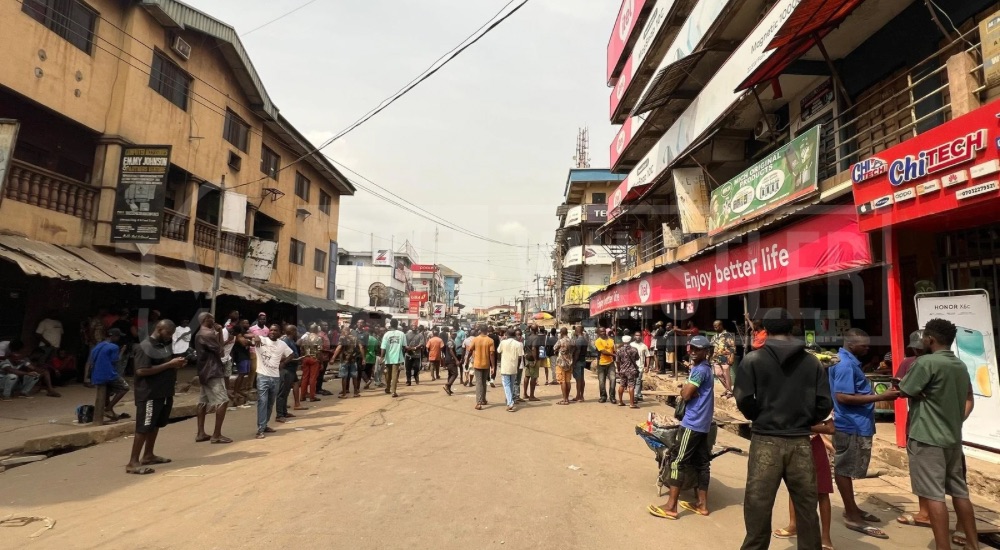
On Friday, May 16, 2025, a routine request to speak to Onitsha traders across different market sections on the effect of the Monday sit-at-home order on their businesses escalated into a threat to my life and that of my team members.
The plan was to capture the market on its busy day vis-a-vis on Mondays, but it was met with hostility and harassment, and presenting my media identity card proved insufficient.
At the Marine market, where containers were being offloaded, market leaders seized our drone, grounded us for 45 minutes, and demanded that all captured footage and images be deleted.
Shortly after, they escorted my team and me out of the market.
They explained that we failed to obtain their authorisation to film market activities. This position stood despite an earlier approval secured from the Onitsha main market authority, which included a negotiated fee of N3,500 to operate our equipment.
The Marine market insisted that permission from one section of the Onitsha market did not extend to another. Consequently, the use of a drone was described as ‘highly suspicious’, ‘an unauthorised invasion’ and ‘possibly an act of espionage’.
Advertisement
Fear Over Profit
Beyond the dispute over equipment, lay their glaring discomfort.
Attempts to explain our intentions: to discuss Nnamdi Kanu of the Indigenous People of Biafra (IPOB); his prolonged incarceration; the reason behind the Monday sit-at-home directive and its economic implications, were vehemently resisted.
This reaction wasn’t isolated, the pattern repeated itself across multiple markets in Onitsha. Traders were unwilling to engage on the matter, even off the record. They either gave cautious glances or were outrightly silent.
Repeated statements such as “fear of being picked up”, came up as justification for the inability to speak freely, which led to a shift in the focus of the initial report.
Advertisement
Nevertheless, the team returned on Monday, May 19, 2025, to get a proper scenery of the market while locked down, again, we were greeted with restricted movement and threats from the market’s guards.
Over time, it became obvious that traders were not only staying away from their shops on Monday as an act of solidarity with Kanu, but increasingly out of fear and perceived intimidation.
This fear has gradually evolved into a trade-off, one involving sacrificing a day’s income, resting on Mondays and prioritising personal safety over profit.
The situation is not unfounded. In September 2023, Enibe Francis, the chairman of Mgbuka Amagu Market, an old motor spare part market situated along the Onitsha-Owerri Road, was kidnapped.
Francis was reportedly kidnapped after he opened the market for the Monday morning prayers and clean-up exercise as directed by the market association in the state.
According to eyewitness accounts, his abductors stormed the market, shot sporadically, beat him up to a pulp and whisked him away in a waiting vehicle. He has not been seen since then, despite the reported payment of ransom.
Advertisement
Economic Sabotage
Ordinarily, traders in Anambra understand the cost of locked shops, even as business remains their drive to survival. However, the possible threat of losing one’s life would outweigh the need for daily earnings.
Even so, the impacts of the sit-at-home on Anambra state’s economy which began in 2021, are too significant to ignore. The state estimated its weekly losses at N8bn weekly, out of the approximately N19.6bn lost weekly across the Southeast region.
A 2025 report by SBM Intelligence, further reinforced these figures, estimating that the region cumulatively lost about N7.6trn, since the civil disobedience began over Kanu’s detention.
This led Governor Chukwuma Soludo to shut down the market for a week, pending the resumption of business activities on Monday. The decision generated mixed reactions locally and internationally.
While many stakeholders, including the Chairman of the Onitsha Main Market, described the decision as long overdue, critics faulted the approach, arguing that it lacked empathy and overlooked the security vulnerabilities faced by the traders.
Safety Over Threat
So, listening to traders at the Onitsha main market, on January 27, lament the temporary closure, and the awaiting financial losses, yet insisting no business on Mondays, revived memories of May 2025.
Although younger traders carried placards and appeared to treat the enforcement lightly, shop owners openly discussed the overwhelming presence of security personnel within the market precinct.
During one engagement, a trader said, “See how happy the officers are chasing us. These are officers we give money sometimes, yet the government cannot bring even half of them to at least secure the market on Mondays if they are serious about the market,”
Another trader added, “There are people who come to this market on Mondays to handle logistics business and other small things, and they know how to package themselves without being caught.
“So, it is risky to come on Mondays, I cannot come here please. So, he (Soludo) should just open this market because this is where I feed my family from.”
Regaining Control
Away from the economic and personal toll, the situation further exposes the question of control within the state.
A security expert with SBM Intelligence, David Nwaigwe, explained that the prolonged sit-at-home order underscores the challenges of state legitimacy.
“If a non-state actor such as IPOB can issue directives and they are widely obeyed it undermines both the legitimacy and power of the state.
He noted that the governor’s directives represent an attempt by the state government to reassert itself as the sole legal authority within Anambra.
According to Nwaigwe, the decision was also influenced by what the state perceived as a decline in IPOB activity and the relative calm experienced during the last Yuletide season.
“So, the government believed there was no longer a justification for the sit-at-home. IPOB activities are not as rampant as before, when operatives could invade markets and shoot sporadically.
“They have been degraded to the point that escape would be difficult if they attempted such attacks.
He, however, cautioned that the effectiveness of the governor’s directive remains uncertain, noting that the market shutdown persists.
“We have seen the trader resisting the directive and even blocking the Onitsha Bridge. What remains to be seen is how the security agencies manage the situation in the coming weeks, which would determine what becomes of the Monday stay-at-home in the state,” he noted.