U.S. Struck Sokoto Without Nigerian Govt’s Consent, Sowore Claims
…Foreign Bombs Not Solution To Nigeria’s Insecurity – Lawyer
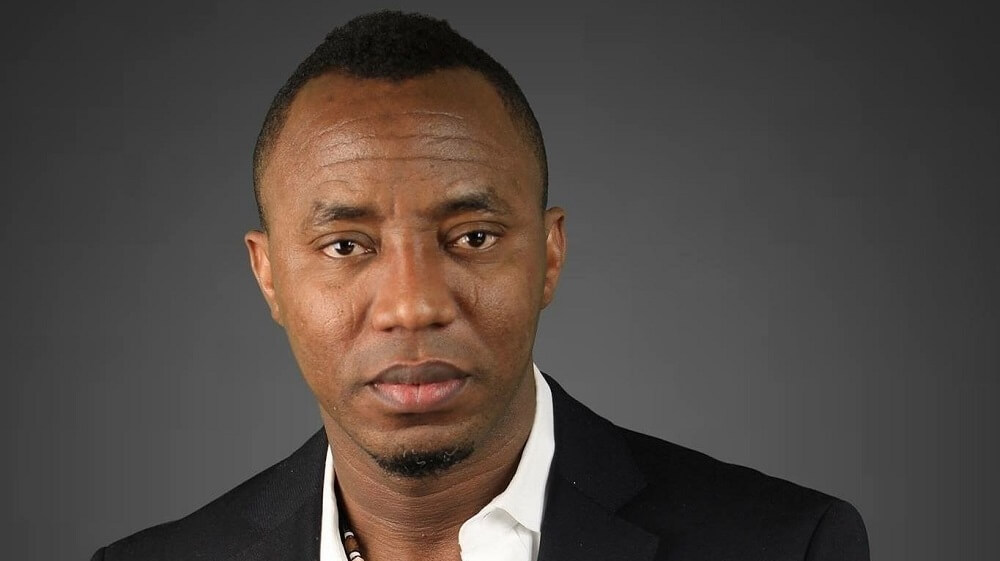
Former presidential candidate of the African Action Congress (AAC) and human rights activist, Omoyele Sowore, claims the Nigerian government lacked prior knowledge of the airstrikes carried out by the United States military in northwest Nigeria on Christmas Day.
Sowore’s reaction followed President Trump’s Christmas Day announcement on his Truth Social platform that the U.S. military had carried out airstrikes against ISIS-linked terrorists operating in northwest Nigeria.
Moments after Trump’s post, the Nigerian government confirmed that airstrikes had indeed taken place.
In a statement issued by the Ministry of Foreign Affairs and shared by the Presidency, the Federal Government described the operation as part of ongoing security cooperation between Nigeria and the United States, acknowledging intelligence collaboration with U.S. authorities.
However, Sowore, in a post on his Facebook page, dismissed the government’s explanation and questioned both the legitimacy of the operation and Nigeria’s capacity to defend its sovereignty.
Advertisement
“I have read reports that the United States government launched attacks on Nigerian soil on Christmas Day, as announced by @realDonaldTrump and the U.S. Secretary of War, @PeteHegseth, purportedly targeting terrorist groups within Nigeria,” Sowore said.
While the Federal Government portrayed the operation as a joint effort with “international partners,” Sowore argued that the strikes were carried out without consent of Nigeria’s government.
“Although the Nigerian government now claims it was aware and describes the operation as a joint effort with vague ‘international partners,’ it is evident that the strikes were carried out without the genuine authority or informed consent of the weaklings masquerading as government under Asiwaju Bola Ahmed Tinubu,” he stated.
Sowore maintained that the strikes on a village in Sokoto State raises concerns about civilian safety and Nigeria’s control over its own territory.
“My position remains unchanged. Judging by the nature of the confirmed strike on a village in Sokoto, it is clear that the U.S. President under whose authority this operation occurred neither understands nor genuinely cares about Nigeria or Nigerians,” he said.
Advertisement
He described the situation as “deeply troubling,” stressing that Nigeria, despite being Africa’s most populous nation, lacks the capable and sovereign leadership required to protect its citizens and territorial integrity.
“As a result, the country has been reduced to a bystander while its sovereignty is violated under the direction of U.S. President Donald J. Trump,” Sowore added.
He insisted that Nigeria’s security challenges cannot be solved through foreign military actions, but through accountable and effective leadership at home.
“I reiterate: only true, tested, and informed leadership can protect Nigerians—not imperiled, jaundiced neoconservatives operating from Washington, D.C.,” he said.
Similarly, human rights lawyer, Chief Malcolm Emokiniovo Omirhobo, also warned that foreign military intervention would not resolve Nigeria’s insecurity.
In a statement posted on his X account, Omirhobo argued that Nigeria’s security crisis is fundamentally a failure of governance and justice, not a religious conflict that can be solved through foreign airstrikes.
Advertisement
“The Federal Government’s confirmation of intelligence cooperation with the United States in relation to airstrikes against terrorists in Nigeria should alarm every Nigerian who understands the nature of our crisis,” he said.
According to him, insecurity persists because the state has failed to arrest and prosecute powerful individuals allegedly involved in sponsoring, financing, arming, or facilitating terrorism, including cross-border movements from the Sahel region.
“Nigeria’s insecurity problem is not religious. It is a failure of governance,” Omirhobo stated.
He lamented that despite repeated intelligence reports, media investigations, and public allegations pointing to elite complicity in terrorism, the government has focused instead on disarming ordinary citizens and restricting lawful self-defence, leaving communities vulnerable.
“A state that prevents its citizens from defending themselves while refusing to prosecute known sponsors of terror has abdicated its constitutional responsibility,” he said.
Omirhobo cautioned against presenting foreign military involvement as a solution, citing countries such as Afghanistan, Iraq, Libya, and Syria, where foreign interventions failed to deliver lasting stability or worsened existing crises.
He further warned that foreign involvement risks reframing Nigeria’s insecurity as a religious conflict between Christians and Muslims, a narrative he described as dangerous and misleading.
“Nigeria’s problem is not Christianity versus Islam. It is impunity versus justice. It is elite protection versus accountability,” he stressed.
The lawyer warned that allowing the crisis to take on a religious dimension could have catastrophic consequences, with violence spreading across cities, towns, villages, and homes.
“Nigeria does not need foreign bombs. Nigeria needs law enforcement,” Omirhobo said, calling for the arrest, prosecution, and conviction of terror sponsors, “no matter how highly placed.”
He concluded that without justice and accountability, intelligence cooperation, airstrikes, and foreign partnerships would amount to little more than an illusion of security.