
289 MDAs Fail Anti-Corruption Tests, 241 Ignore Whistle-Blower Frameworks – ICPC Report
…178 MDAs Without Governing Boards, 119 Others Fail To Submit Financial Reports
…50 Federal Agencies Face ICPC Investigations Over Procurement, Recruitment Breaches
A comprehensive compliance assessment of federal Ministries, Departments and Agencies (MDAs) has uncovered widespread deficiencies in governance structures, financial accountability, procurement practices and anti-corruption frameworks across the public sector.
The report prepared by the Independent Corrupt Practices and Other Related Offences Commission for the 2025 fiscal period reviewed 357 MDAs.
THE WHISTLER analysis of the report revealed that nearly half of the institutions assessed lacked clearly articulated organisational values, mission and vision statements accessible to staff, raising concerns about institutional culture and direction.
According to the findings, 169 MDAs, representing 49.13 percent, do not have core values, mission and vision systems for staff understanding, while 191 MDAs (55.52 percent) have not domesticated policies regulating the acceptance of gifts, donations and hospitality.
Advertisement
The assessment also highlighted serious governance gaps. A total of 178 MDAs were found not to have instruments establishing governing boards or councils, while 39 MDAs currently operate without boards or oversight structures in place.
Strategic planning and performance monitoring also emerged as weak areas. The report disclosed that 106 MDAs (30.81 percent) lack strategic plans, while 157 MDAs (45.64 percent) do not have effective monitoring systems and failed to conduct monitoring and evaluation of their programmes and projects.
Anti-corruption mechanisms appeared particularly weak in many of the establishments. The report noted that 289 MDAs, representing 84.01 percent, do not encourage Anti-Corruption and Transparency Units (ACTUs) to conduct System Studies or Corruption Risk Assessments.
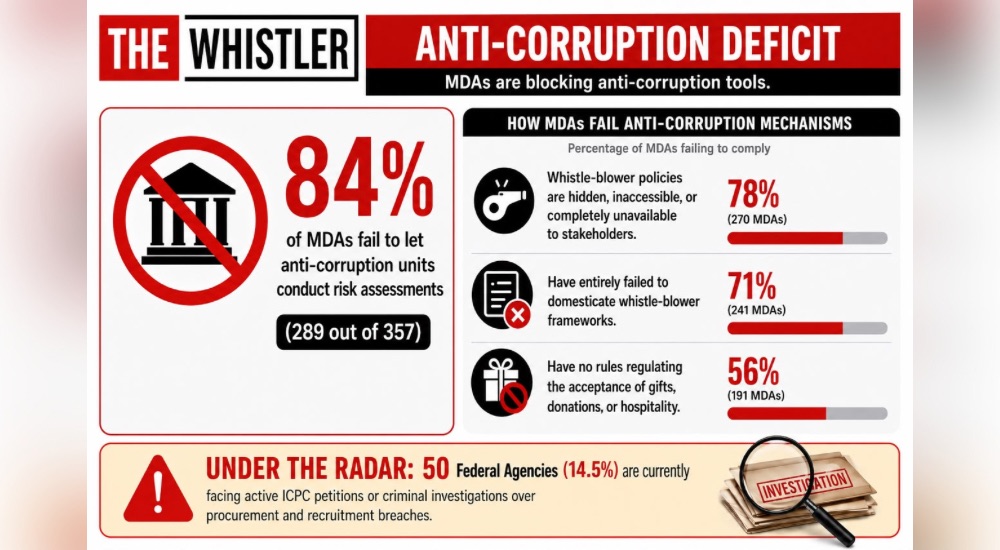
Similarly, 241 MDAs (71.22 percent) have not domesticated whistle-blower policies, while whistle-blowing policies in 270 MDAs (78.49 percent) are either inaccessible or unavailable to stakeholders.
Advertisement
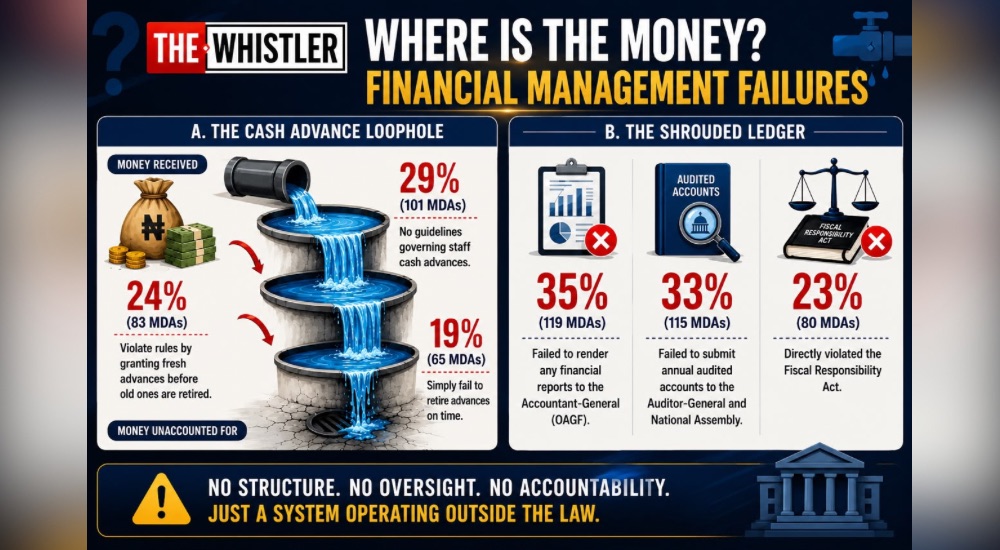
Financial management deficiencies were also discovered to be widespread. The report found that 101 MDAs (29.36 percent) do not have guidelines governing staff advances.
In addition, 65 MDAs (18.9 percent) fail to ensure timely retirement of advances, while 83 MDAs (24.13 percent) grant fresh advances before previous ones are retired.
The report further stated that a total of 119 MDAs (34.59 percent) failed to render financial reports to the Office of the Accountant-General of the Federation (OAGF) during the period under review.
Forty-two MDAs (12.21 percent) were found not to comply with regulations on the remittance of Internally Generated Revenue (IGR), while 80 MDAs (23.26 percent) violated provisions of the Fiscal Responsibility Act.
Internal and external audit compliance also remained problematic. Sixty-three MDAs (18.31 percent) failed to conduct internal audit activities as required, while 115 MDAs (33.43 percent) did not submit annual audited accounts to the Office of the Auditor-General for the Federation and the National Assembly.
The report further revealed that 61 MDAs (17.73 percent) lacked externally contracted auditors engaged through due process.
Advertisement
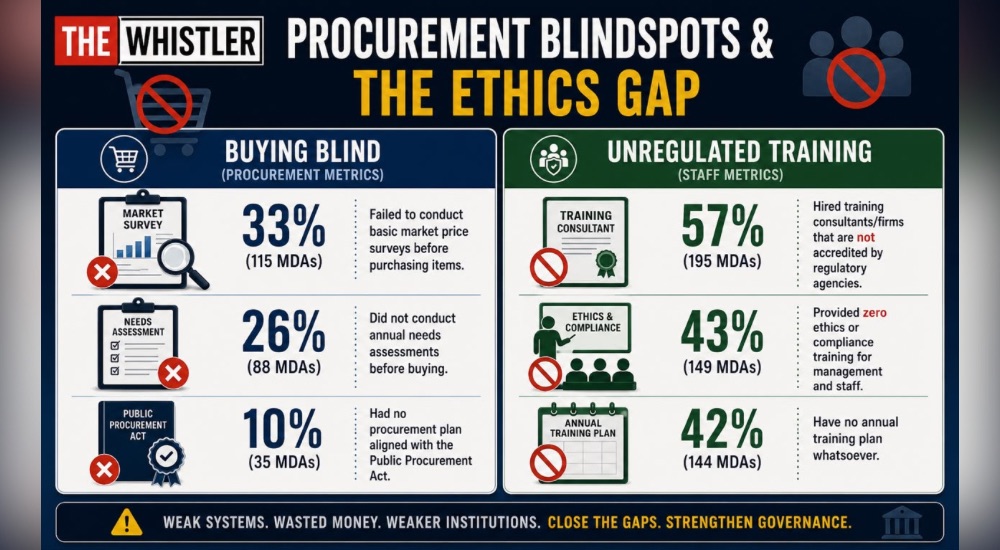
On procurement, the report showed that 88 MDAs (25.58 percent) did not conduct annual needs assessments before procurement activities, while 35 MDAs (10.17 percent) lacked annual procurement plans aligned with the Public Procurement Act 2007 and approved budgets.
Also, 115 MDAs (33.43 percent) failed to conduct market surveys during the year under review, while 76 MDAs (22.09 percent) did not provide external partners and stakeholders with ethics and compliance principles, including sanctions for violations.
The report also noted that 37 MDAs (10.76 percent) failed to undertake performance certification of ongoing projects and verify supplied goods.
“Significantly, 50 MDAs (14.53 percent) currently face petitions or ongoing investigations by the Independent Corrupt Practices and Other Related Offences Commission (ICPC) over alleged infractions involving procurement and recruitment processes.”
“Legal and administrative shortcomings were equally evident. Twenty-one MDAs (6.10 percent) were found to be operating without legal instruments establishing their existence, while 25 MDAs (7.27 percent) do not conduct annual performance reviews and appraisals, resulting in irregular staff promotions,” the report added.
It further stated that 56 MDAs (16.28 percent) still rely largely on manual record-keeping systems, while 15 MDAs (4.36 percent) either lack websites entirely or have not updated them within the last six months.
Capacity development and ethics training remain major concerns. According to the findings, 144 MDAs (41.86 percent) do not have annual training plans, while 149 MDAs (43.31 percent) fail to provide ethics and compliance training for management and staff.
“Furthermore, 195 MDAs (56.69 percent) engage training consultants or firms that are not accredited by relevant regulatory agencies,” the report said.
It also identified weaknesses in ethical standards and staff motivation. Ninety-nine MDAs (28.78 percent) do not have domesticated codes of conduct, while professional codes in 179 MDAs (52.03 percent) are outdated.
The report, which was signed by the Chairman of the ICPC, Dr Musa Aliyu, SAN, noted that 152 MDAs (44.19 percent) lack reward systems for employees.
To address the deficiencies, the report recommended stronger collaboration between the ICPC, the Office of the Head of the Civil Service of the Federation (OHCSF) and other stakeholders to improve monitoring and compliance through adequate funding and manpower.
The Commission urged the Federal Government to enforce statutory requirements on the submission of periodic and annual audited reports by MDAs, including the application of sanctions where necessary.
The ICPC, in the report, stressed the need for strict compliance with the Public Procurement Act 2007 and other regulatory frameworks, while recommending urgent legislative action for public institutions operating without enabling laws.
Among other recommendations, the report urged the Secretary to the Government of the Federation (SGF) to advise the President on the need to constitute and inaugurate governing boards for statutory institutions.
It further proposed profiling persistently non-compliant MDAs through system studies and enforcement measures, as well as ensuring that the Budget Office and National Assembly make budgetary provisions for Anti-Corruption and Transparency Units (ACTUs).
The report also recommended that the ICPC create a dedicated budget line for monitoring ACTUs and following up on compliance activities to strengthen accountability across government institutions.
THE WHISTLER had on Tuesday, reported an audit showdown between the Public Accounts Committee of the Senate and three federal government agencies on issues bordering on alleged financial infractions.
The heads of the three agencies – Bank of Agriculture (BOA), the Nigerian Security Printing and Minting Company (NSPMC), and the Rural Electrification Agency (REA) were consequently ordered to appear before the Committee to respond to outstanding audit queries or risk sanctions.