
Abia Govt Moves To Improve Rural Water Access
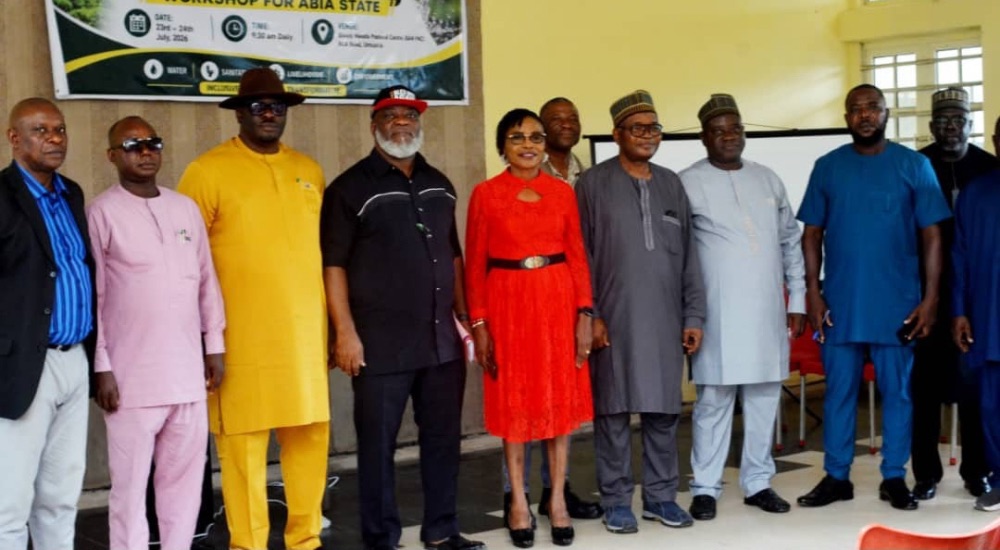
The Abia State Government has commenced a two-day validation workshop for the state’s rural water, sanitation and hygiene (WASH) data, with stakeholders calling for accurate data collection and sustainable investment to improve access to safe water and sanitation facilities across rural communities.
The workshop, which brought together representatives of the state government, the Rural Water and Sanitation Agency (RUWASA), local government authorities, WASH coordinators, technical officials, consultants and other stakeholders, is aimed at validating data collected from rural communities across the 17 Local Government Areas of Abia State.
The exercise is being facilitated by Team Global Associates under an African Development Bank (AfDB)-funded project of the Federal Ministry of Water Resources and Sanitation.
Speaking on behalf of the Commissioner for Power and Public Utilities, Ikechukwu Monday, the Director of Administration in the ministry, Mrs Nwamiko Udo-Nwokeocha, said water was a fundamental human right and essential to the survival and wellbeing of the people.
She said the state government was committed to transforming the water sector by moving away from temporary solutions towards sustainable infrastructure and improved water distribution systems.
“Water, as we know, is not a luxury at all. It is a basic human right and the cornerstone of survival. If you must survive, you need water,” she said.
Advertisement
According to her, access to potable water has a direct impact on the quality of life of citizens, while investments in the sector contribute significantly to the health and development of communities.
She added that clean water remained a critical defence against waterborne diseases, including cholera and typhoid, stressing that the state government was determined to improve access to safe drinking water in both urban and rural areas.
“When we invest in water, we invest in the very lifeblood of our communities. The foundation of public health, clean water is our first line of defence against diseases,” she stated.
Udo-Nwokeocha said the state government was pursuing strategic partnerships, rehabilitation of existing water schemes and modernisation of distribution networks to ensure that households across the state enjoy reliable access to potable water.
“Our goal is very clear, and that is to ensure that every household, far and near, in the urban and rural areas, enjoys uninterrupted access to safe drinking water,” she said.
Advertisement
She welcomed the Team Global Associates and other stakeholders to the state, expressing optimism that the workshop would contribute to the advancement of the water sector in Abia and Nigeria at large.
Also speaking, the General Manager of the Abia State Rural Water and Sanitation Agency, RUWASA, Engr. Uzo Kalu, said the validation workshop was necessary to ensure that the data collected from rural communities accurately reflected the water, sanitation and hygiene needs of the people.
He explained that enumerators, working under the guidance of Team Global Associates, had earlier visited communities across the 17 Local Government Areas to collect WASH-related data despite challenges encountered during the exercise.
According to him, the purpose of the workshop was to allow local government representatives and WASH coordinators to scrutinise the data, correct any inaccuracies and contribute additional information before the final investment plan is produced.
“We are here today as mayors and as WASH coordinators to go through what they brought, dot the I’s and cross the T’s, so that we’ll be able to get what we call an investment plan for water, sanitation and hygiene across rural communities in Abia State,” Engr. Kalu said.
He stressed that the participation of local government stakeholders was crucial because they possessed firsthand knowledge of the conditions and needs of communities within their jurisdictions.
Advertisement
Engr. Kalu said the data would serve as an important planning tool for the government and development partners, enabling them to identify specific WASH challenges and determine where interventions were most urgently required.
“This data will help in planning, so that when development agencies appear in the state and somebody is asking me what their WASH challenges are, I don’t need to call somebody there. I’ll just bring out a document,” he said.
He urged WASH coordinators and other stakeholders to carefully examine the baseline data presented during the workshop and make necessary corrections or additions, warning that stakeholders should not wait until the final document was produced before raising concerns.
“It’s better we participate from the onset. Carry everybody along. Let the stakeholders know this is what is coming to us, so that in future, when we start implementation, you will not say we were not told,” he stated.
The RUWASA boss further described the workshop as an opportunity for stakeholders to take ownership of the process and ensure that the final investment plan accurately captured the needs of rural communities.
He noted that because the project was funded by the African Development Bank, stakeholders needed to ensure that the document was properly validated before its completion.
“Help us to help you. Once again, you are all welcome,” he said.
In his presentation on the objectives of the workshop, Mr Ziyok Ishaku, WASH Expert, who was represented by the Team Lead of Team Global Associates, Gbamidele Igboro, explained that the two-day exercise was designed to present and validate data collected across the 17 Local Government Areas of Abia State.
Igboro said the exercise focused primarily on rural communities with populations of not more than 5,000 people, explaining that enumerators were deployed to such communities to gather information on water supply, sanitation and hygiene.
“The first day is meant for us to bring the data that was collected across all the 17 Local Government Areas of the state so that you can see what we have done,” he said.
He urged local government chairmen and other representatives to carefully examine the data relating to their areas and identify gaps or omissions that needed to be corrected.
According to him, the data collection covered primary schools in rural communities, public health centres, markets, motor parks and community water facilities.
He explained that the exercise assessed whether schools and other public institutions had access to functional water supply and sanitation facilities, while information on sanitation and hygiene practices was also collected from communities.
“Our target is primary schools. We want to say in our schools, there must be potable water. There must be water, sanitation and hygiene facilities all in the school,” he said.
Igboro said some secondary schools were also visited where possible, noting that the primary focus remained on rural primary schools.
He added that public health centres in rural communities were assessed to determine the availability of water and sanitation facilities, while markets and motor parks were also visited for similar assessments.
The WASH Expert’s representative further disclosed that details of water facilities identified in communities were captured using geographical coordinates to ensure that each facility could be accurately located and verified.
“If there is any water facility in any community, we make sure that we know that facility by its own particulars. We stand by that facility and we take the coordinates of that facility,” he explained.
He said the geospatial information would make it easier for government and development partners to identify existing facilities, determine their locations and monitor interventions without relying solely on verbal descriptions.
Igboro also highlighted the importance of developing accurate unit costs for WASH infrastructure across the state, noting that the cost of constructing water and sanitation facilities could vary significantly from one location to another.
He said the input of WASH coordinators, RUWASA and the state Ministry of Power and Public Utilities would be required to establish realistic costs for different interventions across the 17 Local Government Areas.
“We don’t want to assume, because it is an investment plan. People are going to come to work to spend money to do it. So if we give them a wrong costing now, it will affect output at the end of the day,” he said.
According to him, the ultimate objective was to produce a comprehensive WASH investment plan that would indicate the amount of funding required for water and sanitation interventions in each local government and individual rural community between now and 2035.
He said the plan would also help prevent duplication of projects by ensuring that government agencies and development partners had access to a common document showing what facilities already existed and where additional interventions were required.
“There should be harmony. The same document you have, they also have. So that by the time they come tomorrow, if you are giving them a particular place in your LGA, it will just tick that this one has been done. So they can face the other ones that don’t have,” he stated.
Igboro also raised concerns over the large number of water facilities that had become non-functional despite the significant resources invested in their construction.
He said the investment plan would not only focus on constructing new facilities but would also examine why existing facilities had failed and identify measures required to sustain them.
“One of the things that is bothering our mind is why are they not working when they are supposed to work? Because if you look at the money that was spent in doing them, it’s huge,” he said.
He added that the sustainability of WASH infrastructure would require attention to training, equipment and institutional capacity alongside the construction and rehabilitation of facilities.
“As you think of this construction, as you think of this rehabilitation, you are also thinking about putting the institutions that will work to protect this investment in place,” he said.
The workshop therefore provides stakeholders with an opportunity to validate the baseline information, identify gaps in water and sanitation services, determine realistic investment requirements and establish a coordinated roadmap for improving WASH services in rural communities across Abia State.
The organisers urged local government representatives and WASH coordinators to actively participate in the validation process, stressing that the accuracy of the final investment plan would depend largely on the quality of inputs provided by stakeholders at the workshop.