
AMCON Levy Drains Banks Of N733bn As Stakeholders Demand Exit Plan
…Shareholders, Analysts Call For Review As Contributions Rise By 47.07%
…Levy Consumes 17.10% Of Banks’ Operating Expenses
Nigeria banks quoted on the Nigerian Exchange Limited (NGX) paid a combined N732.98bn to the Asset Management Corporation of Nigeria (AMCON) in statutory levies during the 2025 financial year, raising fresh concerns among shareholders, analysts, and industry stakeholders over the sustainability of the agency’s funding model and its continued relevance more than 15 years after its establishment.
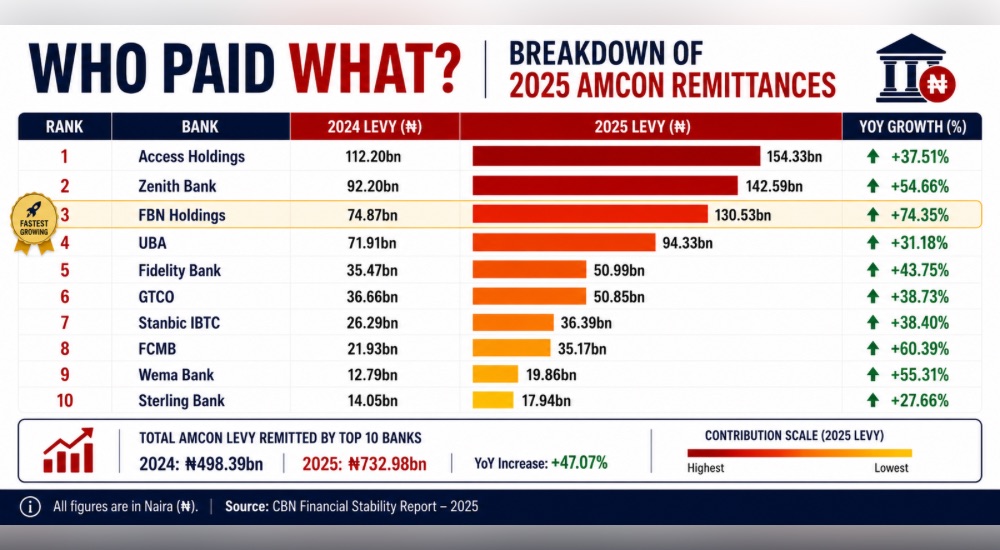
An analysis of the audited financial statements of Access Holdings Plc, United Bank for Africa (UBA) Plc, Zenith Bank Plc, FBN Holdings Plc, Guaranty Trust Holding Company Plc (GTCO), Fidelity Bank Plc, Stanbic IBTC Plc, FCMB Plc, Wema Bank Plc and Sterling Financial Holdings Plc shows that AMCON levy payments surged by 47.07 per cent from N498.39bn in 2024 to N732.98bn in 2025.
The levy consumed approximately 17.10 per cent of the banks’ combined operating expenses of N4.29tn during the period, underscoring the growing financial burden on institutions that are among the most profitable and systemically important in the country’s banking sector.
The development has intensified calls for a comprehensive review of AMCON’s operations, funding structure, and exit strategy, with critics arguing that the corporation has long exceeded its original mandate as a post-crisis financial stabilisation vehicle.
Advertisement
Created in 2010 following Nigeria’s banking crisis, AMCON was designed to absorb toxic assets from troubled banks, restore confidence in the financial system, and prevent a wider banking collapse. The corporation’s activities are largely funded through annual contributions from banks, currently pegged at 0.5 per cent of total assets and off-balance-sheet exposures under the AMCON Amendment Act.
However, as AMCON enters its 16th year of operation, questions are mounting over whether the continued imposition of rising levies on healthy financial institutions remains justified.
A breakdown of the contributions shows that Access Holdings recorded the highest payment, remitting N154.33bn in 2025, representing a 37.51 per cent increase from N112.2bn paid in the previous year.
Zenith Bank followed with N142.59bn, reflecting a 54.66 per cent increase from 2024, while FBN Holdings paid N130.53bn, up by 74.35 per cent from N74.87bn.
UBA’s contribution rose to N94.33bn from N71.91bn, representing a 31.18 per cent increase, while GTCO paid N50.85bn, up 38.73 per cent from N36.66bn recorded in 2024.
Advertisement
Fidelity Bank contributed N50.99bn from N35.47bn, representing a 43.75 per cent increase, while Stanbic IBTC paid N36.39bn, up 38.40 per cent from N26.29bn recorded in 2024.
FCMB’s contribution rose to N35.17bn from N21.93bn, representing a 60.39 per cent increase, while Wema paid N19.86bn, up 55.31 per cent from N12.79bn recorded in 2024.
Sterling trailed behind remitting N17.94bn in 2025, representing a 27.66 per cent increase from N14.05bn paid in the previous year
Collectively, the banks contributed nearly N732.98bn to AMCON within one financial year, a figure many analysts say could have been deployed toward expanding credit to businesses, strengthening digital banking infrastructure, or increasing shareholder returns.
Industry observers note that the sharp increase in levy payments mirrors the rapid growth in banks’ balance sheets, driven largely by naira depreciation, inflationary pressures, and expansion in asset bases following the Central Bank of Nigeria’s recapitalisation directive.
Yet, critics argue that the burden is becoming disproportionate, especially for institutions that did not contribute to the accumulation of the non-performing loans that led to AMCON’s creation.
Advertisement
Speaking with THE WHISTLER, investment analyst Felix Odion described the continued increase in AMCON levies as unsustainable and detrimental to shareholder value.
According to him, while banks continue to report strong earnings, a significant portion of their profits is being redirected to fund an institution established to address a crisis that occurred more than a decade ago.
“The levy is reducing the amount available for dividend payments and ultimately eroding shareholder value. It is time for the government and regulators to establish a clear exit plan for AMCON,” he said.
Odion acknowledged the critical role played by AMCON in stabilising the banking sector after the financial crisis but argued that the current levy framework no longer reflects prevailing realities in the industry.
“Many of the banks bearing these costs were not responsible for the toxic assets that led to AMCON’s creation. The authorities should review the framework and reduce the burden on compliant and well-managed banks that are contributing significantly to economic growth,” he added.
He further argued that after more than 15 years of operation, AMCON should be winding down rather than increasing its reliance on bank contributions.
“Paying over N732.98bn in one year alone is excessive and deprives banks of capital that could be used for expansion, innovation, lending and higher returns to investors. The time has come for a gradual discontinuation of the levy regime,” he said.
The National Coordinator of the Progressive Shareholders Association of Nigeria, Boniface Okezie, also criticised the growing levy burden, describing it as a financial drain on institutions that are otherwise profitable and well-managed.
According to him, the resources being transferred annually to AMCON could be more productively deployed toward business expansion, job creation, and improved shareholder returns.
“There needs to be a critical review of these contributions. Either the payments are reduced, or they are halted entirely,” Okezie said.
He argued that most of the toxic assets acquired by AMCON originated from failed institutions that no longer exist, making the continued burden on current operators difficult to justify.
Investment banker and stockbroker Tajudeen Olayinka questioned the continued dependence on annual bank levies, suggesting that it raises concerns about the effectiveness of AMCON’s recovery efforts.
According to him, the fact that the corporation continues to rely heavily on contributions from banks years after its establishment suggests deeper structural challenges in achieving its debt recovery objectives.
Similarly, National Coordinator of the Pragmatic Shareholders Association of Nigeria, Bisi Bakare, accused AMCON of operating without a clearly defined sunset plan.
Bakare argued that despite years of collections from the banking sector, shareholders have not seen commensurate benefits in terms of market confidence, profitability, or improved returns.
“AMCON has outlived its usefulness and should have concluded its operations by now,” she said.
The founder of the Independent Shareholders Association of Nigeria, Sunny Nwosu, linked the increasing levies to pressure on banks’ profitability and dividend-paying capacity.
According to him, Nigeria’s banking sector remains heavily regulated, with multiple charges and obligations that ultimately affect investor returns.
Another shareholder advocate, Moses Igbrude, questioned why AMCON continues to operate beyond its initial timeline.
“If the corporation could not achieve its objectives within the period originally envisaged, stakeholders have a right to ask difficult questions about its future and sustainability,” he said.
Despite growing criticism, AMCON maintains that its role remains essential to preserving financial system stability.
The corporation has consistently argued that substantial outstanding debts remain unresolved and that terminating the banking sector resolution levy prematurely could undermine efforts to recover public funds tied to non-performing loans.
Under amendments to its enabling law, AMCON has been granted expanded powers to pursue debtors and facilitate asset recovery, which it says are necessary to conclude its mandate successfully.
The corporation has also warned that dismantling its funding structure without fully resolving legacy obligations could expose the financial system to renewed vulnerabilities.
The sharp rise in AMCON levy payments comes at a time when Nigerian banks are under pressure to raise fresh capital, invest in technology, strengthen risk management systems, and support economic growth through increased lending.
With shareholders increasingly questioning the value derived from the annual contributions, analysts say regulators may soon face mounting pressure to review the levy framework and articulate a clear roadmap for AMCON’s eventual exit.
ENDS