
EU Group Accuses Security Agencies Of Supervising Vote Buying
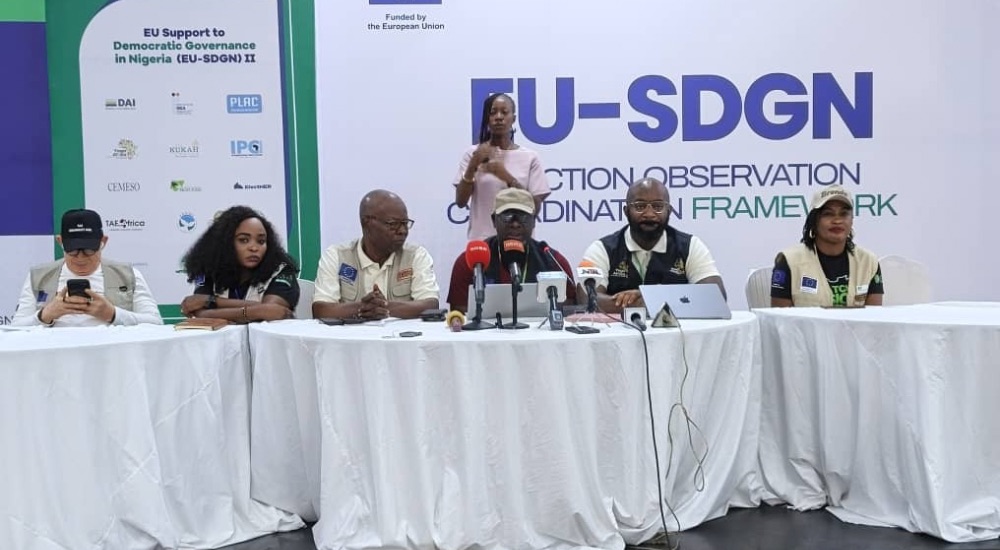
The European Union Support to Democratic Governance in Nigeria (EU-SDGN) Election Observation Hub, which includes Yiaga Africa, has raised concerns over the conduct of security agencies during the Ekiti State governorship election, alleging that some security personnel appeared to have looked the other way while vote-buying took place at polling units.
Presenting the Hub’s joint situational statement in Ado-Ekiti on Saturday, the observers said although the election was largely peaceful and election officials arrived early with adequate materials, the integrity of the process was being undermined by organised voter inducement, vote buying and isolated incidents of violence.
The Hub, comprising The Kukah Centre (TKC), TAF Africa, Nigerian Women Trust Fund (NWTF), Yiaga Africa, International Press Centre (IPC) and the Centre for Media and Society (CEMESO), deployed 598 observers across the 16 local government areas of the state to monitor the election.
Speaking at a press conference for the group, Mr Lanre Arogundade, Executive Director of International Press Centre, said, “The overall security situation is largely peaceful with the deployment of five to 10 security personnel to each of the 2,442 polling units across the state. Voting is proceeding in most observed locations without any significant disruption, large-scale violence or major operational failure.”
However, it noted that “the credibility and integrity of the election is threatened by isolated cases of violence and well-organised voter inducement and vote-buying schemes.”
The observers disclosed that 24 incidents of violence were reported across 10 local government areas, including Irepodun/Ifelodun, Ado-Ekiti, Emure, Ido-Osi, Ilejemeje, Ijero, Ise/Orun, Gboyin, Ikole and Oye.
Advertisement
On electoral offences, the report stated that “reports of vote-buying and voter intimidation were received from across nine LGAs where 24 incidents were recorded with specific cases mainly in Irepodun/Ifelodun and Ado-Ekiti LGAs to compromise the secrecy of the ballot.”
The observation mission also identified inconsistencies in the electoral materials deployed by the Independent National Electoral Commission (INEC).
It said, “There are identified inconsistencies in the number of parties and candidates on the ballot papers and result sheets. For example, while INEC’s final list of candidates contains 14 names, the Form EC8A polling unit result sheets provide spaces for 15 political parties and there are 19 political parties on the ballot papers.”
Despite the reported irregularities, the Hub said election officials and materials arrived early in most polling units, while the Bimodal Voter Accreditation System (BVAS) functioned optimally.
It reported that 246 of the 250 sampled polling units recorded the early arrival of officials and election materials, with INEC officials present in 75 per cent of polling units by 7:30 a.m. It added that 69 per cent of polling units commenced accreditation and voting by 8:30 a.m., while BVAS recorded a 96 per cent functionality rate.
Advertisement
The observers also commended the level of inclusion recorded during the election, noting significant participation by women and persons with disabilities (PWDs). It, however, cited isolated cases where accessibility challenges and operational lapses affected some vulnerable voters.
Addressing the conduct of security agencies, the observation mission urged them to maintain neutrality and actively confront electoral offences.
It recommended that security agencies should “maintain professionalism and absolute neutrality in the electoral process in compliance with the code of conduct and rules of engagement for security personnel on election duties” and “intensify vigilance around the polling units to arrest those engaging in vote-buying and voter intimidation.”
Commenting on the security situation, the observers warned that allowing vote buying to occur unchecked could further weaken public confidence in elections.
“If the security agencies can be supervising and looking the other way while vote buying is going on, then it further deepens the culture of impunity in the course of our elections,” the group said at the press conference.
The Hub also urged INEC to replace malfunctioning BVAS devices where necessary, extend voting hours in affected polling units, ensure immediate uploading of polling unit results to the INEC Result Viewing Portal (IReV), and enforce compliance with electoral guidelines during voting and collation.
Advertisement
It further appealed to political parties to “desist from weaponising poverty through voter inducement and vote buying,” while urging voters to reject financial inducements, protect the secrecy of their ballots and exercise their franchise freely.
The EU-SDGN Election Observation Hub said its assessment was preliminary and based on observations available as of 2 p.m., adding that it would continue to monitor voting, collation and the declaration of results before issuing a final post-election report.