
FG Reorganises Skills Ecosystem As ITF, NBTE Partner For Industry-Ready Workforce
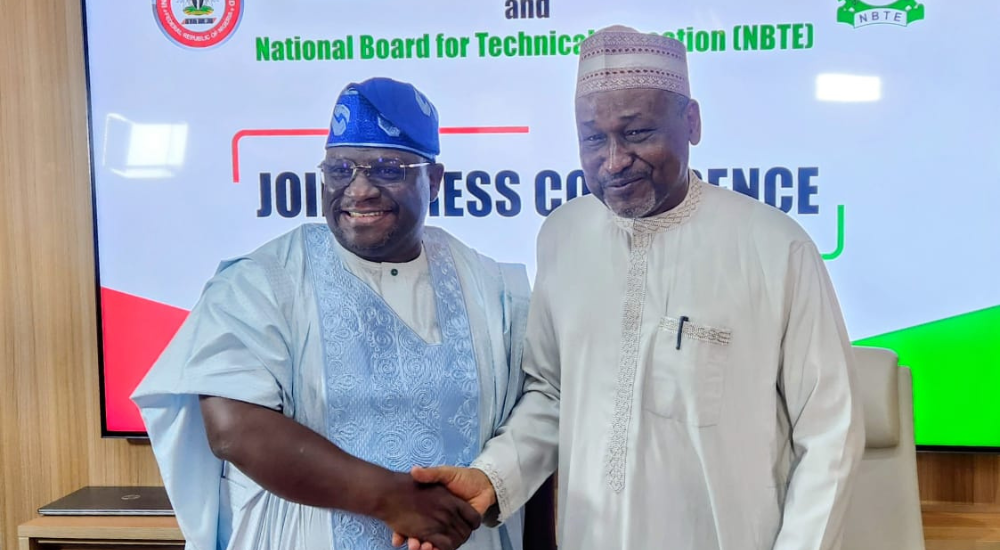
The Federal Government has unveiled a new framework to reorganise Nigeria’s skills development ecosystem, ending years of overlapping responsibilities between the Industrial Training Fund (ITF) and the National Board for Technical Education (NBTE) in a move aimed at producing an industry-ready workforce and boosting national competitiveness.
The new arrangement clearly delineates the responsibilities of both agencies, with the NBTE retaining oversight of formal technical and vocational education, while the ITF assumes responsibility for regulating informal skills development, corporate apprenticeship programmes, artisan certification and industry linkages.
The Executive Secretary of the NBTE, Prof. Idris Bugaje, and the Director-General of the ITF, Dr. Afiz Ogun, announced the new framework during a joint media briefing in Abuja following a collaborative partnership facilitated by the Office of the Vice President through the National Skills Council.
The officials described the agreement as a landmark reform that would eliminate years of institutional rivalry, improve coordination and align Nigeria’s skills development system with global best practices.
Speaking at the briefing, Ogun said the reforms were in line with President Bola Tinubu’s vision of repositioning skills development as a major driver of employment, industrialisation and economic growth.
He explained that the government had recognised the need to distinguish between formal and informal skills development to eliminate duplication of responsibilities among agencies.
Advertisement
According to him, the NBTE will continue to regulate skills acquisition within polytechnics, technical colleges, colleges of technology and other formal technical institutions, while the ITF will oversee artisans, technicians, informal apprenticeships, Recognition of Prior Learning (RPL), Sector Skills Councils and industrial training.
“The President believes there is employment. What we need is to organise our skills ecosystem properly and ensure Nigerians possess the competencies industries require,” Ogun said.
He added that the ITF would also be responsible for connecting graduates from formal technical institutions with industries through structured industrial training programmes.
The ITF boss lamented that despite widespread unemployment, Nigeria continued to rely on artisans and skilled workers from countries such as Ghana, Togo, Benin Republic, Bangladesh, Pakistan and India to execute technical jobs.
According to him, this demonstrates that the country’s challenge is not the absence of employment opportunities but a shortage of industry-relevant skills.
Advertisement
He noted that while only about seven per cent of Nigeria’s workforce is engaged in white-collar employment, roughly 93 per cent operate within the informal economy, making it imperative to strengthen vocational and technical skills.
Ogun said one of the major priorities under the new framework would be the creation of a comprehensive database of artisans and technicians across the country, alongside certification and licensing to improve standards and accountability.
He explained that certified artisans would eventually be accessible through a digital marketplace where employers and households could verify their credentials and assess customer ratings before engaging their services.
On his part, Bugaje said the agreement represented one of the most significant reforms in Nigeria’s skills development sector in recent years.
He disclosed that the Nigerian Skills Qualification Framework (NSQF), previously characterised by overlapping responsibilities, would now be coordinated by the ITF.
He added that the Secretariat of the National Council on Skills, chaired by Vice President Kashim Shettima, had also been transferred to the ITF to enhance coordination of national skills policies.
Advertisement
Bugaje further announced that the Secretariat of WorldSkills Nigeria had equally been moved to the ITF because of the need to strengthen collaboration between skills training and industry.
He said the ITF had accepted responsibility for establishing and operating the WorldSkills Academy in Abuja, where master craftsmen, instructors from polytechnics and technical colleges would receive advanced training that meets international standards.
According to him, the academy would also prepare Nigerian competitors for future WorldSkills competitions while raising the quality of technical education across the country.
The NBTE boss also disclosed that the ITF had agreed to promote dual certification for trainees by combining the Nigerian Skills Qualification Certification with internationally recognised qualifications.
He explained that while the domestic certification would strengthen Nigeria’s own skills ecosystem, international certification would enhance the global mobility and employability of Nigerian workers.
Bugaje noted that the collaboration would also deepen support for the Students Industrial Work Experience Scheme (SIWES), ensuring that graduates from tertiary institutions acquire practical industry experience before entering the labour market.
He stressed that the partnership would strengthen collaboration between both agencies and improve alignment between training institutions and employers.
The Executive Secretary argued that skills have become the global currency of labour and urged universities to integrate practical vocational competencies into their curricula to improve graduate employability.
He observed that many countries had already adopted skills-based degree programmes, adding that Nigeria must follow similar reforms to remain globally competitive.
According to him, technical education has historically driven industrial revolutions around the world, making it imperative for the country to invest more aggressively in technical institutions and vocational training rather than relying solely on academic qualifications.
Both agencies expressed confidence that the new framework would eliminate institutional conflicts, improve efficiency in skills development and support President Tinubu’s broader economic reform agenda.
They said the collaboration would produce globally competitive Nigerian artisans and technicians, strengthen industrial productivity, reduce dependence on foreign skilled workers and position Nigeria as a major supplier of skilled manpower to both domestic and international labour markets.
ENDS