
Gender Gap Widens In Telecom Sector As Men Dominate Workforce
…Women Account For Only 28% Of 15,748 Jobs
…Nigerians Make Up 97.5% Of Industry Workforce
…Data Services Surpass Voice As Operators’ Top Revenue Earner
Although the telecom industry contributes about 15 per cent to the country’s Gross Domestic Product, it employs only a small percentage of the workforce – precisely, 15,478.
The Nigerian Communications Commission indicated the size of the industry workforce in its 2024 Subscriber/Network Performance Report.
Advertisement
According to the report, the workforce is dominated by male workers. It also shows that the localisation of the workforce is nearing 100 per cent.
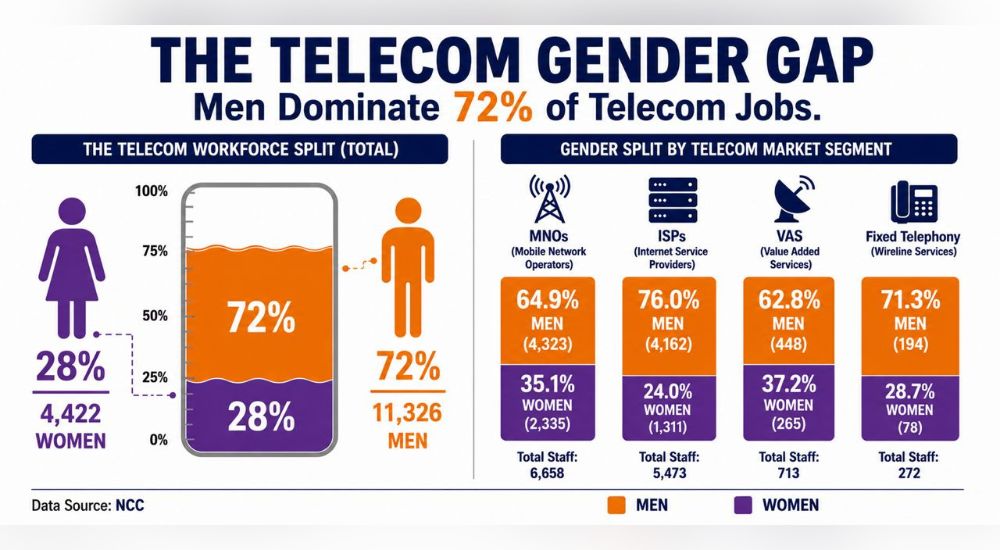
Out of a total workforce of 15,748, the industry employs a total 11,326 men, leaving 4,422 positions for women. This shows that men account for 72 per cent of the workforce while women account for 28 per cent.
Expatriates numbering 388 accounted for 2.5 per cent of the workforce while Nigerians accounted for 97.5 per cent or 15,360 workers.
In terms of market segmentation, the Mobile Network Operators (MNOs) including MTN Nigeria Communications Limited, Airtel Nigeria and Globacom had a total staff strength of 6,658.
This can be split into 6,480 Nigerians and 178 expatriates. The gender equation shows that 4,323 are men while 2,335 are women.
Advertisement
Fixed telephony operators, on the other hand, had 272 workers – 270 Nigerians and two expatriates. While 194 workers in the fixed telephony segments are male, 78 are female.
Internet Service Providers (ISPs) is the second highest employer segment of the industry. This segment employed 5,473 workers made up of 4,162 men and 1,311 women. The number can be further split into 5,411 Nigerians and 62 expatriates.
Value Added Services (VAS) providers employed a total of 713 workers made up 703 Nigerians and 10 expats. Gender analysis shows that 448 of this number is male while 265 workers are female.
Other unclassified operators in the industry employed a total of 2,632 workers made up 2,496 Nigerians and 136 expats. On gender basis, this is made up of 2,199 men and 433 women.
Fixed telephony recorded the strongest employment growth. Staff increased from 153 in 2023 to 272 in 2024, an increase of 119 employees (77.8 per cent).
The growth aligns with higher revenue and expanding fixed broadband infrastructure during the same period.
Advertisement
In the ISP segment, employment declined slightly. ISP workforce reduced from 5,589 to 5,473, representing a 2.1 per cent decrease (116 employees).
Despite this reduction, ISP subscriptions, Points of Presence (PoPs), and revenues all increased, suggesting improved operational efficiency and productivity.
Although telecommunications contribute about 15 per cent to the nation’s Gross Domestic Product, it employs less than 0.05 per cent of the country’s workforce of more than 70 million people.
Experts say the sector is much more dependent on infrastructure and contrasts sharply with large employer-sectors such as agriculture and manufacturing.
However, the services provided by the sector supports the work done in several other sectors of the economy.
According to the report, the Nigerian telecommunications industry lost 59.8 million active subscribers between 2023 and 2024 as the subscriber base reduced from 224.71 million to 164.93 million.
Consequently, tele-density, which measures the number of telephone connection per 1,000 persons declined from 103.66 per cent to 76.08 per cent.
The industry regulator attributed this development to the churning of subscriptions from the networks as a result of the inability of the subscribers to link their mobile lines to their National Identity Numbers.
The report indicates that Nigeria’s telecommunications industry entered a period of market consolidation rather than subscriber expansion.
While the industry recorded fewer subscribers, users consumed substantially more data, broadband adoption improved, ISP infrastructure continued to expand, and the fixed telephony segment strengthened financially.
These trends indicate increasing demand for higher-capacity digital services and a transition toward a more broadband-centric telecommunications market.
Although total internet subscriptions declined, broadband penetration increased from 43.71 per cent to 44.43 per cent. This shows that more users are migrating toward broadband-quality connections.
In the midst of reduced subscriptions, the operators recorded higher data traffic which increased by 34.26 per cent. This is attributable to higher video streaming, increased digital services, greater reliance on broadband, and improved smartphone usage.
Subsequent statistics have shown that data services surpassed voice services as the highest revenue earner for mobile operators in the country.
ENDS