Makoko Evictions: Rights Group Condemns ‘Violent Crackdown’ On Protesters
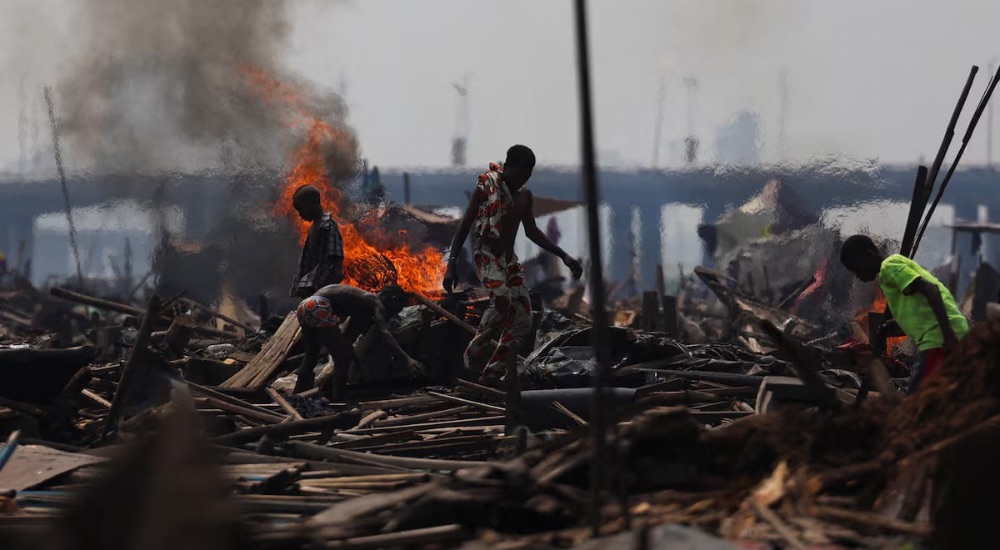
Outrage has continued to trail the arrest of protesters who demonstrated at the Lagos State House of Assembly on Wednesday over the ongoing demolition of waterfront and other communities across Lagos State, particularly the Makoko area.
The protest followed renewed demolition exercises in the Makoko waterfront community, which residents and rights groups say have resulted in the deaths of two babies and an elderly woman, while forcing thousands of residents from their homes.
During the protest, police operatives fired teargas canisters at demonstrators who had converged on the Assembly complex in Alausa to demand an end to forced evictions, respect for court orders, and the protection of their constitutional rights.
Reacting to the incident, the Co-Founder and Co-Executive Director of Justice & Empowerment Initiatives (JEI), Megan Chapman, condemned what she described as a violent crackdown on peaceful and lawful protesters.
“It is, unfortunately, not shocking that the same government that heartlessly and unconstitutionally destroys the homes and lives of tens of thousands of vulnerable residents of Lagos would also violently crack down on peaceful and lawful protest,” Chapman told THE WHISTLER.
She warned that brutality in one area threatens justice and the rule of law everywhere, calling on Nigerians and the international community to stand in solidarity with affected communities and demand an end to mass forced evictions, illegal demolitions, and disregard for court orders.
Advertisement
Chapman also lamented that years of engagement with the Lagos State Government on alternatives to forced eviction had yielded little result, alleging that communities that embraced participatory planning were systematically demolished in favour of powerful private interests.
“We have spent the last few years trying to build engagement with the Lagos State Government around alternatives to forced eviction. The last two years, the same Government has systematically destroyed nearly every community that put its hopes and efforts into participatory planning toward a win-win partnership, defaulting instead to mass land grab in service of powerful private interests,” she said.
Similarly, the Centre for Anti-Corruption and Open Leadership (CACOL) condemned the violent dispersal and arrest of protesters, demanding the immediate and unconditional release of all detained individuals, including activist and youth leader Hassan Soweto, popularly known as Soweto.
In a statement signed by its Director of Administration and Programmes, Tola Oresanwo, CACOL described the protest as a legitimate exercise of the right to peaceful assembly and expression as guaranteed under Section 40 of the 1999 Constitution of the Federal Republic of Nigeria (as amended).
The organisation accused the police of gross overreach and warned that the action could criminalise civil dissent, erode public trust, escalate social tensions, and violate human dignity. It called on the Inspector General of Police and the Commissioner of Police, Lagos State Command, to investigate the incident and hold those responsible accountable.
Advertisement
“The Centre for Anti-Corruption and Open Leadership (CACOL) vehemently condemns the recent violent attack and unwarranted arrest of peaceful protesters demanding entry into the Lagos State House of Assembly in Alausa who were allegedly met with gunfire and aggressive police action on Wednesday, leaving several residents injured and blood covering parts of the road,” the statement read.
“The response of the Nigerian Police Force, as evidenced in disturbing reports and footage, represents a gross overreach of authority and a blatant violation of democratic norms. It is profoundly overzealous and reprehensible for law enforcement officers, whose duty is to protect citizens, to turn their weapons and aggression against peaceful protesters organizing to defend their right to shelter.”
However, the Lagos State Government has defended the demolition exercise in Makoko. Speaking over a week earlier, Governor Babajide Sanwo-Olu said evacuation notices had been served more than two years before the demolition to residents living within 150 to 250 metres of high-tension power lines.
The governor said the exercise was carried out in the collective interest of Lagos residents and for safety reasons, stressing that the government was not demolishing the entire Makoko community but clearing structures built under high-tension wires to avert disaster.
“People need to understand that it is a big city we are dealing with, and the emergency and safety of lives and properties are paramount that we need to prioritise. Of what interest would it be for the government to want to unduly demolish anybody’s property? What interest if it is not for the overall safety of the citizens we are talking about?
“A lot of the people have built shanties under the high-tension wire, and the regulation is that you need to clear between 150 and 250 metres away from the high-tension wire. We are not demolishing the whole of Makoko; we are clearing the shanties so they do not get to the Third Mainland Bridge and stay behind the high tension,” Sanwo-Olu said.
Advertisement
He alleged that some non-governmental organisations wanted to profit from Makoko situation.
“We are aware that there are some local and international NGOs that want to profit from this. We are studying things, and we are going to show evidence. They have made so much money from international organisations and asked for so many grants and resources to go into those places. It is just for them to cover their own lies because they have not done what they said they were going to be doing. That is why they are all shouting and crying more than the bereaved,” the governor said.
The Lagos State Police Command also justified its action, saying officers used minimum force to disperse violent protesters who allegedly blocked major roads leading to the Assembly complex for several hours, disrupting traffic and public movement.
In a statement on Wednesday, the police said the protesters ignored calls for dialogue, barricaded public highways, and attempted to force entry into the Assembly premises, prompting the use of teargas to restore order.
“The Police concern is for law and order to prevail, to ensure public safety and protection of lives and property of millions of other Lagosians that go about their lawful duties and other responsibilities peacefully. The protesters violently and vehemently denied other Nigerians free passage throughout the affected areas.
“Reports of sick people fainting in their cars were recorded, trauma and panic were created in the whole of Alausa and Ikeja area, causing people to scamper for safety as a result of the pandemonium and chaos created deliberately by these violent protesters. Their protest then became a danger to the safety of lives and property of other Nigerians,” the statement read.
The police confirmed the arrest of Soweto, and Dele Frank, stating that they were being investigated for offences including obstruction of traffic, incitement, and conduct likely to cause a breach of the peace.
While reaffirming that the right to protest remains fundamental in a democracy, the police maintained that protests must be peaceful and must not infringe on public safety and the rights of other citizens.
Since 2024, demolitions have been carried out in many communities, including Okobaba, Ayetoro and Oworoshoki—moves critics warn could worsen poverty and homelessness across the state.
Makoko, one of the largest waterfront communities, is home to an estimated 80,000 to 200,000 residents, according to civil society organisations.