
Nigeria’s Financial Account Deficit Hits $2.51bn In Q1
…Portfolio Flows Outpace FDI Amid Strong Foreign Interest
…Long-Term Capital Inflows Decline To $1.03bn
Nigeria’s financial account remained in deficit in the first quarter of 2026, with net borrowing rising to $2.51bn, as a sharp increase in foreign portfolio investment inflows outweighed a marginal decline in foreign direct investment, according to data released by the Central Bank of Nigeria.
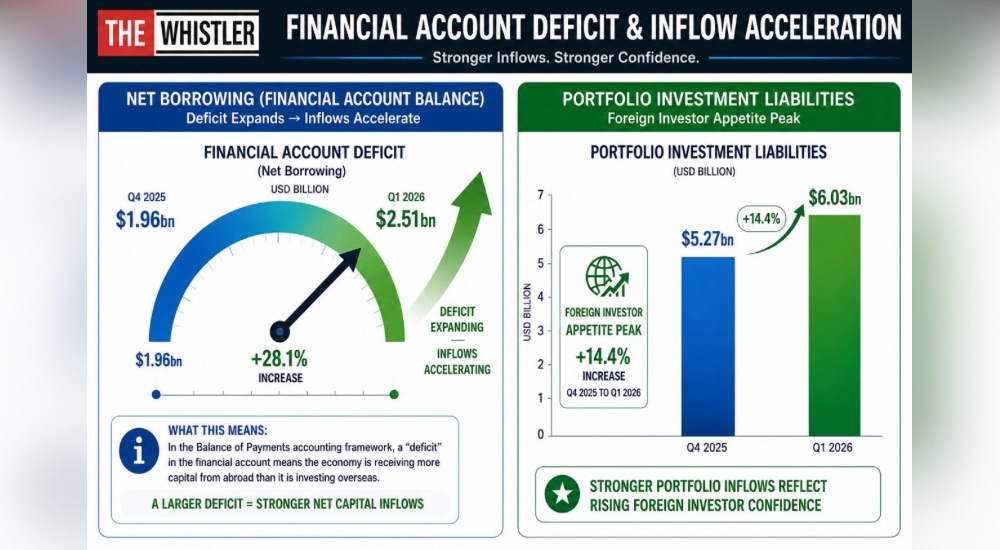
The figures, contained in the apex bank’s Balance of Payments report for the first quarter of 2026 seen by THE WHISTLER, showed that the financial account retained its net borrowing position, with the deficit increasing from $1.96bn in the fourth quarter of 2025 to $2.51bn in the first three months of 2026.
The financial account captures transactions involving financial assets and liabilities between residents and non-residents and serves as a key measure of capital flows into and out of the economy.
According to the report, the major driver of the financial account during the review period was a substantial increase in foreign portfolio investment inflows into the country.
Advertisement
The CBN disclosed that portfolio investment liabilities, which represent foreign portfolio inflows into Nigeria, rose to $6.03bn in Q1 2026 from $5.27bn in Q4 2025, reflecting an increase of approximately 14.4 per cent within the period.
The development indicates growing foreign investor appetite for Nigerian financial assets, particularly government securities, fixed-income instruments and equities.
The increase in portfolio investment inflows comes amid ongoing economic reforms and improvements in macroeconomic indicators, which have helped restore investor confidence in the Nigerian market.
Portfolio investment emerged as the largest source of capital inflows into the economy during the quarter, significantly outpacing foreign direct investment.
However, while portfolio inflows strengthened, the report showed that direct investment liabilities recorded a decline, falling to $1.03bn in Q1 2026 from $1.11bn in Q4 2025.
Advertisement
The decline, though marginal, suggests that long-term investments in productive sectors of the economy did not keep pace with the increase recorded in portfolio flows.
Foreign direct investment typically includes investments in sectors such as manufacturing, telecommunications, agriculture, infrastructure, energy and services and is widely regarded as a more stable source of foreign capital because of its long-term nature.
The data indicates that investors remained more attracted to Nigerian financial assets than to direct investments in businesses and productive enterprises during the review period.
A breakdown of the financial account data also showed increased overseas investment activities by Nigerian residents.
According to the report, direct investment assets recorded an outflow of $0.20bn in Q1 2026, indicating that Nigerian entities continued to commit capital to investments outside the country.
Similarly, portfolio investment assets recorded an outflow of $0.26bn, reflecting increased acquisition of foreign financial assets by residents.
Advertisement
The CBN noted that the increase in the acquisition of portfolio investment assets abroad by residents contributed to movements in the financial account during the quarter.
The report also highlighted developments under the category of other investments, which include loans, trade credits, currency and deposits, and other financial instruments not classified under direct or portfolio investments.
According to the apex bank, other investment liabilities recorded a reversal of $0.22bn in Q1 2026, indicating a reduction in liabilities under that category compared to previous periods.
On the asset side, however, other investment assets recorded an inflow of $1.93bn during the first quarter of 2026.
The inflow was largely attributed to an increase in external reserve assets, reflecting efforts to strengthen the country’s foreign exchange buffers and improve external sector resilience.
The report specifically noted that the quarter witnessed an accretion to Nigeria’s external reserves, a development that helped support the country’s external position amid evolving global economic conditions.
THE WHISTLER reports that the latest figures underscore the increasing role of portfolio investments in financing Nigeria’s external sector.
Although portfolio inflows can provide much-needed foreign exchange liquidity and support financial market stability, economists have often cautioned that they are generally more volatile than direct investments.
Unlike foreign direct investment, which is tied to physical assets and long-term business operations, portfolio investments can be withdrawn quickly in response to changes in investor sentiment, global interest rates or domestic economic conditions.
Nevertheless, the increase in portfolio investment liabilities to more than $6bn suggests that foreign investors continued to view Nigerian assets favourably during the quarter.
The strong inflows also coincided with broader improvements in the country’s external accounts.
The financial account deficit occurred alongside a robust current account performance, which benefited from increased earnings from crude oil, gas and refined petroleum exports as well as lower import bills.
The net borrowing position of $2.51bn recorded in the financial account means that Nigeria attracted more foreign capital than the amount invested abroad by residents during the quarter.
While a financial account deficit may appear negative at first glance, in Balance of Payments accounting it reflects net capital inflows into the economy and can help finance investment, support external reserves and strengthen foreign exchange liquidity.
The increase from $1.96bn in Q4 2025 to $2.51bn in Q1 2026 indicates that capital inflows into the economy accelerated during the period.
Analysts say the figures reflect improving investor confidence in the Nigerian economy, driven by reforms in the foreign exchange market, efforts to enhance fiscal sustainability and expectations of stronger economic growth.
However, they also note that the relatively weaker performance of foreign direct investment highlights the need for further structural reforms aimed at attracting long-term capital into productive sectors.
Such investments are considered critical for industrial expansion, job creation, technology transfer and sustainable economic development.
The decline in direct investment liabilities from $1.11bn to $1.03bn suggests that despite improvements in investor sentiment, concerns relating to infrastructure deficits, energy costs, regulatory uncertainties and operating expenses may still be affecting long-term investment decisions.
The data further revealed a contrast between foreign investor activity and resident investment behaviour. While foreign investors increased their holdings of Nigerian assets through portfolio investments, Nigerian investors simultaneously expanded their overseas asset holdings through both direct and portfolio investments.
This reflects growing integration of Nigeria into global financial markets and increasing cross-border capital mobility.
With portfolio investment inflows rising to $6.03bn, direct investment inflows standing at $1.03bn, direct investment asset outflows amounting to $0.20bn, portfolio asset outflows reaching $0.26bn, other investment asset inflows totaling $1.93bn, and net borrowing increasing to $2.51bn, the first-quarter figures paint a picture of an economy attracting significant foreign capital while continuing to grapple with the challenge of boosting long-term productive investment.
As policymakers seek to sustain the momentum in capital inflows, attention will likely focus on converting strong investor interest in financial assets into larger volumes of foreign direct investment capable of supporting economic diversification, employment generation and long-term growth.
ENDS