
South-East: 2,907 Killed In Five Years Despite Security Interventions
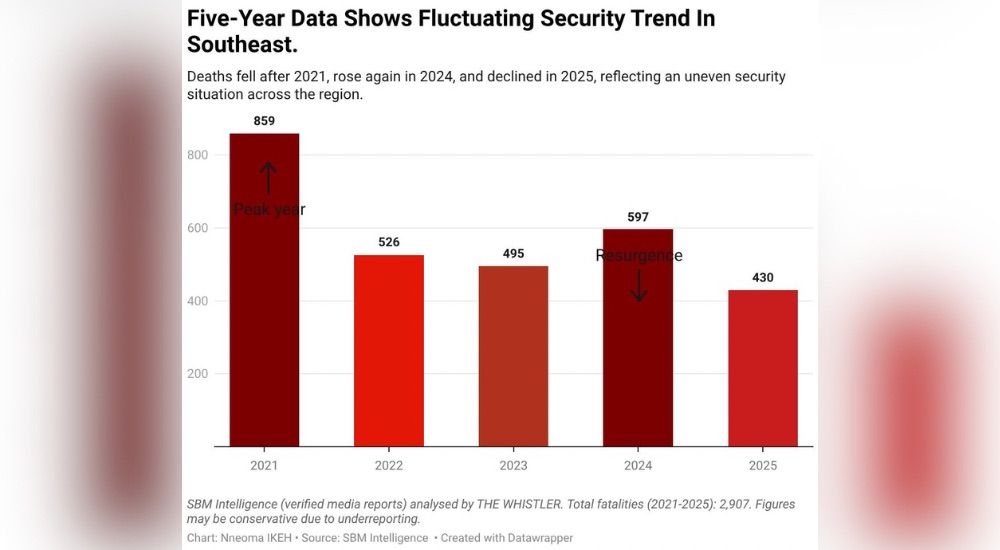
Despite sustained security interventions, no fewer than 2,907 people have been killed across Nigeria’s South-East between 2021 and 2025.
THE WHISTLER analysis of cumulative data by SBM Intelligence on verified media reports of fatalities in Anambra, Enugu, Abia, Imo and Ebonyi States within the period showed a rise in deaths despite security interventions.
The analysis provides context to the region’s security trajectory, examining the impacts of security operations and the drivers of violence.
Categorised by its compact geography, cultural uniformity and economic interdependence, the Southeast has faced a wavering yet persistent security crisis in recent years.
Many of which have been linked to both organised armed groups and localised criminal networks, resulting in increased tension, abductions, violent attacks and indiscriminate killings in the period in view.
Data Breakdown
Advertisement
THE WHISTLER’s analysis showed that no fewer than 887 fatalities were recorded in Anambra, 809 in Imo, 533 in Ebonyi, 410 in Enugu, and 268 in Abia in the last five years.
However, 2021 was arguably the peak of violence in the region, with an estimated 859 fatalities. Imo, Ebonyi and Anambra recorded the highest death toll in the region.
The year also witnessed heightened activities by the Indigenous People of Biafra (IPOB) and its armed wing, Eastern Security Network (ESN), following the extradition of its leader, Nnamdi Kanu, in June 2021.

The enforcement of the sit-at-home order later in August, deepened tension across the five states, with reported cases of attacks on civilians, security personnel, and public infrastructure.
Advertisement
In 2022, the death toll declined by 38.8 per cent to 526 fatalities. This signified an ease in violent attacks in the region.
However, the decline was uneven. In Enugu, killings increased by 37.5 per cent, suggesting either a shift in hotspots or a relocation of the criminal elements to the state.
The downward trend continued in 2023, with fatalities declining slightly by 5.9 per cent, to 495.
Not to mention that the period saw increased security interventions including the launch of the Ebubeagu regional security network, the deployment of Joint Task Force operations in flashpoint areas, and the military’s Operation Udo Ka.
The marginal decline indicated that despite security operations, the underlying drivers of violence persisted, with Anambra and Imo remaining the worst-hit states, each recording over 100 deaths.
By 2024, fatalities had sharply risen by 20.6 per cent to 597, linked to a combined factor of communal clashes, land disputes, cult-related violence, and misinformation-fuelled attacks.
Advertisement
Anambra remained a major hotspot in the region, with these factors contributing to public distrust and affecting economic activities, especially during the yuletide.
Fragile gains
Meanwhile, 2025 marked the most significant drop since 2022. Fatalities declined by 28.0 per cent to 430, with factors pointing to state-level interventions across the Southeast.
The Anambra government had introduced the Homeland Security Law 2025 and launched Operation Udo Ga Achi, to complement federal policing efforts.
The year saw Enugu, set up the Forest Guards Reforms to improve environmental security and establish a partnership with Abia to curb cross-border activities.
While the Abia government provided operational vehicles to boost mobility, Imo launched a grassroots security mobilisation, where traditional rulers became responsible for their domains.
Despite this seeming decline, affected families remain at a loss, only relishing memories of their deceased.
Yet, the flaunting patterns and fragile gains since 2021 reek of uncertainties, particularly with the 2027 general elections in view.
The analysis signals the need for more proactive, rather than reactive measures to achieve a consistent downward trend.
The reopening of markets and schools, for instance, in Anambra, may arguably be one of many significant feats since 2026, the analysis suggests a sustained security response to prevent a relapse.