
Students Sit On Bare Floor In Katsina School
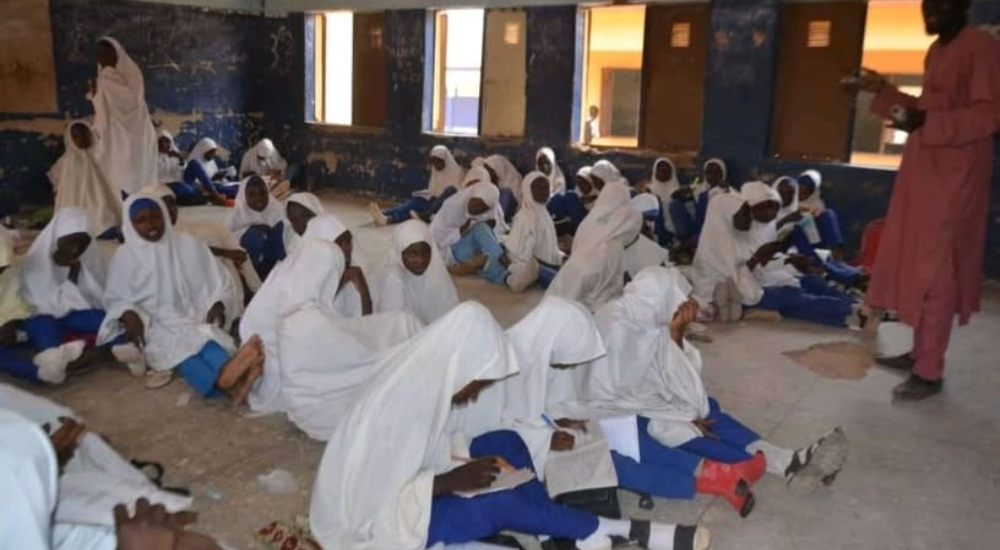
More than 1,000 students of Government Day Secondary School (GDSS), Maidabino, in Dan Musa Local Government Area of Katsina State, are receiving instruction on stones, broken blocks and bare earth, as the institution remains without desks, chairs, roofs or sufficient teachers, despite the state government’s budgetary allocations running into billions of naira for the education sector.
This is according to a report by Zagazola Makama, who posted the findings on X after a visit to the school alongside a team of Defence Correspondents.
Findings showed that of the several classroom blocks originally built at the school, only four are still standing, and even these can barely be called classrooms.
Their roofs are gone, windows and doors are missing, walls are cracked, and there is no furniture or learning material of any kind.
Photographs from the visit show a roofless block with its wooden rafters splintered and hanging, cracks running down the walls, and the compound overtaken by shrubs and grass climbing through what used to be classroom floors, evidence, correspondents say, that the structures have been abandoned for years rather than months.
Students, dressed neatly in white and navy uniforms, were seen assembled in the open compound, clutching exercise books with nowhere formal to sit.
Advertisement
In one image, a soldier in full battle gear stands watch beside the pupils in front of a roofless, weather-beaten building, a scene that captures the unusual reality of GDSS Maidabino: children learning under military protection in the ruins of a government school.
Zagazola Makama reported that more than 1,000 students, spanning Junior Secondary School One (JSS1) to Senior Secondary School Three (SS3), are currently being supervised by only one teacher, Malam Ibrahim Salisu Maidabino, who is not employed by the Katsina State Government, receives no salary, and holds no official teaching appointment.
He is a farmer who volunteered to teach because, in his words, he could not watch an entire generation grow up without education.
“I am only doing this because these children deserve a future,” he was quoted as saying. “If I stay on my farm every day, who will teach them?”
According to the report, Malam Ibrahim single-handedly manages six different classes across multiple subjects daily, moving from one group to another in an effort to ensure every student receives some form of instruction before the school day ends.
Advertisement
The report further disclosed that the school currently serves as the Battalion Headquarters of the Nigerian Army’s Forward Operating Base (FOB) Dan Musa, after troops were deployed to the community years ago to protect residents from bandit attacks and to forestall the kind of mass school abductions witnessed elsewhere in northwestern Nigeria.
Malam Ibrahim disclosed that soldiers stationed at the base now assist in teaching and maintaining order among the students in the absence of enough teachers.
The school also has no functional water source, no toilets, no laboratories, no library, no computer room, no electricity, no staff quarters and no staff room, the report said.
Whenever it rains, students are asked to return home because there is no shelter in the classrooms, resulting in lost learning hours throughout the rainy season.
This is despite the Katsina State Government’s education allocations of ₦95.9 billion in the 2025 budget and ₦97.5 billion in the 2026 budget, each representing about 14 per cent of total state spending.
Of the 2026 figure, ₦76.74 billion was earmarked specifically for basic education.
Advertisement
The Commissioner for Budget and Economic Planning, Bello Kagara, had described the 2025 allocation as part of the government’s commitment to “reinvigorate the education sector” under a budget themed “Building Your Future II.”
Zagazola Makama’s report noted that the condition of GDSS Maidabino raises questions about the monitoring of public school infrastructure across the state, and about how such large annual allocations have failed to reach one of the state’s most vulnerable school communities.