
Gas Flaring Drains N17tn From Nigeria’s Economy
…37.6 Billion Cubic Metres Wasted In Five Years
…46 Years Of Missed Deadlines Expose Weak Enforcement Failure
Nigeria flared 37.6 billion cubic metres of gas between 2021 and 2025. This was in spite of the country’s policy and target of ending gas flaring by the end of 2025.
At the cost of $323m per bcm of gas, the monetary value of the gas flared by the country within the five years under review is valued at $12.15bn. This translates to about N16.79tn.
The World Bank provided the statistics of the losses incurred by oil and gas producing nations in its 2026 Global Gas Flaring Tracker Report which was obtained by our correspondent on Monday.
Advertisement
According to the report, Nigeria ranks eight among gas flaring nations of the world. The report also indicated that rather than reducing, Nigeria gas flare increased by eight per cent between 2024 and 2025.
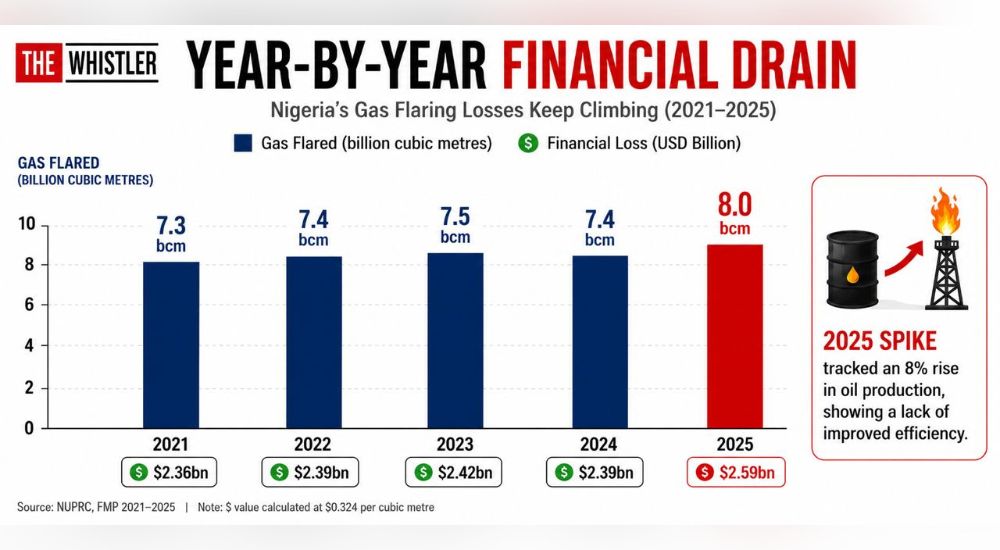
In 2025 alone, the country lost eight billion cubic metres of gas valued at $2.59bn. On the global scale, the world lost 167 billion cubic metres of gas valued at $54bn.
Details of the report showed that Nigeria flared 7.3bcm of gas valued at $2.36bn in 2021. In 2022, the quantity and value increased slightly to 7.4bcm and $2.39bn respectively.
Again, the quantity and value rose slightly to 7.5bcm and $2.42bn in 2023. They decreased marginally the following year, 2024, to 7.4bcm and $2.39bn respectively.
However, by 2025, the gas flared by the country rose significantly to 8bcm valued at $2.59bn.
Advertisement
According to the report, Nigeria is one of the nine countries responsible for 83 per cent of global gas flaring. The top nine countries, however, account for only 46 per cent of global oil production.
The top gas-flaring countries for 2025 are Russia, 30bcm; Iran, 24bcm; Iraq, 24bcm; Venezuela, 14bcm; Mexico, 10bcm; Libya, 9bcm; Algeria, 9bcm; Nigeria, 8bcm; United States, 5bcm; and 10, Saudi Arabia, 2.5bcm.
Thus, Libya, Algeria, and Nigeria are Africa’s three largest gas-flaring countries with Nigeria being the largest gas-flaring nation in sub-Saharan Africa.
Angola and the Republic of Congo were also reported to flare significant quantities with 2.5bcm and 2.3bcm respectively.
According to the report, Africa continues to lose valuable energy resources through flaring.
The report noted that gas flaring increased by eight per cent for Nigeria compared with 2024. Within the same period, Nigeria’s oil production also rose by about eight per cent.
Advertisement
This means that the increase in flaring largely tracked higher production rather than worsen efficiency.
The key causes of gas flaring in Nigeria were attributed to inadequate gas gathering and transportation infrastructure, insufficient capacity to bring associated gas to market, and aging gas-processing plants with frequent downtime.
The report highlighted Kazakhstan as an example of successful flaring reduction through stronger regulation, gas capture investments, and expanded market access. The country reduced flaring by 16 per cent in 2025 and by 87 per cent since 2012.
It also emphasised that the 167bcm of gas flared globally in 2025 was roughly equal to Africa’s annual natural gas consumption, illustrating the enormous opportunity to improve energy security, electricity access, and industrial development by capturing gas that is currently wasted.
The report said the gas wastefully burned could have powered homes and industries, created jobs, reduced import bills, and extended electricity access and clean cooking fuels for communities that still lack it.
Published annually by the World Bank’s Global Flaring and Methane Reduction (GFMR) Partnership, in collaboration with the Payne Institute at the Colorado School of Mines, the report provides a comprehensive independent assessment of global gas flaring volumes, intensity, and trends.
It said, “The 167bcm of gas flared in 2025 exceeds the volume of Liquified Natural Gas that transited the Persian Gulf last year; a resource large enough to equal the gas consumption of Africa, yet burned without benefit.
“The economics demand action. The gas wasted in 2025 was worth an estimated $54bn. Eliminating routine flaring globally would require $70–100bn in upfront investment, roughly twice what is currently being lost each year.
“Despite the tools needed to end routine flaring being well established, it persists; what holds back progress is not technical but structural — inadequate regulation, insufficient capital, limited market infrastructure, and a failure by operators and governments to treat reduction as a priority.
“Progress is possible. Kazakhstan has cut flaring by 87 percent since 2012, and the United States made the largest absolute reduction of any country in 2025. Proven solutions exist. What is needed is the commitment to deploy them.”
The report said oil producers including Nigeria were burning a valuable resource that could support energy access, reduce reliance on costly imports, generate much-needed revenue in developing countries, and cut greenhouse gas emissions.
With acute energy challenges persisting across much of the world, the scale of this missed opportunity demands urgent attention from policymakers, operators, and investors, it said.
In Sub-Saharan Africa, the report added, power outages have been associated with a 14 per cent reduction in employment, a reminder that energy was not just an input cost, but a key enabler of economic development.
If captured and used to generate power, the 167bcm of gas flared could provide approximately four billion kilowatt-hours of electricity, enough to make a material difference in underserved communities around the world, according to the report.
The report said, “For governments in oil-producing developing countries, flaring reduction represents a win-win: capturing associated gas generates government revenues, expands reliable energy access, enables industrial growth, and supports job creation.
“The gas is already there. The question is why it is wastefully burned rather than used productively.”
It added that the cost of inaction would be measured in wasted billions in revenue and energy insecurity for millions of people.
The Associated Gas Reinjection Act of 1979 set a target of 1984 to end gas flaring in Nigeria. The Act was later amended to allow oil companies to pay penalties for gas flaring.
Another deadline was set for 2010. However, this was not enforced and a new date was set for 2020. This was later revised to 2025. With 2025 in the past, a new deadline has been fixed for 2030.