
How 15,831 Nigerian Doctors Saved UK N6.56trn In Medical Training Costs
…Nigeria 3rd Largest Source Of Foreign-Trained Doctors In UK
…242 Million Nigerians Left With 55,000 Doctors
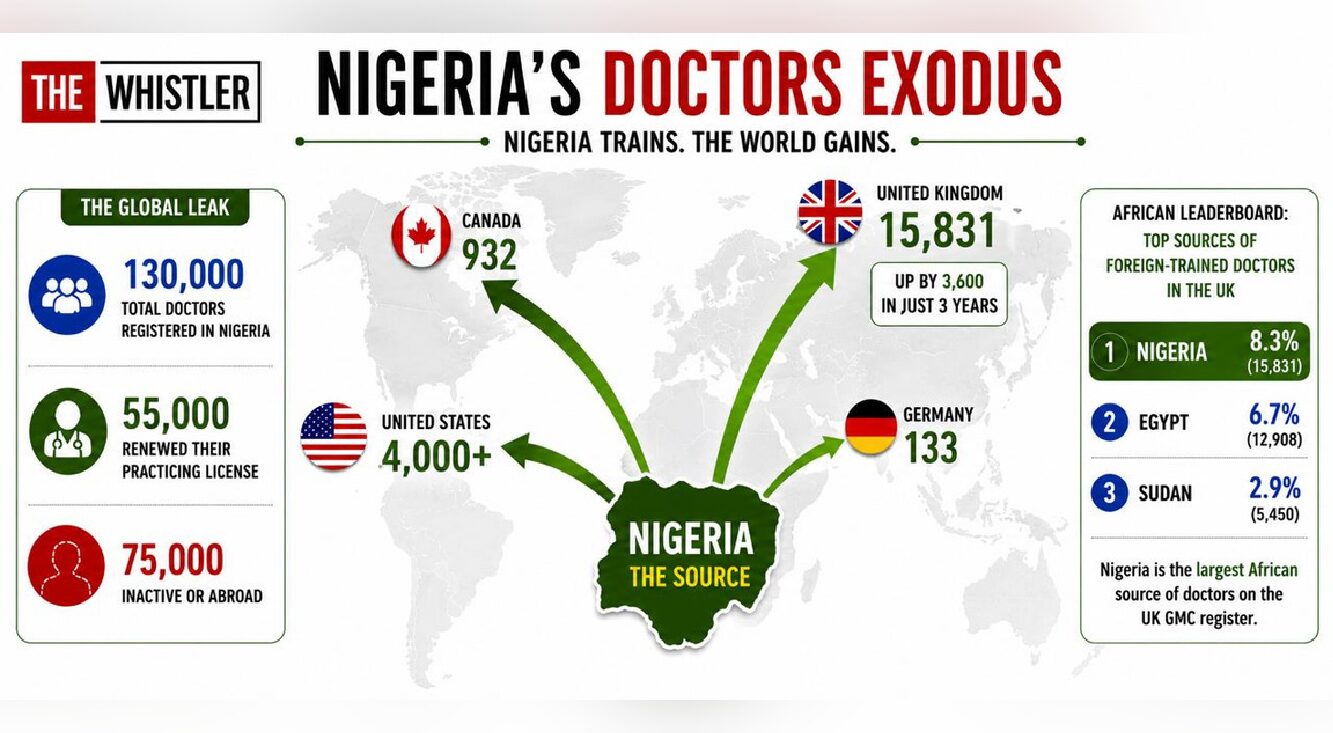
The United Kingdom has saved an estimated N6.56trn in medical training costs by employing 15,831 Nigerian-trained doctors in its healthcare system, according to THE WHISTLER‘s analysis of data from the UK General Medical Council’s physician register.
Our analysis of the data shows that for every 26 doctors in the United Kingdom, one obtained their medical qualification in Nigeria. It also shows that Nigerian-trained doctors account for about 4 per cent of the UK’s 412,511 registered doctors.
According to GMC’s register, there were a total of 412,511 doctors in the country as of June 18, 2026. Among the foreign-trained physicians, India leads with 38,219, Pakistan follows with 27,638, while Nigeria has 15,831 doctors, ahead of Egypt with 12,908. Sudan has 5,450 doctors on the register.
Nigeria alone supplied 8.3 per cent of every foreign-trained doctor on the GMC register, more than any other African country, and 23 per cent more than Egypt, the next-highest African country on the list.
Advertisement
According to the UK Department of Health and Social Care, it costs about £230,000 to train one doctor in the country.
At the current exchange rate of N1,802.60 to £1, training 15,831 doctors within the UK system would cost about £3.64bn (about N6.56trn).
This means that while Nigeria bears the cost of education through subsidised federal university tuitions and teaching hospital budgets, it loses a considerable portion of its medical workforce to developed countries due to various factors.
A 2025 study published in the International Journal of Maternal and Child Health and AIDS put the UK figure at 12,198 Nigerian-trained doctors as of 2023. The GMC current register shows the number climbed by 3,600 to 15,831 within three years.
The study said at least 4,000 Nigerian doctors were practising in the US, Canada had 932 Nigerian doctors, and Germany had 133 as of 2020.
Advertisement
Meanwhile, data from the National Salaries, Incomes and Wages Commission (NSIWC) show that under the 2019 Consolidated Medical Salary Structure (CONMESS), an entry-level medical doctor on CONMESS level (2/1) earned an annual salary of N1,812,600 (about $5,912 at the 2019 exchange rate of N306 to $1).
When compared to their counterparts abroad, a doctor in the UK earns an average of $138,000 annually as of 2023. In the United States, the average annual doctor’s income was $316,000 in 2020. Canadian doctors earned an average of $194,000 annually, while doctors in Germany earned around $183,000, as of 2020.
This means a doctor in the UK could earn the equivalent of an entry-level Nigerian doctor’s annual salary of N1.81m in less than three days. A US doctor could earn the same amount in less than two days.
Consultant Psychiatrist Dr. Yesir Kareem, speaking at a conference at the Federal Neuropsychiatric Hospital, Yaba, in June 2026, said “Poor remuneration and delayed salaries, competitive salaries in destination countries, overwhelming patient loads of 1:10,000 or more, better work-life balance and conditions, and inadequate medical equipment and facilities” are driving Nigerian doctors abroad.
Kareem further mentioned limited access to modern medical technology, restricted career advancement, unsafe working conditions, and political and economic instability among the reasons pushing Nigerian doctors abroad.
Data from the Medical and Dental Council of Nigeria showed that while more than 130,000 doctors are registered with the council, only about 58,000 renewed their practising licences in 2023, and as of June 2026, the figure dropped to about 55,000.
Advertisement
In 2022, the MDCN had 74,543 doctors registered for a population of about 218 million. By 2026, total registrations had nearly doubled to 130,000. But the number of doctors practising in Nigeria fell to 55,000 in 2026.
President of Nigerian Medical Association (NMA), Prof Ernest Omoti, said at the conference: “Only about 55,000 doctors remain to serve a population of over 220 million Nigerians. More than 40 million Nigerians suffer from mental health disorders, yet about 85 per cent of them do not have access to mental healthcare services.
“The economic consequences are equally devastating, with billions of dollars lost annually due to untreated mental health conditions.”
This means about 75,000 registered doctors are either outside the country, inactive or no longer practising. That is more than the 55,000 doctors left for Nigeria’s population of about 242 million.
The National Association of Nigeria Nurses and Midwives also said more than 75,000 nurses and midwives left Nigeria within five years because of low wages, difficult working conditions and insecurity.
Nigeria’s population is estimated at 242.4 million, according to the United Nations. With only about 55,000 doctors in active practice, the country has one doctor for about every 4,400 people. The World Health Organisation recommends one doctor for every 600 people.
IMPACT
Nigeria accounts for 28.5 per cent of all maternal deaths worldwide. In 2020, 82,000 women died in childbirth or from pregnancy-related complications in Nigeria alone. Infant mortality stands at 72 deaths per 1,000 live births.
A study in the National Institutes of Health (NIH)’s PubMed Central linked the deaths to manpower depletion. It said if pregnant women in a rural community develop complications and travel hours to the nearest facility, they are faced with overworked or under-equipped staff.
In 2022 alone, Nigerians spent over $1bn seeking medical care abroad.
Also, Nigeria is reported to have fewer than 150 psychiatrists for a population of 242 million. An estimated 40 million of citizens are said to live with mental health disorders and 85 per cent of them have no access to professional care.
Dr Veronica Nyamali, president of the Association of Psychiatrists in Nigeria, told journalists at the event that the shortage has increased the cost of care and reduced access.
“There are gaps everywhere. Work that should be done by four psychiatrists is now being handled by one or two people. Consultants are increasingly forced to work at lower levels because the doctors they are supposed to supervise are no longer there,” she said.
She said specialists in training are leaving before they finish building a career in Nigeria.
“Junior registrars, senior registrars, many complete their examinations and return abroad. The result is that we have shortages at every level of care.”
“We now have fewer treatment options. Some of the newer drugs that offer better outcomes are no longer readily available. At the same time, the market is being flooded with fake medicines, making treatment even more challenging.
“When specialists become scarce, services become more expensive. Access becomes difficult because patients must travel long distances to find care. This is contrary to the principle of universal health coverage, where mental health services should be available, affordable and accessible to everyone,” she said.