
How Mismanagement, Policy Failures Destroyed 51 Northern Companies
…Kaduna Textiles, Arewa Breweries, NISUCO Among Casualties
…Communities Left With Job Losses, Poverty, Abandoned Plants
At least 51 industries across northern Nigeria have shut down over the past three decades, with labour activists, former workers and industry stakeholders attributing the collapse largely to corruption, policy failures, poor infrastructure, smuggling and weak industrial governance.
The list of affected companies, now circulating among unionists and retired factory workers from Kano to Kaduna and Kwara, includes textile mills, sugar companies, breweries, fertiliser plants, paper mills, automobile manufacturers and food processing companies that once formed the backbone of the region’s economy.
THE WHISTLER investigation, based on interviews with former workers, labour leaders, manufacturers, academic studies, archived reports and Bureau of Public Enterprises records, found that while some of the companies collapsed because of sector-specific challenges, many were brought down by recurring problems, including poor management, inconsistent government policies, inadequate power supply, smuggling and failed privatisation.
Advertisement
Where individual claims on the circulating list could not be independently verified, they are identified as unverified rather than presented as fact.
Among the hardest-hit sectors is the textile industry, which accounted for more than 20 of the companies on the list.
Nowhere was the decline more evident than in Kano, once regarded as the textile capital of West Africa.
The old Challawa Industrial Estate, once home to factories operating three shifts daily, now consists largely of abandoned buildings, rusting machinery and collapsed rooftops.
Former workers who still live around the industrial estate say the factories that once sustained thousands of families have remained silent for years.
The story of Kano’s textile mills reflects the wider decline of northern Nigeria’s industrial base.
It is a story shaped by colonial economic policies, post-independence industrial expansion, structural adjustment reforms, rising production costs, smuggling and insecurity that gradually weakened local manufacturing.
Advertisement
Kano’s textile tradition predates colonial rule.
The city was already a major centre for cotton weaving and indigo-dyed fabrics traded across West Africa.
That heritage remains visible at Kofar Mata, where dye pits established in 1498 are still used by families engaged in the traditional textile business.
Following colonial rule, British authorities established spinning and weaving mills to process locally produced cotton.
After independence, successive governments expanded the industry as part of efforts to industrialise northern Nigeria.
In 1949, the late Premier of Northern Nigeria, Sir Ahmadu Bello, established the Kano Textile Factory in Gwammaja and Kaduna Textile Mill to utilise cotton produced across the region.
Advertisement
The investments transformed Kano into one of Nigeria’s foremost manufacturing centres.
Industrial estates in Challawa, Sharada, Bompai, Independence Road and Club Road expanded rapidly as textile companies established production facilities.
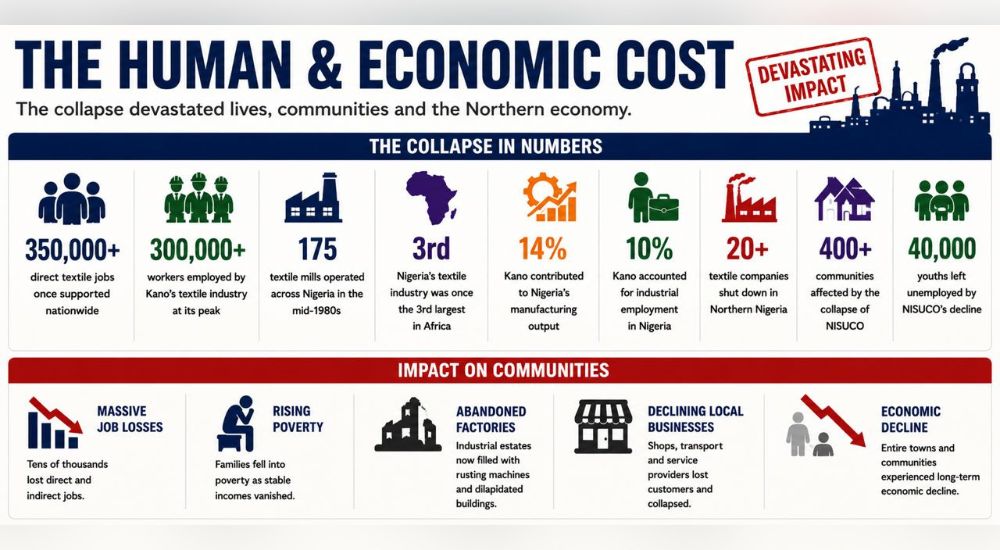
By the mid-1980s, Nigeria had 175 textile mills located in Aba, Asaba, Funtua, Gusau, Kaduna, Kano, Port Harcourt and Lagos.
The industry had become the third largest in Africa after Egypt and South Africa, with factories operating above 50 per cent capacity.
According to the Textile Association of Nigeria, the industry employed more than 350,000 workers directly, making it the country’s second-largest employer after the Federal Government.
In Kano alone, textile factories employed over 300,000 workers and contributed significantly to Nigeria’s manufacturing output.
The city accounted for about 14 per cent of national manufacturing production and 10 per cent of employment in the country’s industrial sector.
Former workers interviewed by THE WHISTLER recalled a period when factory employment provided stable incomes and supported thousands of households across northern Nigeria.
Among the companies that dominated the industry were Gaskiya Textile Mills, Kano Textile Limited, African Textile Manufacturers Plc and Tofa Textile Mills.
Each became a major employer in Kano and ultimately shut down.
The investigation found that while the circumstances differed from one company to another, the underlying challenges were largely the same.
Economic reforms introduced by government increased production costs through currency devaluation, rising interest rates and inflation.
At the same time, unreliable electricity forced manufacturers to depend heavily on diesel generators, significantly increasing operating costs.
Manufacturers also faced increasing competition from imported textiles, particularly products smuggled into Nigeria through neighbouring countries.
Industry stakeholders said these combined pressures steadily reduced production, weakened profitability and forced many companies to shut down.
Among the companies that survived longer than many of their competitors was Tofa Textile Mills Limited.
Located at Plots 104/105, Sharada Industrial Estate Phase II, Kano, the company specialised in cotton-based household textiles, particularly blankets, giving it a niche in the domestic market.
For decades, the company was led by its Managing Director, Salisu Usman Tofa, who also served as Chairman of the Manufacturers Association of Nigeria (MAN), Kano Chapter. In that role, he became one of the industry’s most vocal advocates, repeatedly highlighting the challenges confronting textile manufacturers in Kano.
By the outbreak of the COVID-19 pandemic, Tofa Textile was among the few textile mills still operating on a meaningful scale.
Its Executive Director, Finance and Administration, Mohammed Bello Umar, who also served as MAN’s Vice Chairman for the Bompai Industrial Zone, told THE WHISTLER that the company had been operating at about 80 per cent capacity before the pandemic, producing approximately 300,000 blankets weekly.
“Our capacity before COVID-19 was 80 per cent, in the region of 300,000 blankets a week,” Umar said.
The pandemic, however, dealt another blow to the company.
“During the lockdown we closed down completely for six months and therefore lost dozens of millions due to the pandemic,” he said.
To keep the company afloat, management suspended salary payments for senior staff and adopted a rotational production system under which workers were paid only when their departments resumed operations.
“We stopped all payments and when we returned it was based on pay as you work in the different departments, spinning, weaving, finishing and colouring. The spinning department would come for a week or two, produce the thread, we pay them for that, and the next week the next department would come,” Umar explained.
For many workers, the arrangement meant severe financial hardship.
One of the casual workers, Usman Bala, said his family struggled to survive during the lockdown.
According to him, his wife sometimes resorted to begging neighbours for food, while the family occasionally survived on tea and sugar because they could not afford proper meals.
When restrictions were lifted, Bala abandoned factory work and began selling sachet water to support his family.
Even after production resumed, Tofa Textile was operating at roughly half of its pre-pandemic capacity.
Across Kano, the Manufacturers Association of Nigeria reported that about 65 per cent of its roughly 150 member companies shut down completely for between four and six months during the pandemic, with many operating at only about 40 per cent capacity after reopening.
Tofa Textile survived the immediate impact of the pandemic but eventually joined the list of companies that shut down in Kano.
Its closure was attributed largely to rising production costs, unreliable electricity supply and the inability of local manufacturers to compete with imported products.
The experience mirrored that of several other textile companies across Kano.
Gaskiya Textile Mills, once regarded as one of the city’s indigenous industrial success stories, also shut down after years of rising production costs and multiple taxation.
Established by businessman Nababa Badamasi, the company employed more than 2,000 workers directly and was among Kano’s largest indigenous manufacturing firms.
In the mid-1980s, its investment stood at about N12m, while its fixed assets were valued at N60m.
The company folded in 2005.
A former employee, Aminu Kabiru, said workers who had spent between 10 and 19 years with the company were left without their entitlements.
“We worked 10 to 19 years and after they closed the company in 2006, they refused to pay those of us who resigned. Some of us are staying at home waiting for the money to start up something,” he said.
African Textile Manufacturers Limited suffered a similar fate.
The company, known for producing African and wax prints, struggled with rising production costs and competition from imported fabrics before shutting down in the early 2000s.
Kano Textile Limited, established under the northern regional government’s industrialisation programme, also ceased operations after decades of production.
The decline extended beyond Kano.
United Nigerian Textiles Plc (UNTL), headquartered in Kaduna, once employed more than 7,000 workers and was regarded as Nigeria’s largest textile company.
The company manufactured African prints, Java prints, wax prints and polyester-cotton fabrics before closing in 2007.
Industry stakeholders attributed its collapse partly to the failure to curb the smuggling of textile products through Kano and Katsina.
Labour leaders said the closures marked the end of an era.
Ali Baba, General Secretary of the National Union of Textile, Garment and Tailoring Workers of Nigeria (NUTGTWN), recalled that the Bompai and Sharada industrial clusters alone once had at least 15 major factories employing more than 7,000 union members.
Across northern Nigeria, he said, the UNTL group alone employed not fewer than 21,000 textile workers during the industry’s peak.
THE WHISTLER investigation found that the collapse of the textile industry resulted from a combination of factors.
Another major factor was the influx of imported textiles.
Beginning around 2000, cheaper fabrics entered Nigeria through neighbouring countries, particularly Benin and Niger.
Industry stakeholders said many of the products were smuggled into the country, while others copied Nigerian textile designs and sold at prices local manufacturers could not match.
The World Bank estimated that textiles worth about $2.2bn were smuggled into Nigeria annually through Benin Republic, compared to local production valued at about $40m.
The textile industry was not the only casualty of northern Nigeria’s industrial decline.
The list of 51 companies reviewed by THE WHISTLER also includes sugar companies, breweries, paper mills, fertiliser plants, tanneries, food processing firms and automobile manufacturers whose closures reshaped communities that depended almost entirely on them for employment and economic activity.
One of the most striking examples is the Nigerian Sugar Company (NISUCO) in Bacita, Kwara State.
Established in 1964 as Nigeria’s first integrated sugar company, NISUCO became the economic backbone of Bacita, where more than 70 per cent of houses, including a primary school that produced many prominent Nigerians, were built on company land.
At its peak, the company cultivated over 30,000 hectares of sugarcane, had a production capacity of 300 metric tonnes of sugar per day and employed more than 4,000 workers directly and indirectly.
By 1991, production had increased to 23,000 metric tonnes per day before the company’s fortunes began to decline because of poor management, inadequate funding and mounting debts.
The company’s privatisation under the administration of former President Olusegun Obasanjo marked another turning point.
Sold by the Bureau of Public Enterprises to Josepdam Sugar Company, NISUCO failed to recover.
Instead, former workers said the company’s focus shifted from cultivating sugarcane to importing raw sugar for refining.
A former worker who rose to the position of manager described the transition.
“The company began to collapse when it was privatised, as the company was given to a wrong hand. She started bringing raw sugar for refining here. At the sugarcane plantation, nothing was happening and eventually everything got out of hand. She herself died in the process,” he said, referring to the late chairperson of Josepdam Group of Companies, Mrs Josephine Damilola Kuteyi, who died in a helicopter crash at Ife-Odan, Osun State.
Union leaders estimated that the unresolved legal disputes surrounding the company had left more than 40,000 youths unemployed while affecting the livelihoods of residents in over 400 surrounding communities.