
OPINION: The Senate Chose Nigeria’s Future Over One Man’s Tantrum
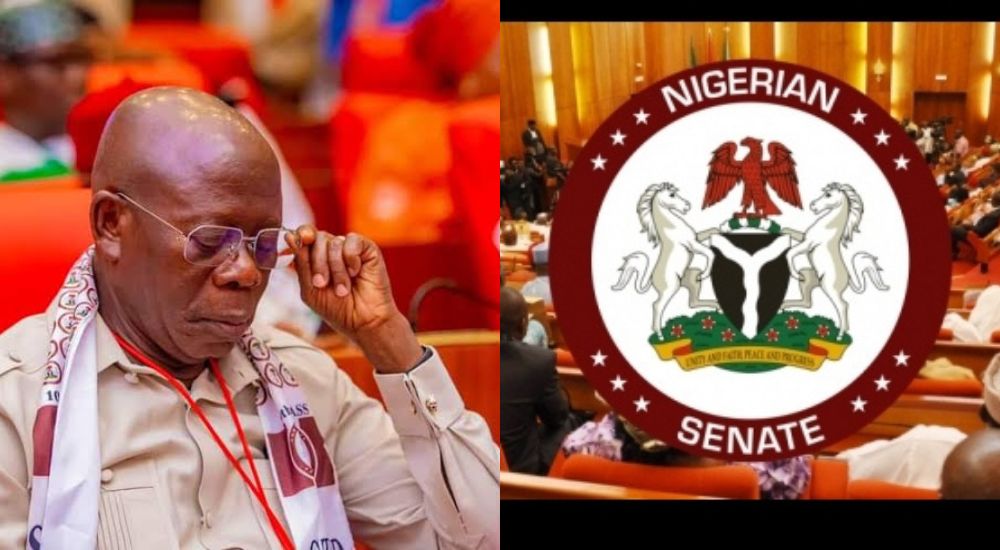
There is a fine line between vigorous oversight and reckless grandstanding. Last week, Senator Adams Oshiomhole bulldozed that line with a wrecking ball, describing the Nigerian National Petroleum Company Limited (NNPC Ltd) as “a house of thieves” and “a bunch of criminals and thieves”. The outburst came during a session of the Senate Public Accounts Committee, as the country gears up for a game‑changing Initial Public Offering (IPO) of NNPC Ltd.
Yet the 10th Senate did not abandon its corporate sanity. It swiftly disowned Oshiomhole’s remarks, nullified an illegal arrest warrant, and reaffirmed that due process – not sensationalism – must guide legislative oversight. For that, the Senate deserves praise. Oshiomhole, on the other hand, is proving that his trademark rudeness and unearned arrogance make him unworthy of the red chamber.
The trigger was a 10 June 2026 hearing of the Senate Public Accounts Committee. Oshiomhole, in a heated exchange with former NNPC Chief Financial Officer Umar Ajiya, declared: “I listened and heard you say that people want their children to be employed in NNPC. Yes, because it is a house of thieves, and they want their children to benefit from it”. Not content, he added: “NNPC has no reputation, your reputation is for fraud”.
When Ajiya apologised for his own intemperate remarks, the committee accepted the apology and moved on. But Oshiomhole had already crossed a dangerous threshold. The Senate leadership immediately stepped in. Senate Leader Opeyemi Bamidele moved a motion, citing Sections 88 and 89 of the 1999 Constitution, and reminded the chamber that “the power to issue a warrant affecting the liberty of a citizen is an extraordinary statutory power which must be exercised strictly in accordance with the procedure prescribed by law”.
The Senate consequently nullified the arrest warrant issued against former GCEO Mele Kyari and formally distanced itself from Oshiomhole’s comments. Deputy Senate President Barau Jibrin stressed that committees “are subordinate organs of the senate and could only make recommendations”.
Senator Adamu Aliero did not mince words: he called Oshiomhole’s remark “reckless” and warned that it could damage NNPC Ltd’s integrity and discourage foreign direct investment – particularly damaging for a company that accounts for over 90 per cent of Nigeria’s foreign exchange earnings.
Advertisement
This was not a defence of NNPC Ltd’s every action. It was a defence of fairness, of presumption of innocence, and of the institutional integrity required to conduct credible oversight. As the Senate Chief Whip, Tahir Monguno, argued: “The senate, being the highest law‑making body of the country, should not only be above board but should be seen manifestly to be above board”.
At a time when NNPC Ltd is preparing to list on the Nigerian Exchange – a move that could unlock billions in market capitalisation and give ordinary Nigerians a stake in their national oil company – such incendiary language is economic sabotage masquerading as accountability. The Senate chose the national interest. That is the kind of oversight Nigeria needs.
What makes Oshiomhole’s “house of thieves” comment so difficult to stomach is not that it is a one‑off outburst. It is that it fits a long, documented pattern of public disrespect, cruelty and arrogance that spans more than a decade. Consider his conduct as governor of Edo State. In August 2013, he randomly picked a primary school teacher, Mrs Augusta Odemwingie, and forced her to read her own age declaration certificate in public.
After twenty years of service, the woman could not read it fluently. Rather than handle the matter with dignity behind closed doors, Oshiomhole made her a national spectacle – an exercise in raw power that served no pedagogical purpose. That same year, on a routine road inspection in Benin City, he encountered a widow, Mrs Joy Ifijeh, selling goods by the roadside. When the woman knelt to beg for mercy, the governor exploded: “You are a widow. Go and die!” The video went viral and the nation was horrified.
He later apologised and gifted her some money, but the damage to his humanity was already done. These are not the actions of a statesman. They are the actions of a man who confuses public office with a licence to humiliate.
Advertisement
Oshiomhole’s rudeness is not confined to vulnerable citizens. In May 2026, he engaged in a heated confrontation with Senate President Godswill Akpabio over amended Senate rules, demanding that Akpabio resign. Akpabio was forced to issue a stern warning: “Oshiomhole, if you become unruly, we will use the rules to take you out of the Senate”.
That warning was neither the first nor the last. His relationship with his successor as governor of Edo State, Godwin Obaseki, soured spectacularly, with Oshiomhole vowing to “erase” Obaseki from the political space. The bitter feud that followed remains emblematic of his “my way or the highway” style of politics. And in the labour movement, where he once rose to become President of the Nigeria Labour Congress, he has since been accused of betraying the workers who once cheered him.
The Nigeria Union of Petroleum and Natural Gas Workers (NUPENG) strongly condemned his remarks against striking petroleum workers, saying his statements were “the prattle of an apostate, intoxicated by the opium of power and dollarised into betraying the cause of the downtrodden Nigerian workers”. The union declared him persona non grata among oil and gas workers.
Then there is the uncomfortable question that Oshiomhole has never adequately answered: where did the money for his private jet lifestyle come from? In February 2026, a viral video showed a man resembling Oshiomhole aboard a private jet, rubbing a woman’s feet inside a luxury aircraft. The woman later confirmed the video was authentic, contradicting Oshiomhole’s claim that it was AI‑generated. Human rights lawyer Deji Adeyanju did not hold back: “A former textile worker living like Pablo Escobar.
No evidence he inherited money from rich parents or that he is a successful businessman or actively doing anything progressively as at today aside politics”. Oshiomhole’s known career path is humble. He started as a factory hand at Arewa Textiles Mill in Kaduna, earning five shillings and three pence a month. He later rose through the labour movement. He served as governor of Edo State from 2008 to 2016 and now serves as a senator.
But can the remuneration of those offices – or the famously generous pensions for former governors – plausibly fund a private jet lifestyle? The Revenue Mobilisation Allocation and Fiscal Commission (RMAFC) disagrees. The suspicion, therefore, is not prurient; it is a legitimate demand for transparency. If the goal of Oshiomhole’s theatrical outburst against NNPC Ltd is simply a shakedown – a loud performance designed to make the company “play ball” with him – then he should know that Nigerians are watching. A senator who cannot explain his own ostentatious lifestyle has no moral standing to call others thieves.
Advertisement
When a senator routinely abuses vulnerable citizens, picks fights with fellow presiding officers, labels a strategic national asset a “house of thieves” without a shred of judicial determination, and lives a lifestyle that far outstrips his disclosed earnings, he does more than tarnish his own reputation. He degrades the entire institution of the Senate.
That is why the 10th Senate’s swift and decisive dissociation was not just proper; it was necessary for the preservation of its own legitimacy. By nullifying the illegal arrest warrant and publicly distancing itself from Oshiomhole’s comments, the Senate sent a clear message: no single senator, no matter how combative, speaks for the chamber. And no committee may usurp the authority of the full Senate. That is the difference between oversight and chaos. That is the difference between a hallowed chamber and a boxing ring.
Senator Oshiomhole has a right to ask tough questions about NNPC Ltd’s audited accounts. The Senate has every right to investigate the N210tn audit queries that have been raised. But accountability must be grounded in facts and restraint – not in the unchecked fury of a lawmaker who has made a career out of public insults.
The Senate has taken the first step by drawing a clear line. The next step must be a full ethics review. If Oshiomhole cannot behave like a statesman, he should be asked to step aside – not because he is a “former comrade” who has lost his way, but because the Nigerian people deserve a Senate that is a forum for reasoned debate, not a stage for recycled scandals. The Senate chose Nigeria’s future over one man’s tantrum. Now it must choose its own future over one senator’s unchecked arrogance. That is the common sense and fairness that Nigerians expect. And that is why, for once, the Senate deserves not criticism but praise.
–Monguno is a constitutional lawyer. He writes from Abuja.