
Shell, Chevron, Others Paid N602bn As Gas Flaring Penalty
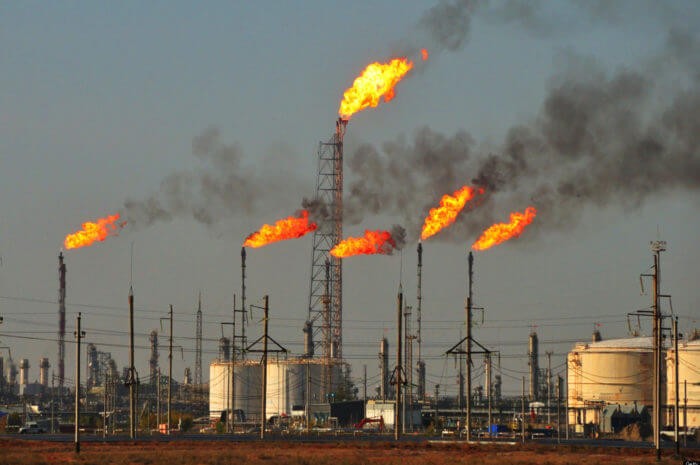
…Over 190 Billion Cubic Feet Of Gas Flared In 2024
Oil and gas companies operating in Nigeria, including major players like the Nigerian Petroleum Development Company (NPDC), Shell, and Chevron, paid the sum of N602.22bn in penalties for gas flaring between 2022 and 2024, latest industry data released by the Nigerian Upstream Petroleum Regulatory Commission has revealed.
The fines, issued by the Nigerian government, were in response to continued violations of gas flaring regulations, a key environmental concern in the country’s oil-producing regions.
The penalties increased sharply over the years, rising from N70.42bn in 2022 to N140.54bn in 2023, and spiking to N391.26bn in 2024.
The companies that paid gas flaring penalties during the period include NPDC, Mobil, Chevron, Addax, Shell, Agip, Esso, First Exploration & Production, Star Deep, Seplat, Eroton, Continental, New Cross, Aiteo, Mid Western, Green Energy, Network Exploration and Production, TUPNI, and Universal.
A total of 2.511 trillion cubic feet (TCF) of associated and non-associated gas was produced in 2024, at a daily average of 6.86 billion cubic feet per day (BCF/D) — marking a modest 0.53 per cent increase from 2023.
Advertisement
Of this volume, 2.317 TCF (92.26 per cent) was utilized, while 0.1918 TCF (7.64 per cent) was flared. The flare rate represents a slight deterioration compared to 7.36 per cent recorded in the previous year, showing that despite improved gas management efforts, flaring persists at significant levels.
Gas utilization covered a range of operations including in-house fuel use, gas lifting, pressure maintenance, storage, and sales to domestic and export markets.
Notably, export sales accounted for 39.5 per cent of the gas produced, far surpassing domestic utilization at 28.7 per cent, reflecting enduring challenges in the local gas market.
The data also revealed that gas production was led by Joint Venture (JV) companies, which accounted for 1.489 TCF (59.30 per cent). Production Sharing Contracts (PSCs) contributed 0.660 TCF (26.29 per cent), Sole Risk operators produced 0.255 TCF (10.17 per cent), while Marginal Field operators added 0.106 TCF (4.24 per cent).
Persistent infrastructure deficiencies continue to hamper gas development and utilization efforts.
Advertisement
The report noted that the country’s gas sector still suffers from inadequate infrastructure and poor interconnectivity across the value chain.
Transmission pressure challenges along the Escravos-Lagos Pipeline System (ELPS), midline booster compression issues, and unreliability of off-takers in taking allocated volumes were also cited as major setbacks.
The 24-inch ELPS line has remained unavailable since 2018, while the alternative 20-inch pipeline experiences frequent outages.
These constraints are further compounded by difficulties in managing gas inventory and pressure/volume accounting.
Compounding the situation is the limited capacity and reliability of Nigeria’s transmission grid, which frequently leads to electricity load rejection by distribution companies and reduces gas offtake.
Security concerns in the Niger Delta, such as vandalism and oil theft, also significantly disrupt liquid evacuation and gas production.
Advertisement
Key infrastructure like the Trans Niger Pipeline (TNP) and the Nembe Creek Trunk Line (NCTL) are often targeted, further hampering operations.
The increasing penalties underscore the Nigerian government’s effort to enforce environmental compliance and push operators toward cleaner energy practices.
However, analysts note that unless infrastructural and market bottlenecks are addressed, flaring may persist despite stiff penalties. Industry watchers have called for more robust domestic gas policy enforcement, sustained investment in gas processing and transmission infrastructure, and improved security around key energy assets.
With global emphasis on clean energy and Nigeria’s declared transition goals, gas flaring remains a critical environmental and economic issue in Africa’s largest oil producer.
The Nigerian Upstream Petroleum Regulatory Commission had last week said its gas-centric transition strategy would eliminate routine flaring by 2030 and reduce methane by 60 per cent by 2031.
The commission’s Chief Executive, Gbenga Komolafe, while speaking at the 24th Nigeria Oil and Gas Energy Week conference said the strategy would monetise vast gas reserves, creating thousands of green jobs in the process.
He revealed that the strategy was supported by initiatives such as the Decade of Gas, the Nigeria Gas Flare Commercialisation Programme and the Presidential Compressed Natural Gas (CNG) Initiative.
“Nigeria is building Liquefied Natural Gas capacity, deploying floating infrastructure, and leading cross-border pipeline development to fuel not only its own economy, but Africa’s industrial renaissance.
“Further anchoring this ambition is Nigeria’s Upstream Decarbonisation Framework, which integrates emissions tracking, MRV systems, carbon capture, and climate finance access through carbon markets.
“These aren’t just policies; they are opportunities for investment, innovation, and inclusive growth,” he said.