
Stanbic IBTC, FCMB, Tatum Bank Lead CBN List Of Costliest Lenders
…Agric, Manufacturing, Real Estate Hardest Hit Sectors With 60% Lending Rate
…Lending, Deposit Rates Disparity Widens
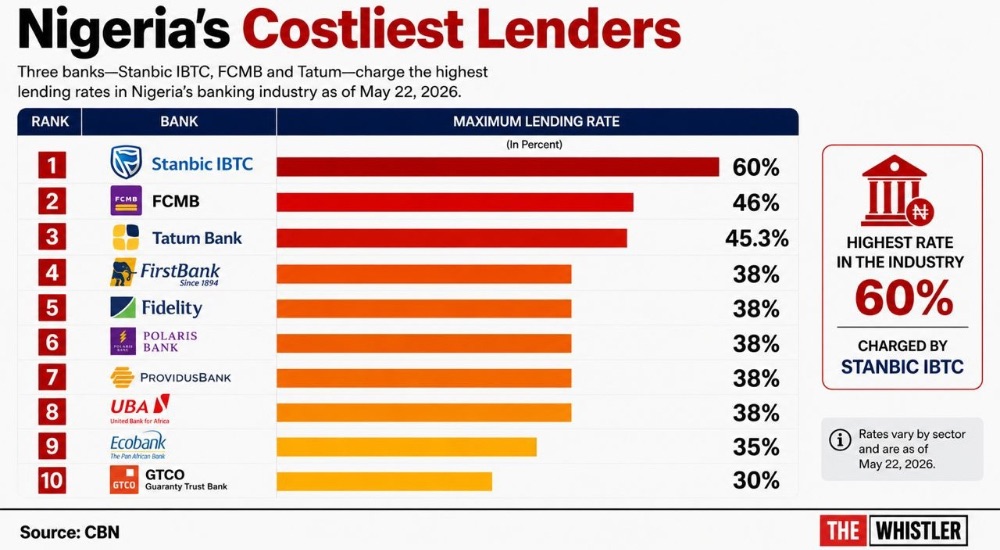
Three banks—Stanbic IBTC, First City Monument Bank Plc and Tatum charged the highest lending rates in Nigeria’s banking industry as of May 22, 2026, with maximum rates reaching 60 per cent in some sectors, according to lending and deposit rate data obtained from the Central Bank of Nigeria (CBN).
The data, analysed by THE WHISTLER published under a new transparency initiative approved by the Monetary Policy Committee (MPC), provides a comprehensive snapshot of lending and deposit rates across Deposit Money Banks (DMBs), exposing significant differences in the cost of credit and returns on savings.
The figures show that while most banks paid between 7.95 per cent and 18.85 per cent on deposits, borrowers across key sectors of the economy faced lending rates ranging from single digits to as high as 60 per cent.
THE WHISTLER analysis of the data showed that Stanbic IBTC topped the list of the most expensive lender with maximum rates of 60 per cent.
Advertisement
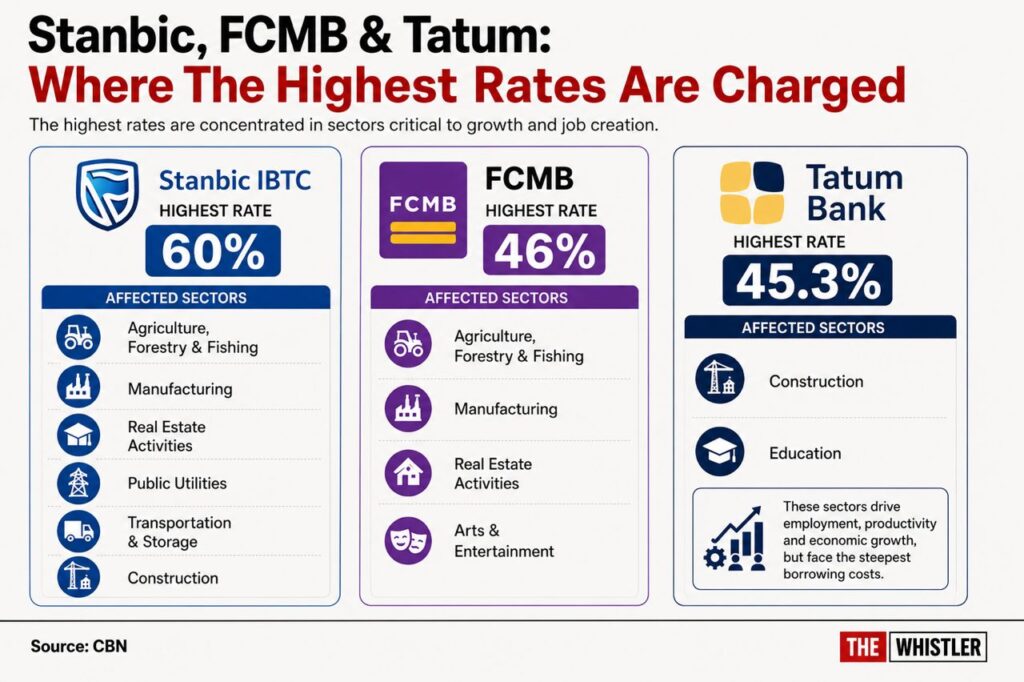
The bank emerged the costliest in terms of borrowing at a maximum rate if 60 per cent in key sectors of the economy such as agriculture, manufacturing, real estate, public utilities, transport, and construction among others
The bank was followed by FCMB with 46 per cent lending rate in the following sectors agric, manufacturing, real estate, arts and entertainment.
Further analysis by THE WHISTLER revealed that Tatum bank emerged the third most priced bank in terms of lending rate with 45.3 per cent in sectors such as construction, and education among others.
Other banks with notably high maximum lending rates included First Bank of Nigeria, Fidelity Bank, Polaris Bank, Providus Bank and United Bank for Africa, where maximum rates ranged between 33 per cent and 38 per cent depending on the sector.
Advertisement
The data further revealed that Ecobank maintained lending rates of between 26 to 35 per cent across several sectors.
Guaranty Trust Bank, Keystone Bank, Nova Bank, Optimus Bank and Sterling Bank also recorded prime rates of around 30 per cent in multiple sectors.
At the lower end of the spectrum, Citibank maintained relatively moderate lending rates, with prime rates of 19 per cent and maximum rates of 20 per cent in sectors where data was available.
Coronation Merchant Bank reported prime lending rates as low as 9 per cent and as high as 35 per cent in some sectors, while Rand Merchant Bank recorded rates between 20 per cent and 26 per cent in selected sectors.
The agriculture, forestry and fishing sector recorded some of the widest disparities in borrowing costs.
Advertisement
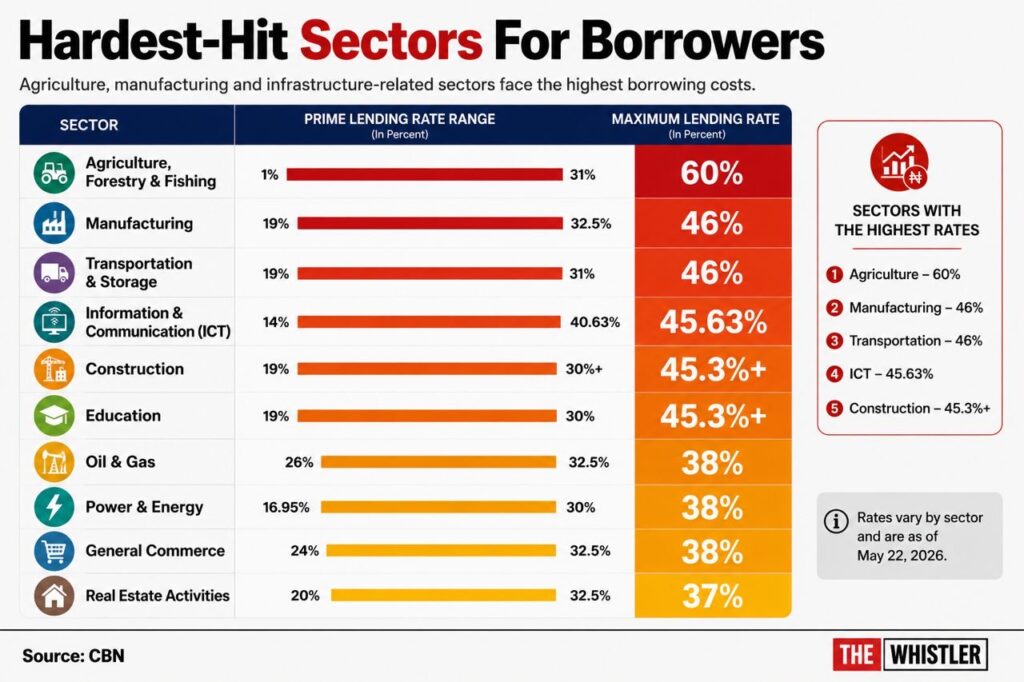
While some lenders offered agricultural loans at prime rates of between one per cent and nine per cent, most banks charged between 19 per cent and 31 per cent. Maximum rates in the sector ranged from 20 per cent to 60 per cent.
For the manufacturing sector, which remains central to Nigeria’s industrialisation agenda, prime lending rates generally ranged from 19 per cent to 32.5 per cent. Maximum rates reached 46 per cent at some institutions and exceeded 30 per cent at most major lenders.
General commerce, one of the largest recipients of bank credit, also attracted significant borrowing costs. Prime lending rates ranged from 24 per cent to 32.5 per cent, while maximum rates rose to between 32 per cent and 38 per cent.
In the oil and gas sector, prime lending rates were largely concentrated between 26 per cent and 32.5 per cent, while maximum rates climbed as high as 38 per cent.
Construction firms faced similarly high financing costs, with prime lending rates ranging from 19 per cent to over 30 per cent and maximum rates extending beyond 35 per cent for many borrowers.
The information and communication sector, one of the fastest-growing segments of the economy, recorded some of the most expensive loans. Prime lending rates ranged from 14 per cent to 40.63 per cent, while maximum rates reached 45.63 per cent.
The transportation and storage sector also faced substantial borrowing costs with prime rates ranging from 19 per cent to 31 per cent, while maximum rates rose as high as 46 per cent.
For businesses operating in the power and energy sector, prime lending rates varied from 16.95 per cent to 30 per cent, while maximum rates reached 38 per cent.
Real estate activities, which require long-term financing, attracted prime lending rates ranging between 20 per cent and 32.5 per cent, with maximum rates reaching as high as 37 per cent.
The professional, scientific and technical services sector recorded prime lending rates largely between 19 per cent and 30 per cent, while education and health-related activities attracted rates within similar ranges.
Beyond lending rates, the CBN data also highlighted sharp differences in the rates paid to depositors.
For demand deposits, which are typically current account balances, it was gathered that most banks offered returns below one per cent.
For instance, Access Bank paid 0.47 per cent, Citibank 1.49 per cent, Ecobank 0.43 per cent, FCMB 0.50 per cent, Fidelity Bank 0.50 per cent and Keystone Bank 2.50 per cent.
Savings deposit rates showed far less variation. Most banks paid the regulatory benchmark rate of 7.95 per cent. First Bank offered 8.25 per cent.
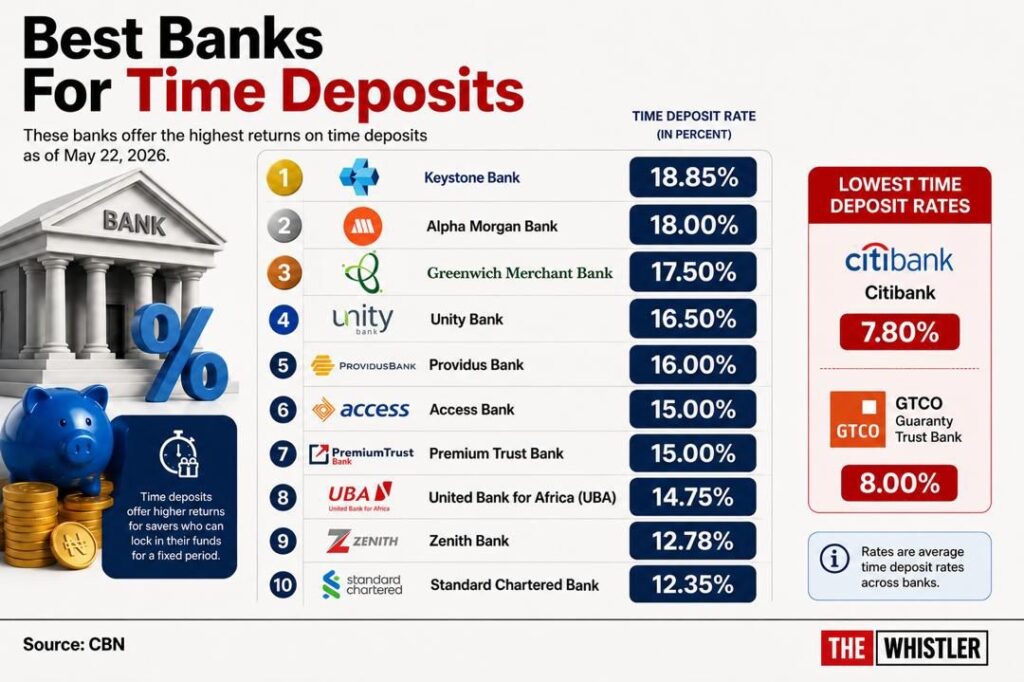
Time deposits generated the highest returns for customers with Keystone Bank emerging as the top payer with an average time deposit rate of 18.85 per cent.
Keystone Bank and Sterling Bank paid 7.95 per cent each, while United Bank for Africa offered 8.10 per cent. Ecobank’s savings rate stood at 6.5 per cent, while Stanbic IBTC paid 2.65 per cent.
First Bank followed with 11.05 per cent, while Alpha Morgan Bank paid 18 per cent.
Greenwich Merchant Bank offered 17.5 per cent, Standard Chartered Bank paid 12.35 per cent, Providus Bank offered 16 per cent and Unity Bank paid 16.5 per cent.
Access Bank offered 15 per cent on time deposits, Premium Trust Bank 15 per cent, Union Bank 11.25 per cent, Zenith Bank 12.78 per cent and UBA 14.75 per cent.
Citibank recorded one of the lowest time deposit rates at 7.8 per cent, while Guaranty Trust Bank paid eight per cent.
The data revealed a substantial gap between what banks pay savers and what they charge borrowers.
While the highest time deposit rate in the industry stood at 18.85 per cent, the highest lending rate was 60 per cent, representing a spread of more than 41 percentage points.
The CBN said the weekly publication of rates is intended to promote transparency and enable businesses and households to compare lending and deposit offerings across banks.
Analysts believe the disclosures could intensify competition in the banking sector and improve consumer awareness, especially among businesses seeking credit.
However, they note that elevated inflation, a high Monetary Policy Rate and persistent economic uncertainties continue to exert upward pressure on lending rates.
The figures provide a detailed roadmap for borrowers of where credit is cheapest and most expensive.
For depositors, they reveal which institutions offer the best returns on savings and fixed deposits.
For the broader economy, the data underscores the challenge of balancing financial sector profitability with the need for affordable credit to drive investment, production and economic growth.
ENDS