
881 Pages Later: The Sentence Missing From Gowon’s Memoir
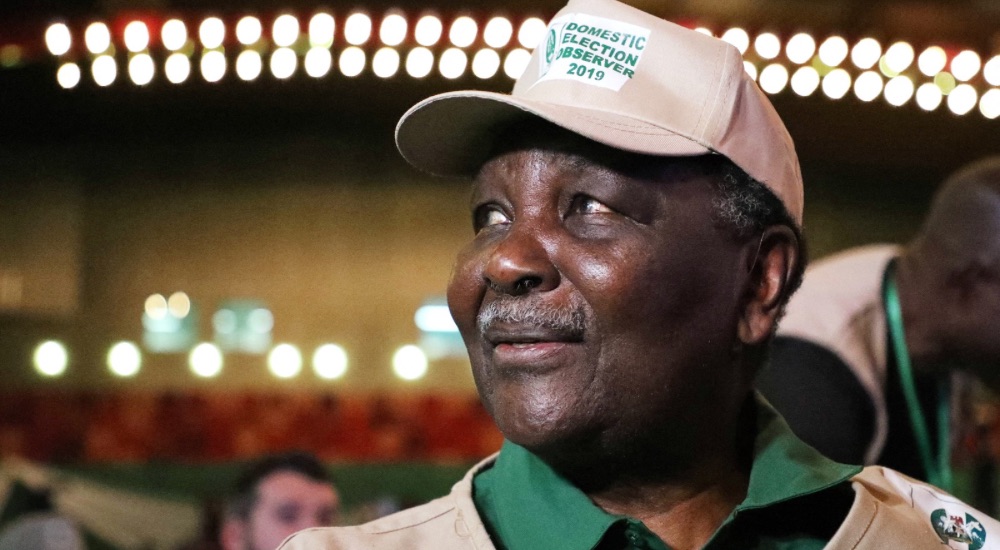
I watched the lavish rollout of General Yakubu Gowon’s 881-page autobiography, “My Life of Duty and Allegiance,” at the International Conference Centre here in Abuja and all I felt was a profound sense of disbelief.
The room was a glittering sea of Nigeria’s untouchable political elite. Billionaires, retired generals and top government officials clinked glasses, smiled for the cameras and casually pledged ₦3.5 billion to buy and distribute the book. It was a masterclass in elite back-slapping.
But while the billions were being rolled out under the chandeliers, I kept thinking about the heavy, suffocating silence hanging over the rest of the country. There is something fundamentally broken about a nation where ₦3 billion can be dropped in an afternoon to polish one old man’s legacy, while the grandchildren of those who paid the price for his decisions are still treated with structural suspicion by the state.
We are told this massive book is Gowon’s final shattering of a decades-long silence. But after sitting with the excerpts, the reviews and his interviews, I realized this isn’t a historical accounting or an effort to heal a fractured country. It is a highly managed exercise in self-justification.
Gowon is 90 years old. He wrote this book to secure his preferred spot in the history books, choosing to protect his own legacy at the absolute expense of the raw truth.
Gowon himself admits that he had to write most of this book from memory because his personal records were carted away during the 1975 coup that overthrew him. That is a personal misfortune, yes, but it has given him a convenient license for selective amnesia.
Advertisement
He spends hundreds of pages walking us through the breakdown of the Aburi Accord, the fluid betrayals of the old political class and how the West abandoned him, forcing him to buy weapons from the Soviets. As a historical record, these details matter. But explaining the mechanical logistics of how you fought a war is entirely different from facing up to the human misery your choices unleashed.
This is where the book hits a moral brick wall. To Gowon, the total federal blockade that cut off food and medicine to Biafra was just a sterile, unavoidable military necessity.
I simply cannot accept that coldness. Nor can anyone who has read Frederick Forsyth’s The Biafra Story. Forsyth was on the ground. He didn’t see a clean military maneuver; he saw the deliberate weaponization of hunger. He documented a landscape where the primary casualties weren’t soldiers trading bullets in trenches, but toddlers starving to death in their mothers’ arms.
To make matters worse, I watched Gowon double down on this revisionism during his recent Arise TV interview. To hear a former Head of State look into a camera in 2026 and claim that most of the shots fired by the federal troops were targeted palm trees over people, while dismissing a catastrophic famine as just a byproduct of Biafran internal decisions, is a staggering rewrite of history.
Let’s call it what it is: gaslighting on a multi-billion-naira scale. You cannot rewrite a blockade meant to starve an enclave into submission as a simple skirmish with “armed secessionists” without completely erasing the swollen-bellied ghosts of over a million civilians who died of kwashiorkor far from any battlefield.
Advertisement
Gowon’s book reduces mass starvation to a tactical footnote and in doing so, it insults the lived trauma of an entire generation.
The memoir also frames the initial collapse of peace in 1967 as an inevitable tragedy born of mutual suspicion. But thanks to the historical digging of veteran journalists like Eric Teniola, we know a much uglier truth. The historic Aburi Accord signed in Ghana, a deal that could have given us a loose confederation and saved millions of lives wasn’t defeated on the battlefield. It was deliberately sabotaged by unelected civil servants in Lagos.
The moment Gowon landed from Ghana, a group of powerful permanent secretaries, led by Prince S.I.A. Akenzua (who later became the Oba Erediauwa of Benin), went to work dismantling the agreement. Akenzua handed Gowon a memo on January 8, 1967, telling him bluntly that he had “given too much away” and that a weak center would ruin the country. That memo sparked a secret meeting in Benin where the civil service completely re-interpreted and rejected what was signed at Aburi. That bureaucratic coup led straight to Decree No. 8 and the collapse of diplomacy.
Colonel Odumegwu Ojukwu saw the script clearly. In his February 1967 letter to Gowon, he openly accused him and his “civil service advisers” of systematically stalling and destroying the highest agreements in the land.
Wole Soyinka captured this same heavy-handed reality in The Man Died, writing from the lonely prison cell where Gowon’s government locked him up just for trying to broker an alternative to the slaughter. By completely ignoring how his own inner circle chose aggressive centralization over a peaceful settlement, Gowon buries his own political guilt.
Then there is the myth of “No Victor, No Vanquished” and the celebrated “Three Rs” (Reconciliation, Reconstruction and Rehabilitation). Gowon leans heavily into this narrative in his book, painting it as a triumph of Christian magnanimity. But let’s look at the actual history. On the ground, that famous slogan was a political smoke screen.
Advertisement
While Gowon was talking about reconciliation on the radio, his administration was rolling out economic policies that felt like a deliberate, targeted castration of the surviving Igbo population. They capped the life savings of every Biafran at a flat twenty pounds (£20), no matter how much they had in the bank before the war. Then they dropped the Indigenization Decree, letting those who hadn’t been touched by the war buy up foreign shares and state assets while the South-East was still digging itself out of the rubble.
Chinua Achebe didn’t mince words about this hypocrisy in There Was a Country. He called “No Victor, No Vanquished” a brilliant public relations stunt designed to placate the international community while masking a structural reality of total economic exclusion. As Achebe put it, the twenty-pound policy was “premeditated economic strangulation.”
Gowon’s memoir completely skips these uncomfortable facts. He writes as if his path was the only logical choice available. But other key players left records that completely shatter his singular worldview.
General Alexander Madiebo, commander of the Biafran Army, pointed out that the war was the direct result of a federal government that flatly refused to protect its own citizens during the horrific 1966 pogroms. When Gowon glosses over his failure to secure Igbo lives before secession, he ignores the very spark that lit the fire. Even within his own victory lap, the story fractures.
General Olusegun Obasanjo’s civil war memoir, My Command, shows a far more chaotic, uncoordinated and messy federal war effort than the tidy story of “duty and allegiance” Gowon is selling us today.
Public analyst Khaleed Yazeed hit the nail on the head in his recent moral audit of the book. He noted that after 881 pages and 90 years of life, the ultimate tragedy is that Gowon chose explanations over contrition. As Yazeed wrote, “Moving forward without acknowledging the past is like walking with a broken leg and pretending it does not hurt.”
This is exactly why this memoir matters so much right now. It is not some dead relic from 1970; it is a perfect mirror of Nigeria in 2026. This pathological inability of Nigerian leaders to say “I am sorry” is a foundational disease.
The hyper-centralized, bloated federal center that Gowon cemented through Decree No. 8 to win the war is the exact same governance structure that is suffocating Nigeria today. It is the root cause of our current economic stagnation and the modern security crises tearing at our borders, from banditry to relentless regional agitation.
The same arrogant culture of unaccountability that allowed civilian slaughter to be dismissed as “tactical necessity” in 1968 is the exact same culture that allows modern administrations to look at the crushing poverty of 133 million Nigerians and call it a mere “economic adjustment.”
I say this to General Yakubu Gowon with all due respect: history has been incredibly kind to you. You survived a brutal war, a coup, years in exile and you have been blessed to reach the venerable age of 90. You have your legacy and no one can take away your effort to keep the map of Nigeria whole.
But a map is just a piece of paper; a nation is made of flesh and blood. Explanations are not apologies. Context is not contrition. At your age and with this book serving as your final testament, it takes far more strength to be vulnerable than to be defensive.
It is still not too late to step outside the protective walls of your 881 pages, look into the eyes of the grandchildren of Biafra and say three simple words: “I am sorry.” It would be the greatest, most courageous act of statesmanship of your entire life.
To the political class who gathered in Abuja to cheer this sanitized history, the warning is staring us in the face. Nigeria is bleeding today because we keep trying to build peace on a foundation of buried truths and unwashed wounds. You cannot forge a genuine national identity when your official history demands that one section of the country pretend they do not bleed.
Young Ozogwu is an Abuja-based public commentator and media executive. You can contact him at young.ozogwu@gmail.com