
Agric Research Institute Gets 1,737 Times More For Roads Than Seedlings
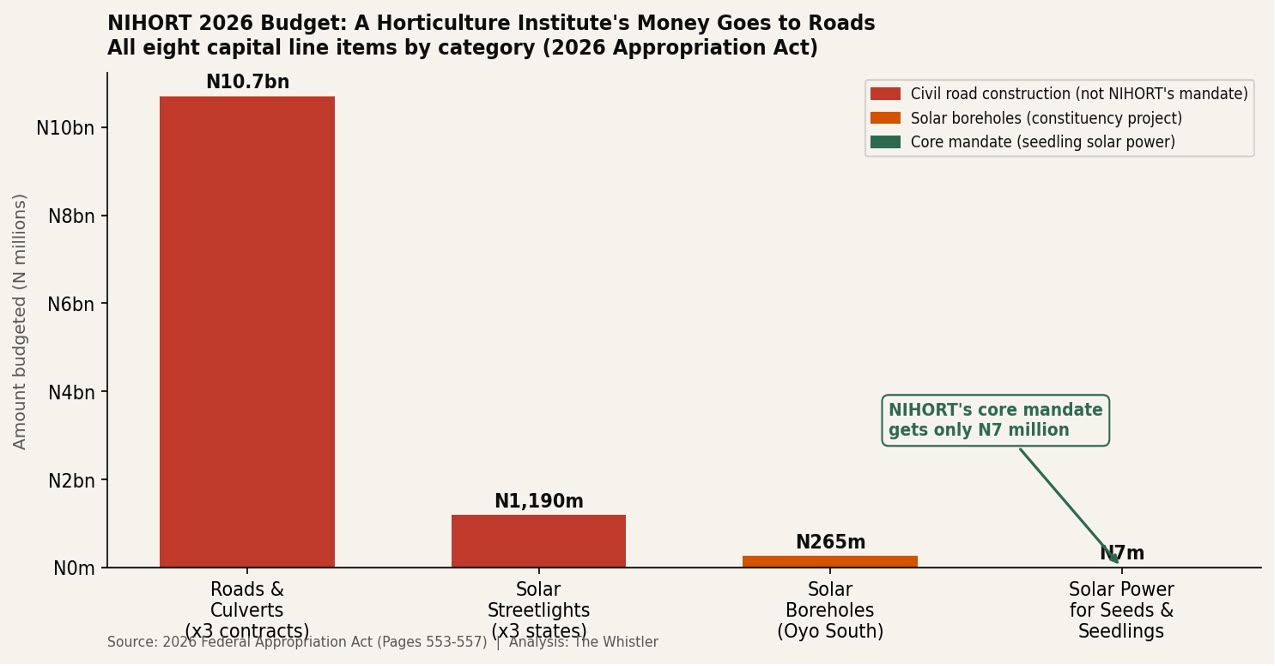
…N12.16bn Infrastructure Projects Tucked Into Horticultural Institute’s 2026 Budget
…Core Seedling Production Receives N7m Despite Institute’s Statutory Mandate
…S/West Roads, Maiduguri Streetlights Hidden In Horticultural Institute’s Budget
…Funding Pattern Exposes Glaring Mismatch Between Institute’s Mandate, Budget Priorities
There is a fruit and vegetable research institute in Ibadan whose job, by law, is to improve the quality of Nigeria’s tomatoes, peppers, plantains and ornamental plants. It was established in 1975 with a federal mandate: study tropical fruits, develop better seeds, improve how we grow and preserve our produce. For half a century, the National Horticultural Research Institute, NIHORT, has been quietly doing exactly that from its campus in the Jericho Reservation Area of Ibadan, Oyo State.
So, when THE WHISTLER opened the 2026 Federal Appropriation Act and found NIHORT’s budget code sitting on top of N12.16bn allocated for road construction across the South-West, solar streetlights in Borno State, and boreholes in Oyo, the first reaction was that someone had made a filing error. It was not no error, but a deliberate planned heist that buried across five pages of the budget law.
Advertisement
The same budget that handed NIHORT over N12bn to build highways gave the institute N7 million for solar power to run its seedling production. Not N700 million, not N70 million, seven million naira, to power the seeds and seedlings that are literally the reason NIHORT exists.
That is the budget. On one side, N12,155,000,000. On the other, N7,000,000. Same institution. Same appropriation year. Pages 553 to 557 of a document that 99 percent of Nigerians will never read.
NIHORT’s Statutory Mandate
Before we get to the roads, it helps to understand what a horticultural research institute actually does, because the gap between the mandate and the money is where the story lives.
NIHORT’s founding decree and its current operational framework task it with genetic improvement of tropical fruits and vegetables, better production techniques for smallholder farmers, post-harvest handling to reduce the catastrophic spoilage rate of Nigerian produce, and scientific research into spices and ornamental plants. Its scientists are agronomists, plant breeders, soil scientists and post-harvest pathologists. Its facilities include germplasm banks, screenhouses, tissue culture laboratories and field trial plots.
Advertisement
What it does not have, and has never had, is a roads department. No highway engineers. No quantity surveyors. No environmental impact assessment teams. No registered civil engineering consultants on payroll. Because a fruit research station in Ibadan has never needed any of those people, until somebody decided to put N10.7bn in road contracts under its budget code.
Pages 556 and 557 of the 2026 budget law contain three line items that, on their own, would fund a mid-sized state infrastructure programme. They are not in the Ministry of Works, nor in the NDDC, but rather, they are sitting inside the budget of a horticultural research institute.
The first: N4.6bn for the construction and full rehabilitation of roads and culverts in selected locations in the South-West, described as multiple lots.
The second: N4bn for the construction and major rehabilitation of roads, culverts and erosion control in selected locations in the South-West. Also multiple lots. Also NIHORT.
The third: N2.1bn for the construction of roads connecting farming settlements in various locations, Lots 1 to 5. Also NIHORT.
Three contracts. N10.7bn. Not one of them names a specific local government. Not one identifies engineering designs, survey reports, or environmental impact assessments. Not one explains what a fruit and vegetable research institute in Jericho, Ibadan is doing supervising a regional highway programme. The description for the N4.6bn contract, for example, simply says ‘selected locations in South-West.’ Which locations? Selected by whom? The budget does not say.
Advertisement
“A horticultural institute has agronomists and plant breeders. When you force a N4.6bn highway project through their budget, the institute becomes a rubber stamp for whoever controls the real money.”
A senior procurement auditor in Abuja, who reviewed the line items at THE WHISTLER request and asked not to be named, put the problem plainly.
“A horticultural institute is staffed by agronomists, plant breeders, soil scientists and post-harvest pathologists. They do not employ registered civil engineers, highway surveyors or quantity surveyors capable of supervising a N4.6bn highway construction project. When you force such projects through an agricultural research institute, the institute inevitably becomes a rubber stamp for external political sponsors who control the tender boards.”
In plain English: whoever inserted these road projects into NIHORT’s budget will not be building roads through NIHORT. NIHORT will sign the paperwork. The money will flow elsewhere.
From Ibadan To Maiduguri: The Geography Problem
The road contracts are strange enough. Then you get to the streetlights, and the geography stops making any sense at all.
NIHORT is in Ibadan, Oyo State. That is the South-West. On Page 554 of the 2026 budget, entry number 5, a N490m allocation appears under NIHORT’s code for the provision and installation of solar-powered street lights across the fifteen wards of Maiduguri Metropolitan Federal Constituency in Borno State.
Maiduguri, Borno State in North-East Nigeria is approximately 1,300 kilometres by road from NIHORT’s campus in Jericho, Ibadan. In a different geopolitical zone. Representing a different senatorial district. Connected to NIHORT by precisely nothing except a budget code somebody typed into a spreadsheet.
The streetlight allocations do not stop at Maiduguri. Ogun State gets N500m for solar streetlights across various communities. Ilaje/Ese-Odo Constituency in Ondo State gets N200m for solar streetlights. Oyo South Senatorial District, which is at least in the same state as NIHORT, gets N265m for solar-powered boreholes across Ibadan Land.
Add those up. Four states, four sets of constituency projects, N1. 455bn in solar streetlights and boreholes, all sitting inside a horticultural research budget. When the Maiduguri insertion is the most blatant because of the distance, the Ogun, Ondo and even the Oyo allocations raise exactly the same question: what does any of this have to do with improving Nigeria’s fruit and vegetable research?
The N7m That Tells The Whole Story
After all the roads and all the streetlights and all the boreholes, when you finally reach the line item that is actually supposed to be in NIHORT’s budget, you find it on Page 553. Solar power system for seed and seedling production. The thing that keeps NIHORT’s greenhouses and laboratories running. The energy supply for the genetic improvement work that is the entire reason the institute exists.
To put that in context: the Maiduguri streetlight project that has nothing to do with NIHORT received N490m. That is 70 times more than NIHORT’s core operational solar budget. The smallest of the three road contracts, N2.1bn, is 300 times larger than the seedling solar allocation. The entire N12.16bn portfolio dwarfs the mandate funding by a ratio of 1,737 to one.
This is how budget insertions work in practice, and why they are so damaging beyond the obvious corruption concern. When political projects are loaded into technical agency budgets, the agency’s actual operational funding gets squeezed or ignored. NIHORT’s plant breeders and agronomists presumably know that their solar power for seedling production received N7m this year. They also presumably know that somebody put N4.6bn in road contracts next to it. Whether they feel they can say anything about it publicly is a different question.
How It Is Supposed To Work
Uder the Nigerian procurement system, any entity seeking to execute capital projects must demonstrate technical capacity relevant to those projects. The Bureau of Public Procurement guidelines require that agencies supervising contracts have the in-house expertise to evaluate bids, monitor execution and certify completion.
A horticultural research institute certifying the completion of a N4.6bn highway contract is not a technical impossibility. It is a procurement catastrophe waiting to happen. The institute has no highway engineers to inspect the road. It has no quantity surveyors to verify that the volume of asphalt laid matches what was invoiced. It cannot meaningfully challenge a contractor who delivers 60 percent of a culvert and bills for 100 percent, because it does not have the staff who would know the difference.
That institutional vacuum is precisely what makes research agency budgets attractive vehicles for political insertions. The money passes through an agency that cannot question it, goes to contractors that the inserting politician has already selected, and the research institute’s director signs off on whatever paperwork arrives at the gate.