
Igbo Community Battles Language Loss With Free Classes For Children
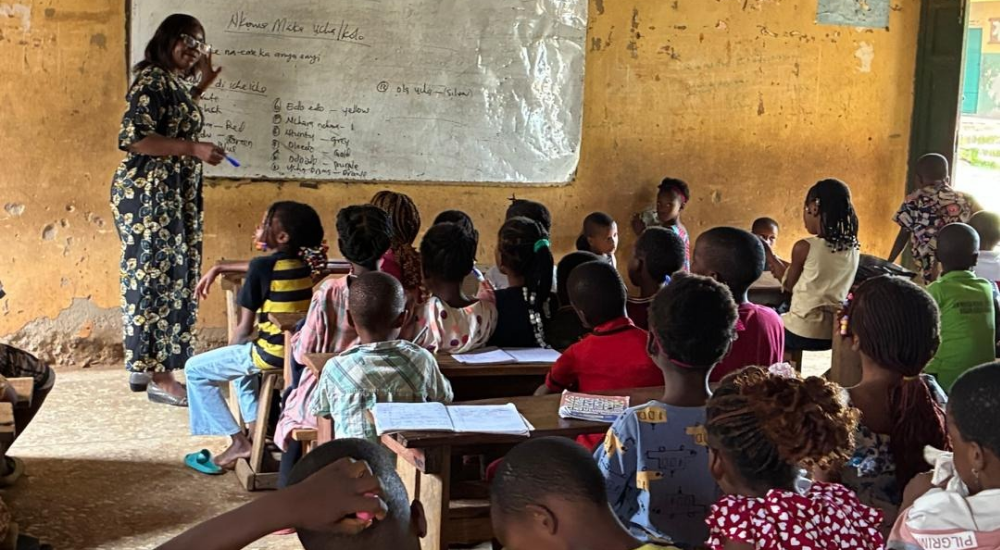
At exactly 12pm in LEA Ijayapi Primary School, Kubwa, the compound came alive.
“Anyi agbasa go akwukwo,” meaning “we have been dismissed from school,” the children sang in Igbo, clapping and packing their books after a two-hour lesson.
For many who grew up in the eastern part of the country, the song follows the last bell and signals the end of school. But the children singing it were nowhere near the east. They were in Abuja, in the FCT, taking lessons to learn how to speak the Igbo language.
THE WHISTLER gathered that the lessons were organised by a group, the Igbo Community Assembly and are free for all Igbo children. They are currently holding in six centres across Kubwa, a suburb in the FCT.
THE WHISTLER while observing the lessons before the dismissal, noted children with excitement repeating Igbo words after their teachers.
One of the teachers at the centre, Mrs. Mary Jane Okara, who disclosed that the lesson started on August 4, stated that the turnout exceeded expectations.
Advertisement

Okara, a trained Igbo language teacher with an NCE, a BA in Igbo, and a Masters in Education, explained that the pupils were grouped by age into three classes, adding that her class alone had 65 children, with similar numbers in the other two classes.
Despite the large population, she said the impact is already visible. Within weeks, children who could not speak Igbo at home can now recite the alphabet, count to 100 in Igbo, greet properly, name family members, and mention traditional foods.
“From home, most of them don’t know how to read and write. That is the reason why we are here. We are here to teach them how to speak the language and how to write,” she said.
Parents are responding positively, she added, with new children being brought in daily after word spread in the community.
Advertisement
Her only major challenge is class size. “The challenge we are having here now is the population. It is not easy for one particular teacher to control that number of children.”
She called for more teachers to support the initiative as it expands across the FCT.
Another teacher, Mrs. Ijeoma Okoro, said the class was born out of frustration with how many Igbo children can no longer speak or write their language and traced the problem to the home, where parents often associate English with intelligence.
“It started from our parents. When you speak Igbo, they think that you are not intelligent. Even some parents that did not go to school will force themselves to speak broken English to their children,” she said.
In her class of children aged five to eight, Okoro said many could not even ask “what is your name” in Igbo.
For the past four weeks, she noted that the lessons have focused on basics: greetings, numbers from one to ten, and simple sentences, repeated daily because retention is low without practice at home.
Advertisement
“I tell them to go home, tell your parents, let them speak Igbo at home. Start from home. Because after these four weeks, if they don’t continue at home, if we come back next year, we’ll still start where we stopped,” she said.
Okoro who holds a degree in Social Studies and an NCE in Igbo Language, stated that the benefit of a child learning his native language goes beyond communication.
“Go to China. You see that it’s their language they are using and you see them producing a lot of things. If we know our language, it will help us a great deal,” she noted.
The children who spoke with THE WHISTLER excitedly recited what they have learnt, including greetings in Igbo, names of foods, colours and other things.
One of the children, Ishiw Emmanuel, said that though she speaks Igbo with her parents at home, there were deep words in the language which she had come to learn during the lesson.
“I did not know much about colours in Igbo. But now I can confidently talk about colours like Akwukwo Ndu(Green), edo edo(Yellow) Ntuntu(Grey),” she noted.
The 11-year-old added that she never knew there were alphabets in the Igbo Language and have come to recite the 36 alphabets.
“I am yet to remember all of them but I am excited to learn a lot about my language and to speak it fluently. I will definitely come back next holiday period, “she said.
For 13 year old, Nwabueze Nta, the lessons have helped him to learn more about the Igbo culture adding with smiles that he is a proud Igbo Boy.
“Now, I will try to speak the language everywhere I go; at home, school and at church. I have asked my parents to keep speaking Igbo to me so I will learn better,” he noted.
This initiative comes as academics warn that Igbo is slipping away from everyday use.
In a 2023 study titled “Igbo Language as an Endangered Language: Causes and Possible Solutions” published in the Nigerian Journal of Arts and Humanities, Dr. Florence Uju Ibeh of the Department of Igbo, African and Communication Studies, Nnamdi Azikiwe University, Awka, said the identity of the Igbo race is under threat. She observed that many Igbo people now default to English even at home.
“When you speak to an ignorant indigene, he or she responds in English. Even the ones that try to speak the Igbo language cannot make a complete sentence in the language without code-mixing with English,” she wrote.
“If this continues, the language will gradually disappear,” she added.
The Chairman of the Igbo Community Assembly in Byazhin, Prince Chukwuma Michael, told THE WHISTLER that was exactly why the lessons were organised during the school break.
He lamented that many children can no longer speak Igbo at home, explaining that bringing back the Igbo language to homes was his first agenda after coming into office five months ago.
“I also discovered that other tribes, their language is still standing. I want this for the Igbo language. I want when we have visitors, I want to speak in a way the visitor won’t understand. We could communicate with my language. When we have visitors, I can tell them ‘Gaa ku te re m mmiri’ meaning ‘ go and get water for me’ and they will understand immediately.
“When they go to the village, they will be able to talk with my grandparents without any issue. I don’t want a situation where their grandparents talk to them and they will turn and be asking, ‘What is grandma saying?’”
Ibeh identified the same problem in her research, attributing it to poor attitude, language shift in homes, and school policies.
According to her, though Igbo people are among the most educated in Nigeria, many cannot read and write in Igbo.
“In functions, vote of thanks, welcome address, and speeches in any meeting, whether in the kinsmen village, towns, church meetings and so on, are written and read in English,” she noted.
She added that “the majority of the owners of the language also see it as inferior and a language for the illiterate.”
She said schools are not helping, as most schools in the East, especially private schools, prohibit pupils and students from speaking the language on school premises, adding that some that teach Igbo language do not employ qualified teachers.
Parents too, she added, “now prefer to speak English to their children instead of their mother tongue.”
She also described language shift as happening when parents in multilingual communities stop using their native language regularly and shift to the dominant language.
“The children become native speakers of the dominant language and non-fluent speakers of their parents’ native language,” she noted.
Other factors she listed include migration, the dominance of the colonial language, love for western culture, government policy on education, and lack of enough published works in Igbo.
To reverse the trend, Michael said the Assembly is planning to expand beyond Byazhin to the whole FCT.
“I have discussed with the President General of Abuja, Prince Ikenna Mmuotuanya, to expand it to the whole FCT. We also decided that we are not limiting it to just the long vacation in Byazhin. We want to continue it every holiday period,” he explained.
He explained further that the pupils were provided with free textbooks written in Igbo which they take home to continue their studies.
“For example, Cup is ‘iko’. Water is ‘mmiri’. It explains the language from the scratch. It also teaches them writing, ‘edemede’, and the alphabets…A, B, Ch, D…”
The children are also learning culture through language.
“All of them know all that now. They know the names of foods in Igbo language like ‘ofe nsala’, white soup, ‘ofe onugbu’, bitter leaf soup. There are also songs for them. When you teach children with songs, they will never forget,” he said.
He noted that the community monarch has visited the centres.
“Our Igwe, Jude Udobi, visited the centres last week. We have about five centres to see how they are studying. We have them in LEA Primary School, Byazhin, LEA Primary School, Chikakore, Best Famous Comprehensive Secondary School, Kubwa 2 Junior Secondary School, and LEA Primary School Ijayapi. We made it in a way that every child can go anywhere they are.”
To make this work, Michael said they rely on support from individuals which enables them to provide free textbooks, notebooks and pens for the children and payment for teachers, cleaners and security for the schools involved.
“We were particular about this, so we sourced teachers who read Igbo in school to teach these children. We want it to be standard. We are still pleading with people to support because we don’t want it to fail,” he said.
Ibeh recommended similar steps in her paper while urging, above all, that Igbo people should love their language.
“Government should at all levels make policies that will favour the indigenous language. Start by making them compulsory subjects that one must pass. Igbo language should be made an official language in all 5 eastern states.
“Books written in indigenous languages should be promoted. Schools, especially private schools, should be monitored to ensure that they promote the language and culture. There should be awareness for parents to appreciate the language and start speaking to the children,” she said.
These recommendations are quite important as UNESCO data states that at least 40 percent of the 7,000 languages estimated to be spoken in the world are endangered, and that “on average, a language disappears every two weeks, taking away the cultural and intellectual heritage of the communities.”
Michael stated that with the initiative the Assembly has started, Igbo language will definitely not be part of those endangered.
He stated excitedly that parents of children involved in the programme are already noticing changes.
“Now, the parents are calling and saying that they are seeing changes in their children. For example, when they wake up, they will greet them and say, ‘Ututu oma’, that’s good morning. That is what they learnt in school. The parents are happy. If they continue like this, by this time next year in Byazhin, Igbo language will be very common for the children,” he noted happily.