
Lawmakers Raise Concerns As Senate Passes State Police Bill
… Fear Possible Abuse By President, Governors
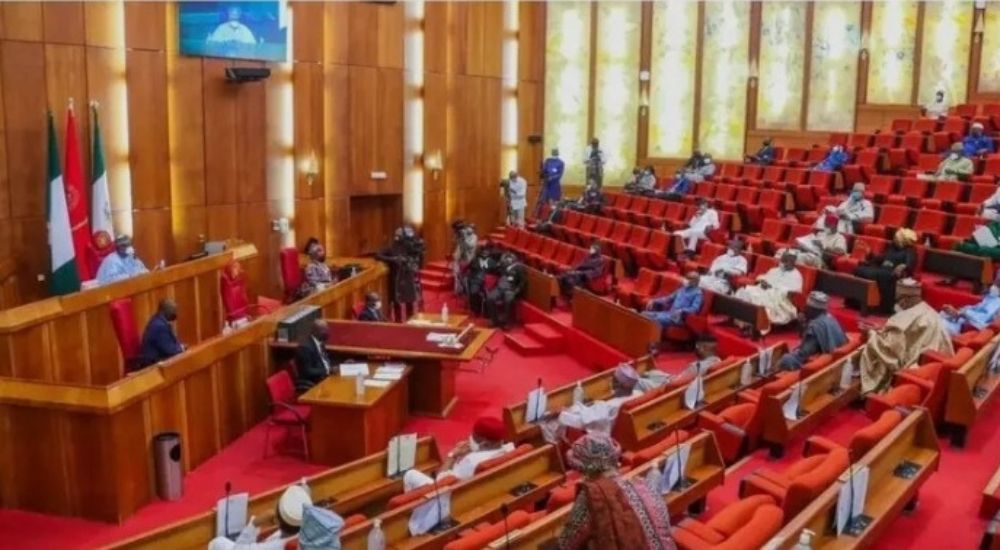
Senators on Wednesday raised serious concerns over possible abuse and misuse of state police personnel by the president and governors when the state police bill eventually became law.
Majority of the lawmakers across party lines expressed strong support for the bill, but voiced their misgivings about some clauses, which they warned could be exploited through wrongful implementation.
First to voice his concerns was the senator representing Abia South, Eyinnaya Abaribe who called for safeguards against possible abuse by the executive at the federal and state levels.
Specifically, Abaribe drew attention to Clause 16(12) in the bill, which empowers the President to take over the control of a state within 48 hours of issuing a written notice.
Such notice, the bill stated, would be transmitted to the governor of the affected state, the state’s assembly and the National Police Council, stating the duration of such intervention.
Advertisement
“The President should not just be empowered to merely write a letter to take over the running of a state,” Abaribe said, arguing that such powers should be shared with the National Assembly.
“What if the President is not in good terms with a governor and decides to arbitrarily take over the running of the state,” he argued.
The Abia senator also raised critical questions over the mode of funding of state police, warning that the same challenges facing local government funding could bedevil state police.
Recall that despite the ruling of the Supreme Court granting financial autonomy to local governments, the state governments are still collecting allocations meant for the councils through joint accounts controlled by the governors.
Abaribe urged the Senate to make the necessary alterations that would channel state police funding through the National Police Council, instead of paying into accounts controlled by state governments.
Advertisement
The vocal lawmaker also urged safeguards against the politicisation of state police and the tendency of the body being used as a political weapons by state governors.
Responding, the President of the Senate, Godswill Akpabio agreed with Abaribe, saying that he also had strong feelings that the governors could used it against their political opponents.
“I agree with you that the governors may abuse state police. Some of them may even run their predecessors out of the state. This has happened before.
“They may not kill their opponents but they may used state police to beat them up anytime they visited the states.
“But they will also leave office one day and their successors would also give them the same treatment,” Akpabio said.
The President of the Senate however, noted that Nigeria had been operating a centralised policing system since 1960, which he said was not working.
Advertisement
“And if we have been operating a system for over 60 years and it’s not working, then we need a change. The observed lapses could be addressed through amendment as we progress,” Akpabio said.
Also in support of the bill was the senator representing Sokoto South, Aminu Tambuwal.
Tambuwal said he had no choice than to support the bill because many parts of his state have come under relentless attacks by armed bandits and other mauraders.
“I have been an advocate of state police since when I was the Speaker of the House of Representatives and even during my tenure as governor.
“State police will lead to the entrenched of true federalism,” Tambuwal said, declaring that he would continue to support the security agencies in the fight against terrorism and banditry in the country.
The bill was passed with an overwhelming majority following an adoption of the report of the Senate Committee on Police Affairs.
The Senate Leader, Opeyemi Bamidele, who led the debate,
said while the proposed legislation would establish State Police Services for states that choose to create them, it would also retain a Federal Police Service.
“Police at the central level would be responsible for national security functions such as counter-terrorism, border security, cybercrime, organised crime and protection of federal institutions.” he said.
According to him, states would only be permitted to operate police services after enacting enabling laws and meeting national minimum standards to be prescribed by the National Assembly.
To address concerns over possible abuse by state governments, Bamidele said the bill contains constitutional safeguards prohibiting governors from using state police for partisan, ethnic, religious or personal purposes.
The proposed legislation also provides for independent State Police Service Commissions, national standards on recruitment, training, discipline and use of force.
“There are also mechanisms for federal intervention where public order breaks down, fundamental rights are violated or national security is threatened,” he added.
Bamidele argued that state police would enhance community policing, improve intelligence gathering, ensure faster response to security threats and strengthen Nigeria’s federal structure.
He maintained that passing the bill was a constitutional response to the country’s evolving security realities and a framework that balances local policing autonomy with national cohesion and accountability.