
Naira Competitiveness, Sound Reform Policies Insulated Nigeria’s Economy From Worse External Pressures—Cardoso
..Says Nigeria’s Economy Performing Far Ahead Of Many Emerging Economies
…Explains Why Trump’s Tariff Policy Didn’t Affect Nigeria’s Economy Negatively
Washington, DC – Nigeria’s economy is showing clear signs of recovery, driven by a more competitive currency and a raft of sound macroeconomic policies that have strengthened resilience and restored investor confidence, the Governor of the Central Bank of Nigeria (CBN), Mr Olayemi Cardoso, has said.
Speaking at a dialogue of the Intergovernmental Group of Twenty-Four (G24) in Washington, DC, Cardoso said Nigeria’s recent reforms have helped the country weather global shocks, including the effects of former U.S. President Donald Trump’s trade tariff policy, which disrupted global trade flows.
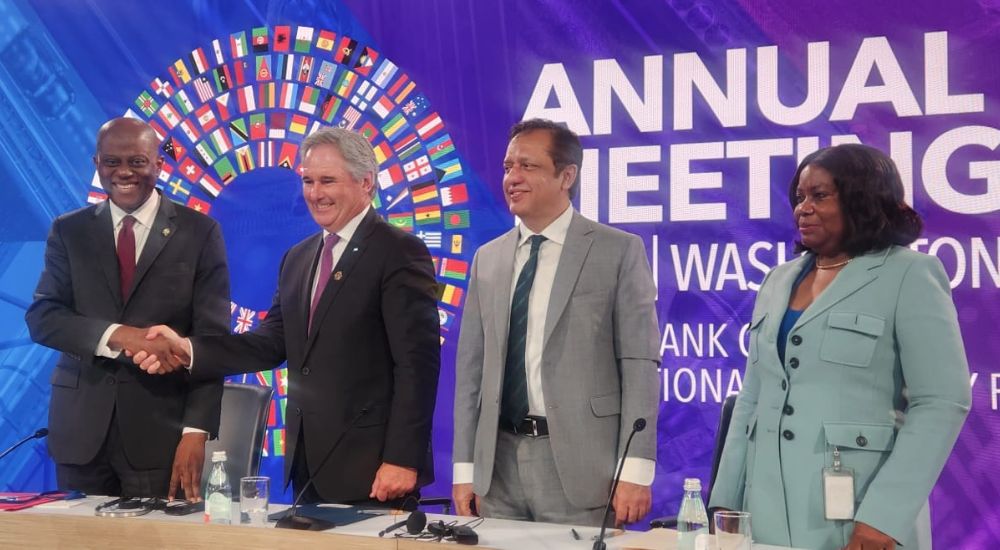
The G-24 is chaired by Pablo Quirno, Secretary of Finance at the Ministry of Economy, Argentina, and had as First Vice-Chair Olawale Edun, Minister of Finance and Coordinating Minister of the Economy, Nigeria, who was represented by Cardoso.
The Second Vice-Chair is Jameel Ahmad, Governor, State Bank of Pakistan, while Iyabo Masha served as the Director of the G-24 Secretariat.
Advertisement
The session was moderated by Pavis Devahasadin, Communications Officer of the International Monetary Fund.
The G24 meeting, held on the sidelines of the IMF and World Bank Annual Meetings, provided a platform for finance ministers and central bank governors from developing countries to discuss strategies for addressing global economic uncertainties, inflationary pressures, and trade disruptions.
Speaking at the session, Cardoso explained that Nigeria’s proactive approach to macroeconomic reform placed it ahead of many emerging economies, insulating it from some of the worst external pressures.
He said, “We were very fortunate, because a lot of the things that needed to be done, we did them much earlier. As a result of that, we were able to create resilience and buffers against potential shocks,” Cardoso said.
The CBN governor noted that despite global headwinds, Nigeria’s growth has performed better than expected.
Advertisement
He attributed this to the administration’s focus on stabilising monetary policy, ensuring fiscal discipline, and improving the business environment.
Cardoso, who participated in the session alongside officials of the International Monetary Fund (IMF) and World Bank, said Nigeria’s engagement at the G24 meeting offered valuable insight into global economic trends and policy coordination among developing nations.
“There was an exchange of ideas that helped global institutions better understand directly from the players what the issues are and where the pain points lie. It was a very effective engagement, and both sides learnt from each other,” he said.
According to him, Nigeria’s economic restructuring has begun to yield measurable benefits, including a more stable and competitive exchange rate, which is encouraging local production and boosting trade performance.
“Now we have a more competitive currency, and as a result, for once, we have a situation where we have a positive balance of trade surplus. We expect it to remain at about six per cent of GDP for some time,” he revealed.
The CBN boss described the trade surplus as evidence that the government’s reform agenda, particularly exchange rate unification, rationalisation of subsidies, and tighter monetary control, is beginning to reposition the economy for sustainable growth.
Advertisement
He also linked Nigeria’s policy success to stronger coordination between fiscal and monetary authorities, adding that the correlation between countries that adopted credible macroeconomic frameworks and those achieving both growth and disinflation was increasingly evident.
“One of the key issues discussed was that macroeconomic policies must be sound and coherent. The data show a clear correlation between those who adopted such policies and those experiencing growth alongside falling inflation,” Cardoso said.
He added that Nigeria’s economic outlook was buoyed by rising non-oil exports and stronger private sector participation, supported by a currency environment that rewards production over import dependence.
While acknowledging that challenges persist, particularly in energy supply and infrastructure, Cardoso maintained that the trajectory of reforms had begun to yield the kind of stability needed to attract investment and create jobs.
Cardoso expressed optimism that with continued discipline and structural reform, Nigeria’s medium-term growth prospects would remain strong.
“What is happening now is a complete restructuring of the economy. The competitive currency is encouraging people to go into domestic production, and that is the direction we want to maintain,” he said.
Participants at the forum also commended Nigeria’s policy alignment and its early response to global challenges, noting that the country’s economic resilience was helping to cushion the impact of volatile commodity prices and external shocks.
Cardoso reaffirmed the CBN’s commitment to maintaining price stability, strengthening the financial sector, and ensuring that reforms translate into inclusive economic gains for Nigerians.