Akobo: Redefining Universities’ Role In Nigeria’s Emerging Economy
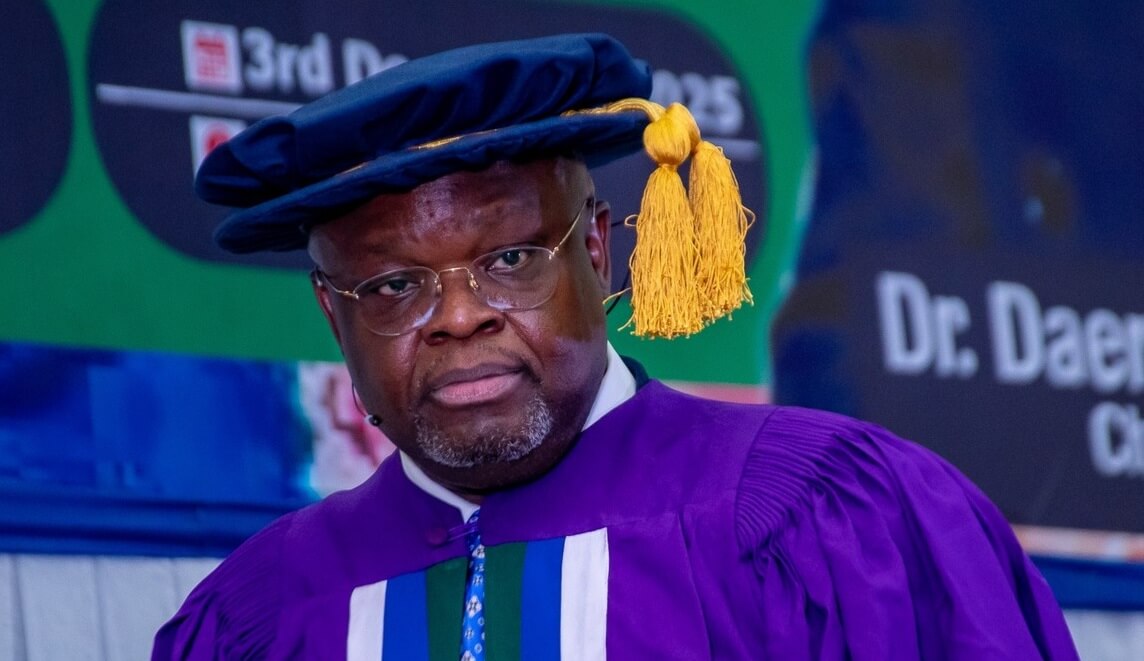
Dr Daere Akobo delivered a lecture at Rivers State University’s combined 37th and 38th convocation ceremony on Wednesday that diagnosed Nigeria’s innovation deficit and prescribed a joint venture model anchored on entrepreneurship, technology, sustainability, and people.
The lecture, titled “Joint University-Industry Ventures: The Entrepreneurship, Technology, Sustainability and People Nexus for Rivers State University,” focused on how Nigerian universities can engage with industries to drive innovation.
“This country is oversized…You need to be innovative. Innovation starts with critical thinking,” Akobo told a packed auditorium of 13,242 graduates at the Nkpolu-Oroworukwo campus of RSU.
The entrepreneur, who earned his first degree in Applied Physics from RSU, used his journey to inspire the graduates and the university’s leadership.
From his early days at General Electric Nigeria, where he was recognised as the company’s top talent in Africa, to building PANA Holdings into a conglomerate spanning energy, technology, telecommunications and real estate, Akobo spoke on the possibilities he believes should be the standard in Nigeria.
He lamented that the country as a whole produces only two patents per million people annually. In contrast, he said institutions like the Indian Institute of Technology Madras (IIT) and Massachusetts Institute of Technology (MIT) have built economic ecosystems around intellectual property and commercialisation.
Advertisement
“How many of you have patents?” Akobo asked the audience.
“Unfortunately, in Nigeria, I did a study. The whole of NNPC does not have more than three patents. In Nigeria, one in every one million people has a patent. In fact, in the whole of Nigeria, only two patents in one million are produced annually.”
Akobo, who is also the founder of PE Energy Ltd, said universities must shift from graduating students based only on exams to graduating them with commercially viable patents.
“How can we move from using tests to graduate students to using patents to graduate students? It is the patent that brings money. When you have patents, people pay for patents. You are off the screen, but your patent is what they are using.”
Akobo envisioned Rivers State University transitioning from producing graduates with theoretical knowledge to producing innovators with marketable intellectual property. He described himself as a commercialisation agent who takes inventions from university laboratories and transforms them into viable businesses.
Advertisement
He recalled that in 2017, he discovered a patent related to agricultural technology and wrote to the late former President Muhammadu Buhari to propose a solution for resolving farmer-herder conflicts in northern Nigeria.
The philanthropist and Forbes Business Council member further spoke on the concept of the ‘triple helix,’ which is a model of innovation anchored on collaboration among academia, industry, and government to drive economic growth, knowledge transfer, and new technologies.
Modern universities, he said, cannot operate in isolation. They must embed industry realities into curriculum design, participate in the co-creation of technology and work with the government to shape policies that support innovation.
Akobo argued that RSU must evolve into a globally competitive knowledge institution comparable to MIT, Harvard and Stanford, not in size but in the quality of ideas it exports to the world. According to him, Nigeria’s economic future depends on universities that can anchor proprietary software, produce commercially valuable patents and nurture innovators who participate in global markets.
“A typical oil and gas industry has more than 750 software, and these software are all developed in India and Pakistan. We cannot make more money without understanding the economies of GDP. And the economies of GDP are all about local goods, what is paid in the country, and what is exported,” he noted.
“If you look at the word MIT, what comes to your mind? Technology. MIT, from the last banking review, they call another world. Because the amount of money the entrepreneurs in MIT have generated, the GDP is bigger than several countries. They call them the 47th world.
Advertisement
“We cannot make money without understanding the economies of GDP,” Akobo stated.
He challenged RSU’s petroleum engineering faculty to develop indigenous software solutions for an industry that currently relies on more than 750 foreign-developed software platforms, each representing lost revenue and missed opportunities for Nigerian innovation.
Akobo further stated that the Rivers State government’s role extends beyond funding. He distinguished between what economists call extractive capacity, which is the government’s ability to collect taxes and mobilise resources, and directive capacity, which is its ability to channel those resources toward national priorities. He called on Governor Siminalayi Fubara to strengthen the latter.
“Do we have state capacity?” Akobo asked.
“Your Excellency, even if you are not here, you are the state governor. Do we have state capacity?”
Akobo recalled visiting IIT Madras in India in his quest to establish Africa’s first data refinery. The institution has attracted hundreds of millions of dollars in research grants from companies like Schlumberger, General Electric and Shell. Its technology park hosts corporate research facilities, and the economic activity generated by its graduates has positioned it as an economic force.
He challenged Rivers State University to pursue a similar transformation by creating a technology hub on campus that would attract corporate partnerships and research funding. The university’s current performance on Sustainable Development Goals indicators shows promise, he noted, particularly in clean energy research, but the challenge is converting academic output into commercial ventures.
“Have you turned this into money? Is there clean water in Rivers State University? Do we have a community water system? You must showcase your talent. Charity begins at home,” he stressed.
Akobo’s lecture further addressed what he called the “mental box” that limits regional ambition. Quoting South African author Steve Biko, he identified self-deprecation and conceptual shame as factors that constrain possibilities.
“When I go to Abuja, I told myself, I cannot fail in Abuja. I cannot see Rivers people not having an office in Abuja. So, I decided I must open an office in Abuja in the heart of Maitama,” he said.
“Also, we should drop that mentality of tearing down people. If you open a company here (Port Harcourt), to be honest with you, you are the first people who want to destroy it. Mental box. We need to get out of it. If you cut your chain, you have freedom. But if you cut your root, you die.”
Akubo’s Port Harcourt office now employs approximately 150 people, all paying taxes in Rivers State. He said it was a deliberate choice he made despite banking and business advantages that favour Lagos. He urged fellow Rivers State indigenes in positions of influence to make similar commitments to developing the region’s economic infrastructure.
The entrepreneur also refuted claims that his father had a connection to President Bola Tinubu due to his success in business.
“Today, I have heard that my father and President Tinubu were very close friends. That’s a lie. My father did not know Tinubu. You know, success can bring a new story. People say that, yeah, my father and Tinubu they are very close friends. My father does not know Tinubu. But I know somebody who knows Tinubu. And you also have that person. So, I take invention, I change the process on how to take that invention to the market,” he said.
In his lecture, Akobo introduced a framework he’s developing into a book, which he described as the Five P’s of business success. He said ‘purpose’ comes first because without clarity of purpose, abuse becomes inevitable. The second is ‘philosophy’, which encompasses the principles and worldview that guide decisions. He said ‘process’ represents the systematic approaches and technology platforms that enable execution. Product, the third P, refers to the solutions and services an enterprise offers, while the fourth P is People.
“Every one of us, including me, started business with people. I saw my younger ones, I employ. I saw my friend’s sister, I employ. Never do so. That is a killer,” he warned.
He also warned graduates against the “three F’s” they must avoid: family, friends and fools. The last category, he explained, includes anyone who punctuates dreams or focuses on problems rather than solutions, including well-meaning colleagues.
Akobo identified the fifth P as ‘Profit and prosperity”, which he said distinguishes between financial transactions and businesses that generate genuine gratitude.
“When you go to shop to buy something, and you give money, if they thank you, that is prosperity. But if you just pay the money and they just collect the money and you go, it’s profit,” he explained.
Speaking further, Akobo cited Steve Jobs’ famous Stanford address and a publication that inspired it, The Whole Earth Catalogue.
The PANA Holdings GCEO said he purchased a 1969 edition of the catalogue in Houston for $10,000 and keeps it as a reminder of Jobs’s closing advice: “Stay hungry, stay foolish.”
“Stay foolish means not a foolish person,” but “Perseverance and Consistency. In a volatile business, you need discipline.”
Akobo challenged the 13,242 graduates to start executing their dreams and not waste time.
“A dream without a deadline is a nightmare. Why will you wait for next tomorrow to begin to think about the day before yesterday?”
Dr Akobo holds postgraduate qualifications from the Federal University of Technology, Owerri, and has completed executive programmes at Harvard Business School, INSEAD, and Manchester Business School.
He was recently awarded an honorary Doctor of Business Management by Obafemi Awolowo University.
— Tayo OLU is the Deputy Editor of THE WHISTLER Newspaper.