
FEATURE: Abuja Metro Saves Commuters Money, But Crowding Raises Health Concern
Jack Ocheme, a resident of Kubwa, first heard about the Abuja Rail Mass Transit(ARMT) also called the Metro Rail, from a colleague last year. He had noticed the colleague who lived on the same route had suddenly stopped following their usual route. Every close of work, the man was always in a hurry.
One day Ocheme asked why.
“I am rushing to meet up with the train,” his colleague answered.
“Which train?” Ocheme fired back.
The colleague explained that he joined the train which passes just close to his house in Dei Dei to work and came back with it in the evening.
“All he does is walk from our office to Wuse, take a N200 taxi to the Metro Station at Church Gate, and then walk to his home. He spends only N400 to go and come back from work,” Ocheme narrated to THE WHISTLER.
For Ocheme, a journalist whose job takes him out daily, rising transport costs had become unbearable. He decided to try the train and has never looked back.
“It’s one of the cheapest means of transportation from my home. Nobody pays a dime. The only thing you do is to get yourself to the train station,” he said.
Advertisement
Ocheme explained that he walks down to the Gbazango Station which is just at the ‘back of his house’ and joins the train.
“From the Terminal Station which is around Church Gate, I take a N300 Taxi to Wuse. Days that I feel like, I take a leisure walk from Wuse to my office in Wuse 2. I do the same while going back home. So I spend only N600 to go to my office,” he stated.
This is a journey that Ocheme says takes him close to N4000 daily. For him, he not only saves money but also finds time for an early walk which is optimally great for his health.
How It Works
THE WHISTLER rode the train from Gbazango Station and observed that the Abuja Metro Line runs a structured route linking suburbs to the city centre.
The first train leaves Gbazango at 7:30am and the second at 9:30am. In the evening, services are at 3:00pm and 5:00pm.
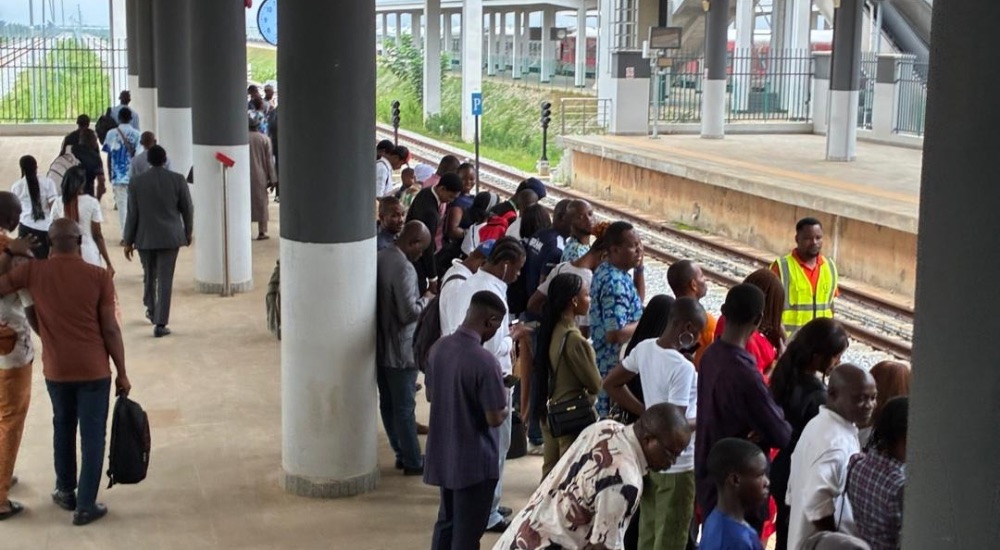
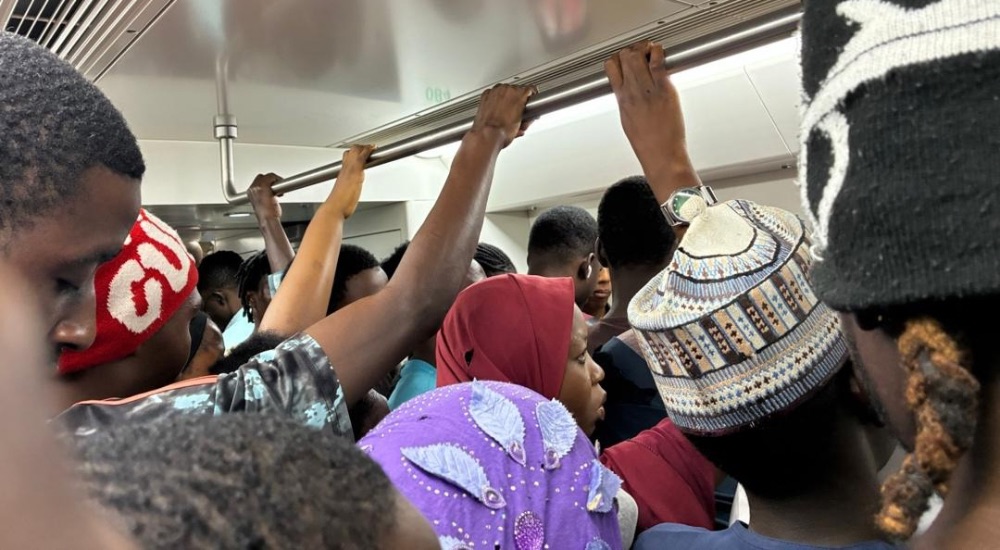
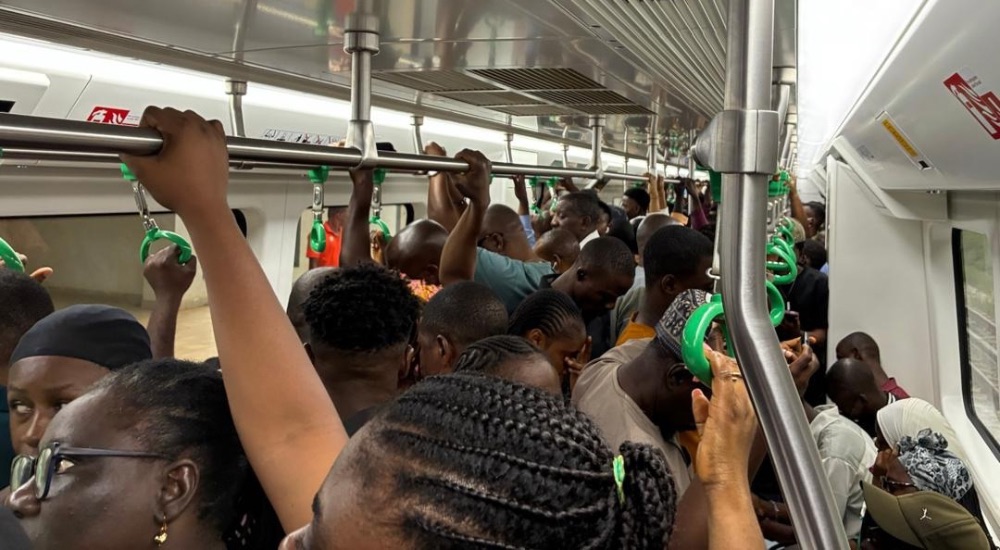
Three minutes after leaving Gbazango, the train arrives at Kagini, then Dei Dei, then Gwagwa, before proceeding non-stop to Idu Station. At every stop, crowds on the platform force their way into coaches that are already full. Seats are taken by early commuters, leaving others to stand for the entire trip, some bracing themselves against walls or holding onto rails for dear life as the train jolts.
Advertisement
At Idu Station, the convergence point, trains from town, the airport and Gbazango meet. Most passengers alight here to change trains. Average waiting time is about 10 minutes. Passengers who have stood all the while pray to get a seat as they rush in to another train; one going to the city center and another heading to the Nnamdi Azikiwe International Airport.
From Idu, the train proceeds to Wupa, then Kukwaba 2. Findings showed Kukwaba 2 records the highest number of boardings on the line. It then moves to Kukwaba 1, then Stadium Station where most passengers disembark. The final stop is Metro Station at Church Gate.
The History
The Abuja Rail Mass Transit was awarded in May 2007 by the Obasanjo administration to CCECC Nigeria Ltd. The plan was a 290km network in six phases, with 60 percent of funding from the China Exim Bank.
The Phase 1, Lots 1A and 3, covers 45.3km and links Idu through Gwagwa-Dei Dei to Gbazango in Kubwa, and also runs to the airport. The former President Muhammadu Buhari commissioned it in July 2018 but operations were later suspended in early 2020 due to COVID-19.
The system was revived under President Bola Tinubu. In September 2023, Tinubu directed the CBN, Ministry of Finance and Accountant-General to release funds for CCECC to complete rehabilitation which was commissioned by the Federal Capital Territory (FCT) Minister Nyesom Wike in May 2024.
As of the restart, the ARMT operates 12 diesel multiple units. Each unit can carry approximately 1,000 passengers. Earlier, the 3 coaches procured had a capacity of 390 passengers, or 130 persons per coach. Services resumed on 29 May 2024 with four trips per day on both lines.
Advertisement
In 2024, Wike announced free train rides for the first two months. However, President Tinubu appealed for the extension to the end of the year. Six months has now turned to two years.
That is how long Anthony Ade has been using the train. Ade, a resident of Kubwa who works at the airport, joins the 7:30am train daily.
He stated that the free train service removed the huge transportation cost burden caused by the removal of petroleum subsidy by the present administration.
“If I were to join the commercial transportation to and fro my office, I would have been spending N4,000 every day. I have saved N4,000 every day in the last two years. I am really happy about this,” Ade said even though most of the times he stands through out the journey.
The Challenges
For Ocheme, Ade and other commuters, the ride comes with serious challenges.
The first is overcrowding. With only two morning trips from Gbazango, coaches fill up within minutes. By the time the train leaves the station, two-third of commuters are already standing. By Kukwaba 2, most passengers are shoulder to shoulder.
“If the number of trips is increased to maybe 10:30 or 11:30, I think it will reduce the rush,” Ocheme said.
Safety and emergency response is another gap. Regular commuters told THE WHISTLER about a man who started gasping for air and collapsed while standing in the overcrowded coach. Passengers rallied around to help, while a lady gave up her seat for him.
But that was not enough; the man began to convulse and one of the passengers had to use a spoon to force his teeth open; a local first aid measure, and held him until the train got to Idu.
THE WHISTLER was also told of a corps member who fainted from standing for too long.
“We asked for First Aid or any medical personnel and there was none,” commuters said.
A staff member at Idu Station, who pleaded anonymity, confirmed that there is no medical facility yet.
“You know it is free for now. There is a room already designated for that, but nothing has taken effect. There is no medical equipment nor medical personnel,” a staff at the Gbazango Station confirmed to THE WHISTLER.
Infrastructure along the track is also a concern. Another commuter, Faith Ararat, recalled an incident around Kukwaba 1 when the train suddenly screeched to a halt, which got many passengers agitated.
“When we looked through the window, we discovered it was a line of goats crossing the track,” she said.
THE WHISTLER observed that while much of the route was originally fenced, some sections have blocks broken, leaving gaps where animals and people access the track.
Accessibility at stations is another problem. Commuters said escalators sometimes fail, forcing persons with disabilities to climb stairs.
“On one occasion, the escalator jerked and caused passengers to start moving backwards instead of forward before staff switched it off. Staff said young passengers run on the escalators to catch seats, damaging the motors. Though it was later fixed,” Ararat stated.
FCT’s Response…
THE WHISTLER contacted the FCTA Transport Secretariat to respond to the issues raised by the commuters. The Director of Transport, Engr. Dr. Akinteye refused to speak.
After a letter of inquiry was routed to him through the secretariat, he said: “Write a letter to the minister’s office.” When the reporter explained that a letter had already been sent to the secretariat, he responded, “You are not serious,” and cut the call.
Experts speak
A transport management specialist, Dr. Chinonye Onah, while speaking on the issue, said the problems reflect both the promise and limits of the project.
He described the free rides as “very, very affordable” but with narrow accessibility.
“It is mostly for people going from the central area to the airport and people connecting to the Kubwa axis. I believe they are just starting. It’s like a pilot project,” he said.
He argued that the two-hour gap between trains drives the crowding.
“If you miss 7:30, you now wait for two hours before you get another one… That’s why it is most of the time crowded,” he said.
Onah also noted the potential of the airport link for integrated transport, but said last-mile buses at stops like Church Gate and Stadium are unreliable outside morning hours.
Also speaking, a public health physician, Dr. Juliette Ango warned that overcrowding carries medical risks.
“In a packed coach, airborne diseases such as TB and COVID can spread quickly, especially when ventilation cannot cope. If the coach is meant to sit 20 but you have 40, the AC might not be able to keep up… you breathe in somebody’s exhaled carbon dioxide,” she said.
That, she said, can trigger asthma attacks or fainting.
Ango recommended that the FCTA deploy on-site health workers stationed at every station to provide first aid and basic checks.
“They should have some form of first aid training for them to handle cases like those the commuters mentioned,” she said.
Her advice to daily commuters is to wear a face mask, avoid running, eat before boarding, and “mentally decongest” to manage the stress.
“You should be able to go to work in a sane and calm environment, not all the rushing,” she noted.