
FG Cuts Out-Of-School Children By One Million In 24 Months
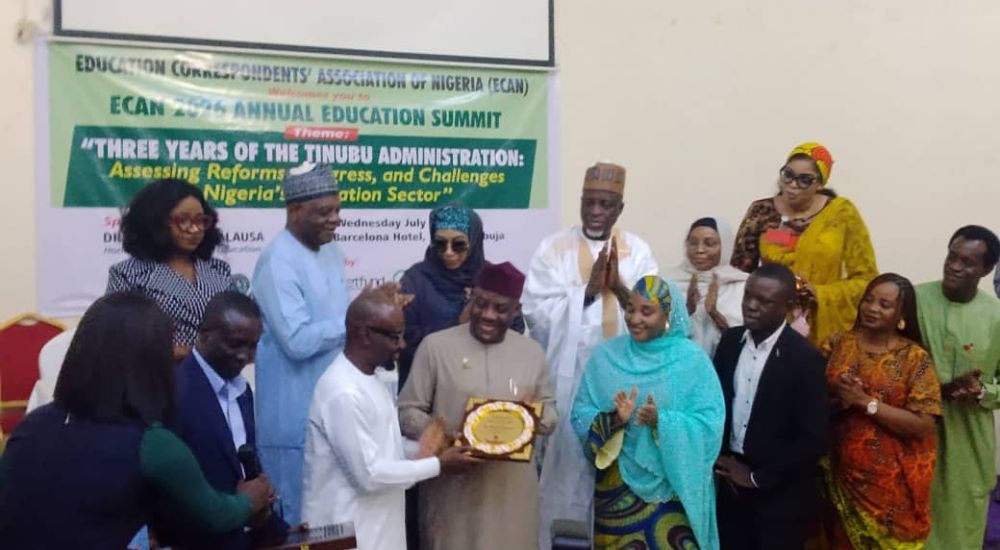
The Minister of Education, Dr Tunji Alausa, says the Federal Government has taken one million children off the streets and enrolled them in school in the last 24 months, leading to a drop in the number of out-of-school children in Nigeria.
Speaking at the Education Correspondents’ Association of Nigeria (ECAN) 2026 Annual Education Summit in Abuja on Wednesday, Alausa said poverty remains the major driver of school dropouts.
He said the estimated number of out-of-school children has reduced significantly from previous figures of between 15 and 17 million.
To sustain the progress, Alausa said the government will roll out five major social safety programmes, including a $500m World Bank credit for community resilience and a $1.2bn HOPE programme covering health, basic education and economic empowerment.
He also cited the Adolescent Girls Initiative for Learning and Empowerment, which has moved over one million girls into school through conditional cash transfers and learning materials.
Advertisement
The Minister said the gains in access are backed by massive infrastructure investments under the Universal Basic Education Commission (UBEC) and Tertiary Education Trust Fund (TETFund)in the last three years.
According to him, almost 88,000 schools have been rehabilitated, more than 6,000 new classrooms built, and 1.7 million instructional materials distributed.
Alausa also charged journalists with using the government’s new education data portal to hold state governments accountable for service delivery.
He said the http://EMIS.education.gov.ng dashboard now provides real-time data on teacher-pupil ratios, facilities and enrolment.
“We need you journalists to go to the website is http://EMIS.education.gov.ng. We need you to use those data to challenge the governors. This is using data for public good. And you are the mouthpiece of the nation,” he said.
Advertisement
On tertiary education, he said the academic calendar has remained stable with no ASUU strike in three years, and that students admitted in 2023 will graduate next year as scheduled.
He added that the reforms have improved global rankings, with 24 Nigerian universities now in the top 1,000 worldwide compared to 21 previously, and 17 of them public.
“Look at up to five years in a row before 2026. We only had 21 universities in the country that made the top 1,000 universities in the world. This 2026, we had 24 universities making that list. And of the 24 universities on that list, 17 of those universities were public universities,” he said.
The Minister further presented 2024-2025 Annual School Census data showing a major transition gap, with almost 25 million children in primary school but only about 5 million in junior secondary school.
He blamed the 20 million drop-off on inadequate JSS facilities and called for an end to the disarticulation policy.
He also announced that teacher professional development has been moved online and that free, zero-rated lessons from Primary 1 to SSS3 are now available, while the UBEC Act is being amended to increase funding from 2 percent to 5 percent.
Advertisement
Also speaking, the Minister of State for Education, Prof. Suwaiba Sa’idu Ahmad said the ministry is driving unprecedented reforms under the Renewed Hope Agenda and described the Honourable Minister as a mentor whose passion for change is unmatched.
She said teacher quality remains central to the reforms, with investments in professional development and the launch of EduRev to give every teacher access to continuous training, while curriculum reviews are embedding AI, digital literacy and entrepreneurship.
Earlier, the Chairman of ECAN, in his welcome address, Mr Chux Ugwuatu, said the summit was convened to assess progress, reforms and challenges in the education sector under the Tinubu administration, noting that education remains the bedrock of national development.
He stated that as education correspondents, their role goes beyond reporting events to partnering in national development through accurate and accountable journalism.
“This summit is not intended merely as a review of government policies. Rather, it’s a platform for constructive engagement, evidence-based dialogue, and the exchange of ideas among policymakers, practitioners, development partners, and the media on how best to strengthen Nigeria’s education system,” he said.
The event was graced by many dignitaries, including JAMB Registrar, Prof. Ishaq Oloyede; TETFund Executive Secretary, Arc. Sonny Echono; and UBEC Executive Secretary, Hajiya Aisha Garba, all of whom received Awards of Excellence from the association.
Also present was NUJ FCT Chairman, Grace Ike and the Special Adviser to the Minister of Education on Media and Communications, Ikharo Attah.