
LPDC Suspends SAN Gadzama For 3 Years Over Client Poaching, Hijack
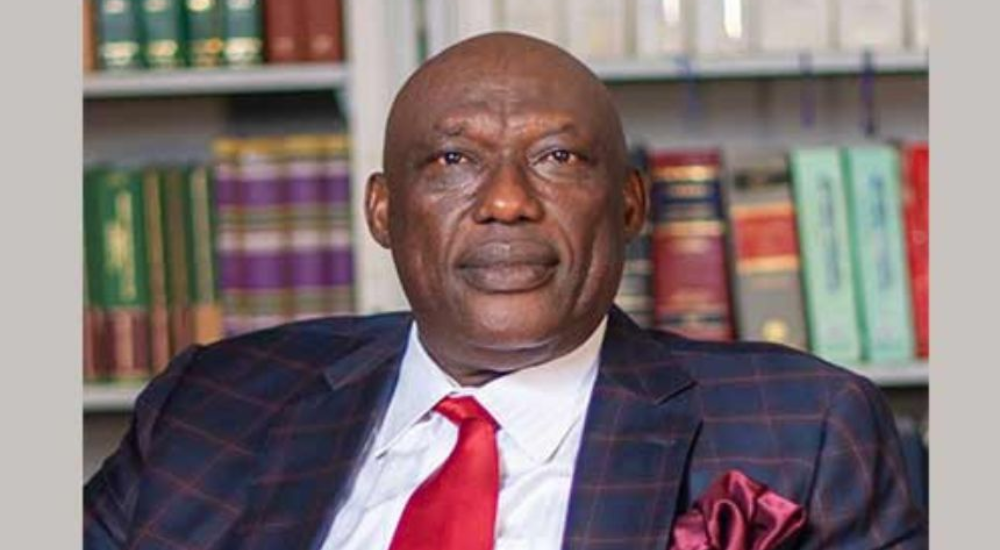
The Legal Practitioners Disciplinary Committee (LPDC) has suspended a Senior Advocate of Nigeria, Joe-Kyari Gadzama, from legal practice for three years after finding him guilty of professional misconduct.
Gadzama was sanctioned for “poaching and hijack of clients” belonging to another lawyer.
In a 70-page certified true copy of the decision obtained by THE WHISTLER, the LPDC held that Gadzama breached Rules 1, 27(1) and 29(1)(b) of the Rules of Professional Conduct for Legal Practitioners, 2023.
The LPDC also suspended a lawyer, Ocha P. Ulegede, from legal practice for 2 years after finding him liable for misconduct in violation of Rule 1 of the Rules of Professional Conduct.
The panel was chaired by Senior Advocate of Nigeria, Mr. Umeh Kalu. The members include Hon. Justice Halima I. Abdulmalik, the Chief Judge of Niger State, and Hon. Justice Halima S. Mohammed, the Chief Judge of Gombe State. Others were Dr. Garba Usman Tetengi and Mr. Solomon Umoh, both Senior Advocates of Nigeria.
The disciplinary proceedings followed a petition filed by a lawyer, Chris Alashi, over the representation of judgment creditors in the prolonged litigation involving compensation awarded after the Zaki-Biam military invasion.
Advertisement
The Zaki-Biam massacre, otherwise known as Operation No Living Thing’, was a Nigerian Army operation in October 2001 that killed hundreds of unarmed Tiv civilians and razed multiple towns in Benue State, in revenge for the killing of 19 soldiers.
The applicant asked the committee to determine whether Gadzama improperly took over clients already represented by Alashi, Ulegede and Sebastine Hon, a Senior Advocate of Nigeria, in the matter.
After reviewing affidavits, court records and documentary exhibits spanning several years, the LPDC concluded that the allegation had been proved.
The committee’s findings focused on the affidavit of the 10th judgment creditor, Mbayemen Masewuan, who alleged that she and other judgment creditors were taken to Gadzama’s Abuja office after being told their compensation would soon be paid.
According to the judgment, Masewuan deposed that they were urged to abandon their existing lawyers because Gadzama would recover the judgment debt for them.
Advertisement
Masewuan further stated that Patrick Twar, in Gadzama’s presence, told her that if she left her lawyers, Gadzama “will be paying me the sum of N20,000.00 per month until the money (Judgment Debt) is paid.”
The affidavit also alleged, “Chief J.K. Gadzama, SAN gave Patrick Twar the sum of N15,000.00 and Patrick Twar handed over the money to me and a pamphlet…”
The LPDC held that, “The above clearly reveals a case of poaching and hijack of clients an act unbecoming of a legal practitioner. It is noted that the 2nd Respondent denied poaching and hijacking of client, but the surrounding circumstance proved otherwise.”
The committee also relied on disclaimer affidavits sworn by several judgment creditors who insisted they never instructed Gadzama to represent them.
One of them, Azenda Igo, the 12th judgment creditor, stated that he and other victims had retained Ocha P. Ulegede, Sebastine Hon, SAN and Chris Alashi to prosecute the appeal and recover the settlement sum.
He deposed, “I… never briefed nor instructed the office of Chief J.K. Gadzama, SAN to file any process and recover the sum of N41.8 Billion or any other amount of money on my behalf.”
Advertisement
He added, “I never briefed nor instructed the office of Chief J.K. Gadzama, SAN indirectly i.e. through anybody whosoever…”
The deponent further reaffirmed, “I… reiterate that my counsel are Messrs Oche P. Ulegede Esq., Sabastine Hon, SAN and Chris Alashi Esq.”
Another affidavit reproduced in the judgment stated, “Chief J.K. Gadzama, SAN is not my lawyer in this matter and I do not have anything to do with him.”
The LPDC said those affidavits strengthened the complaint and noted that despite repeated disclaimers by the judgment creditors, Gadzama continued to act in the matter.
The committee also relied on documents showing that appellants whose names appeared in proceedings later formally withdrew the appeal, stating “This appeal was filed without our authority.”
The appellants further stated, “We have asked J.K. Gadzama LLP to withdraw the appeal but he has refused to do so.”
According to the LPDC, Gadzama continued with the litigation and later sought to amend the appeal by moving some of the applicant’s clients to the respondents’ side despite being served with the withdrawal.
The committee also referred to proceedings before the Federal High Court in which Gadzama acknowledged that some judgment creditors openly denied he represented them.
The judgment quoted him as telling the court, “It is wrong for Ulegede Esq. to announce appearance for all of them. The Court saw the drama this morning when some of the Judgment Creditors stood up and said I am not their lawyer.”
The LPDC said the documentary record did not support Gadzama’s denial of client poaching.
It held, “No Counsel must be seen poaching, hijacking/enticising or wrestling briefs from another counsel.”
It added, “We have traversed the processes and find overwhelming documentary evidence establishing the allegation of poaching and hijacking of client against the 2nd Respondent…”
The committee also examined documents said to have authorised Gadzama to represent some judgment creditors.
It observed that some of the documents relied on by the defence conflicted with other evidence before it, while some signatures appeared irregular.
The LPDC further questioned why certain judgment creditors who denied authorising Gadzama appeared as appellants in proceedings filed on their behalf.
The committee said its findings were reinforced by the Court of Appeal’s decision in Orngu & Ors. v. Gaadi & Ors. (2016) LPELR-42083(CA).
According to the LPDC, the appellate court had found one of the disputed documents unreliable because it carried the signature of a judgment creditor who had died before it was allegedly executed. The Court of Appeal consequently described the document as a forgery and rejected its evidential value.
The LPDC, relying on that decision, held that the documentary record pointed to a sustained attempt to assume control of clients already represented by other lawyers.
The committee stressed that the disciplinary proceedings were not about a litigant’s right to change lawyers but about the professional obligations lawyers owe one another.
It quoted Rule 27(1) of the Rules of Professional Conduct, which provides: “A lawyer shall observe good faith and fairness in dealing with other lawyers.”
The committee also referred to Rule 27(4), which requires an incoming lawyer to notify existing counsel before accepting instructions from a represented client and to use his best efforts to ensure any earned professional fees are paid.
Quoting the rule, the LPDC stated that the incoming lawyer must “use his best endeavours to ensure that the former lawyer is paid his earned fees.”
The committee held that Gadzama’s conduct fell short of those obligations.
It also considered Gadzama’s defence that he acted on the instructions of judgment creditors who retained his services.
While acknowledging that litigants have the right to engage counsel of their choice, the LPDC held that the surrounding evidence did not support his explanation.
According to the committee, “A litigant is free to engage a counsel of his choice but the surrounding circumstance proved otherwise.”
The LPDC, however, declined to uphold some allegations against the senior advocate.
On the allegation that he improperly influenced the court, it found insufficient evidence, holding “We cannot however conclude, that the 2nd Respondent exerted undue influence on the Judge.”
The committee also relied on the Supreme Court’s decision in Ifeogu v. Legal Practitioners Disciplinary Committee (2009), which defined professional misconduct as “any conduct that constitutes an infraction of acceptable standard of behaviour or ethics of the legal profession.”
The LPDC concluded that Gadzama’s actions amounted to professional misconduct under Rules 1, 27(1) and 29(1)(b) of the Rules of Professional Conduct, 2023.
It separately held that Ulegede was liable for misconduct contrary to Rule 1 and ordered his suspension from legal practice for two years.
On Alashi’s request for payment of outstanding professional fees, the LPDC said the issue fell outside its jurisdiction.
It ruled, “Finally, we note that the second prayer of the Applicant is for the payment of his professional fees. We are unable to consider this or even comment on it because this is far beyond the jurisdiction of this Committee. The Applicant can make recourse to the regular Courts for his professional fees.”
Having found both respondents liable, the LPDC ordered “That the name of the 1st Respondent, Ocha P. Ulegede be suspended from the Roll of Legal Practitioners for a period of two (2) years from today.”
It further ordered, “That the name of the 2nd Respondent, Joe-Kyari Gadzama, SAN be suspended from the Roll of Legal Practitioners for a period of three (3) years from today.”
The LPDC directed the Chief Registrar of the Supreme Court to implement the sanctions by making the appropriate notations on the Roll of Legal Practitioners.
Copies of its direction were ordered to be brought to the attention of the Chief Justice of Nigeria, the President of the Court of Appeal, the Chief Judge of the Federal High Court, heads of other superior courts of record, the Nigerian Bar Association, the Attorney General of the Federation, the attorneys-general of the 36 states and other relevant judicial authorities for compliance.