
NHRC Data Exposes Deepening Family Crisis, 7,638 Children Abandoned In 12 Months
…Economic Hardship, Teenage Pregnancy, Stigma, Blamed For Rising Child Abandonment
…Cases Jump 319% In June As Experts Demand Stronger Social Protection System
Child abandonment emerged as the most frequently recorded child-rights violation monitored by the National Human Rights Commission (NHRC) between July 2025 and June 2026, with 7,638 cases reported during the 12-month period.
An analysis of the Commission’s Human Rights Situation Dashboard by THE WHISTLER showed that child abandonment surpassed several other categories of child-rights violations, including child custody, child labour, child abuse, child marriage and sexual abuse.
The dashboard is a regular tracking mechanism used by the NHRC to compile complaints and reported human rights violations received through its nationwide offices and Human Rights Observatory.
The data showed that child custody ranked second, with 6,067 cases during the period, while child labour recorded 4,672 cases.
Advertisement
Other child abuses accounted for 4,515 cases, followed by child marriage with 4,477 cases.
Access to children recorded 4,218 cases, while the right to survival and development accounted for 3,978 cases in the available data.
Sexual abuse recorded 3,779 cases, child trafficking 2,845 cases and violations relating to the right to education 2,165 cases.
The figures, however, should not be interpreted as meaning that 7,638 individual children were abandoned.
The NHRC data records cases or violations and does not establish whether every entry represents a unique child. It is also unclear from the available data whether the same child could appear in more than one case.
Advertisement
Despite the limitation, the scale of reported abandonment cases highlights a major child-protection concern and raises questions about the social and economic pressures facing families across the country.
The monthly figures also reveal a highly uneven pattern rather than a steady increase in child abandonment.
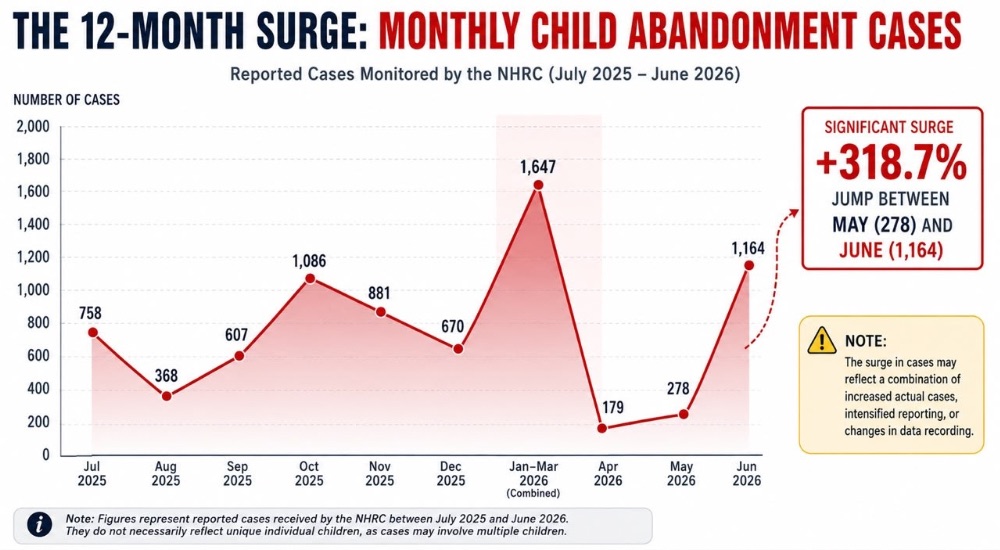
The NHRC recorded 758 cases in July 2025, after which the figure fell to 368 in August.
Cases increased to 607 in September and climbed further to 1,086 in October, making October one of the highest monthly figures recorded during the period.
The number declined to 881 in November and further to 670 in December.
Between January and March 2026, the Commission recorded a combined 1,647 cases of child abandonment.
The figures subsequently fell sharply to 179 cases in April before increasing to 278 in May and then rising dramatically to 1,164 in June.
Advertisement
The June figure was more than four times the 278 cases recorded in May and about 6.5 times the 179 cases recorded in April.
The increase between May and June represents a 318.7 per cent rise in reported cases.
However, the data does not establish what caused the sharp increase.
The jump could reflect a rise in actual cases, increased reporting, intensified monitoring by the Commission, changes in the way cases were recorded or the addition of previously unreported complaints.
It is therefore difficult to conclude solely from the figures that child abandonment itself increased by 318.7 per cent in June.
The monthly data also shows that abandonment was not the leading child-rights violation in every reporting period.
In July 2025, for instance, child custody recorded 961 cases compared with 758 abandonment cases.
By October, however, child abandonment had overtaken custody, with 1,086 cases against 992.
The trend continued in November, when 881 abandonment cases were recorded compared with 840 custody cases.
The gap became significantly wider in June 2026, with 1,164 abandonment cases against 398 custody cases.
Taken together, the figures placed child abandonment ahead of the other categories over the reporting period, even though it did not rank first in every month.
The data has raised questions about the factors driving child abandonment and whether the growing pressure on household finances is worsening vulnerabilities among children.
Co-founder and Chief Operating Officer of the Advocate for Children and Vulnerable Persons Network (ACVPN), Ebenezer Omejalile, said child abandonment should be understood broadly and should not be limited to physically leaving a child.
According to him, abandonment can occur when parents or legal guardians withdraw financial, physical and emotional support without making adequate arrangements for the child’s safety and care.
“Child abandonment is when the parents or legal guardians abandon a child permanently. They stop providing financially for the child, physically and emotionally, and they don’t care for the child without any form of safety arrangement or alternative supervision,” Omejalile said.
He, however, cautioned against automatically labelling parents as offenders based solely on allegations of abandonment.
Omejalile said his organisation adopts an evidence-based approach by examining the circumstances surrounding each complaint and hearing from both parties before determining whether there was an intention to abandon the child.
“Our job is evidence-based. We don’t just work on hearsay. We invite both parties,” he said.
He identified economic hardship, unemployment, inflation and the inability of families to meet basic needs as some of the factors that could push vulnerable families towards abandonment.
According to him, families struggling to afford healthcare, clothing and shelter may become unable to provide adequately for children, increasing their vulnerability to abandonment and other forms of abuse.
“Shelter and clothing and health are the basic rights. So, in terms of unemployment, inflation, unaffordability of families to provide the necessary medical aspect, clothing and then the driving force, the desperate parents…” he said.
His comments point to a broader relationship between household economic conditions and child protection.
Where families lack the resources to meet basic needs, children may face increased exposure to neglect, exploitation, trafficking, child labour and other abuses.
Beyond economic hardship, Omejalile identified teenage pregnancy and the stigma surrounding children born outside marriage as other factors that could contribute to abandonment.
He said young and unmarried mothers, particularly those who become pregnant while still in school, can face pressure from their families and communities.
“Because of the social stigma and also the cultural beliefs, when they give birth out of wedlock, it becomes that they are being shamed,” he said.
According to him, such social pressures can leave young mothers and their children vulnerable, particularly where families refuse to provide support.
He also pointed to harmful cultural beliefs surrounding children as another factor that can contribute to abandonment.
Stigma associated with multiple births and children with disabilities, he said, can expose some children to deliberate rejection or neglect.
Such practices can compound the vulnerability of children who may already require additional care and support.
Rapid urbanisation and migration are also contributing to changes in the traditional family structures that have historically provided support for children, Omejalile said.
He noted that as young people leave rural communities for cities in search of employment, education and other opportunities, the extended-family networks that previously helped parents care for children can become weaker.
“Once young people move away from their rural community, this weakens the traditional family structure,” he said.
The weakening of extended-family support can become particularly significant where parents experience financial difficulties or other crises and can no longer rely on relatives for childcare, accommodation or financial assistance.
In such circumstances, children may become more vulnerable when parents are unable to provide adequate care.
Omejalile also expressed concern about the capacity of the social-welfare system to respond effectively after an abandoned child has been identified.
He said child protection requires coordination among organisations and government agencies responsible for rescue, social welfare, rehabilitation and reintegration.
According to him, rescuing an abandoned child is only the first stage of the process.
“When you have the rescue aspect, I’ve been able to rescue this child, I’ve been able to rescue the situation. You take over,” he said, stressing that agencies must clearly assume responsibility at different stages of the child’s protection.
This, he said, requires a coordinated system capable of moving children from rescue to safe accommodation, rehabilitation, education and, where appropriate, reunification or reintegration.
He also called for stronger government intervention, including financial assistance, childcare support and accessible legal and social services.
“We don’t have robust national government financial aid… to subsidise childcare, accessible, safe programmes and legal assistance programmes,” he said.
The absence of adequate support, he argued, can leave vulnerable families without alternatives when they face financial or social crises.