
UPDATED: Senate Passes N67.32trn 2026 Budget After Upward Revision
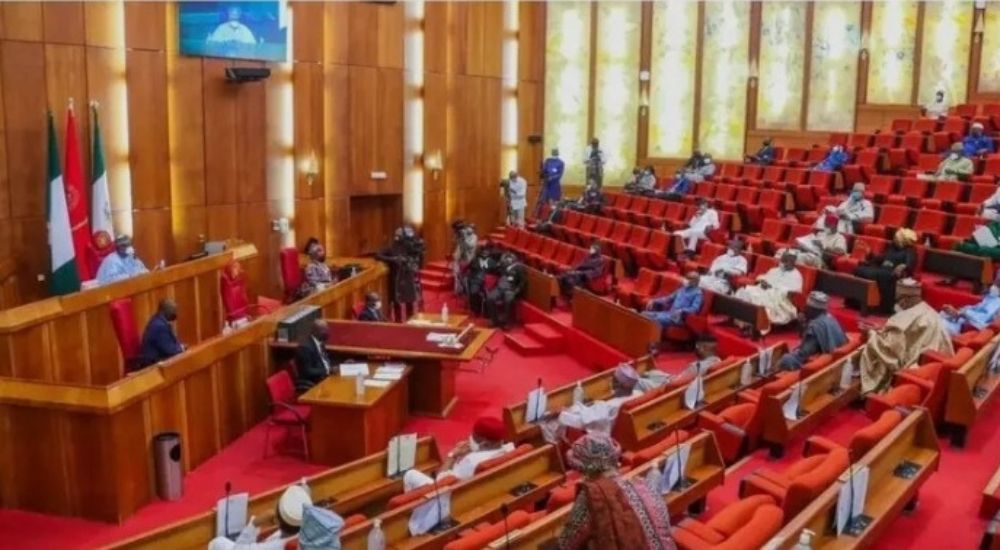
The Senate on Tuesday approved the 2026 Appropriation Bill, raising the budget size to N67. 32 trillion following an upward revision driven by additional spending proposals from the executive.
The approval reflects an increase from the initial N58.47 trillion estimate, after lawmakers granted President Bola Tinubu’s request for an extra N9 trillion.
In a communication to the upper chamber, read at plenary by Senate President Godswill Akpabio, the President said the additional funds would be deployed to finance critical capital projects, including components linked to the 2025 budget cycle.
The Senate also endorsed the President’s request to extend the implementation timeline for the capital component of the 2025 budget from March 31, 2026, to June 30, 2026.
Deliberations on the requests were conducted in a closed session by the senators, before formal approval.
Advertisement
According to the executive, the budget adjustment is aimed at strengthening fiscal transparency, ensuring continuity in priority government programmes.
It added that the adjustment will also ensure the execution of ongoing capital projects tied to the 2025 Budget.
The senators said the expanded appropriation underscores an aggressive fiscal stance, with capital expenditure taking the largest share at N32.29 trillion, followed by N15.43 trillion in recurrent spending, N15.81 trillion for debt servicing, and N4.80 trillion allocated to statutory transfers.
They added that the size and structure of the budget highlight the administration’s continued prioritisation of infrastructure investment as a growth driver.
However, rising debt service obligations continue to exert pressure on public finances, making it difficult for the government to meet some of its key domestic obligations.
Advertisement
Recurrent expenditure remains high, reflecting personnel and administrative costs, while statutory transfers will fund constitutionally mandated institutions, including the judiciary, the budget document said.
The approval incorporates a series of fiscal adjustments submitted by the president, largely targeted at clearing legacy obligations and accelerating strategic projects.
A key component is the provision of N5.71 trillion for capital commitments rolled over from the 2025 budget cycle, alongside N2 trillion earmarked for priority projects across critical sectors.
Under the Ministry of Finance Incorporated (MOFI) framework, N478.60 billion has been set aside for equity investments in rail infrastructure.
The scheme covers light rail projects in Lagos, Kano, Kaduna and Ogun states, as well as feasibility studies for new corridors, including Enugu and Maiduguri.
An additional N8.96 billion is allocated for studies on the Calabar–Maiduguri Corridor and the Maiduguri–Sokoto Superhighway.
Advertisement
In the health sector, the fiscal plan provides $344.83 million (about N482.76 billion) for priority interventions tied to existing bilateral commitments, signalling continued reliance on external partnerships to support sectoral outcomes.
Judiciary allocations were also strengthened, with N98.50 billion earmarked for the Court of Appeal, N36.7 billion for the Supreme Court, and N268.54 billion to enhance overall judicial capacity, including provisions for new appointments ahead of the 2027 general elections.
To finance the enlarged budget, the government is projecting a mix of revenue measures and debt issuance. A $10 increase in the oil benchmark is expected to yield N2.592 trillion in additional revenue.
Similarly, tax reforms in the telecommunications sector are projected to boost corporate income tax receipts, with contributions from major operators like MTN and Airtel estimated at N874 billion.
The fiscal gap will be partly financed through external borrowing of N6.163 trillion, reinforcing concerns around debt sustainability despite the government’s growth-oriented spending strategy.