
When Hospitals Kill You: Nigeria’s Medical Negligence Crisis
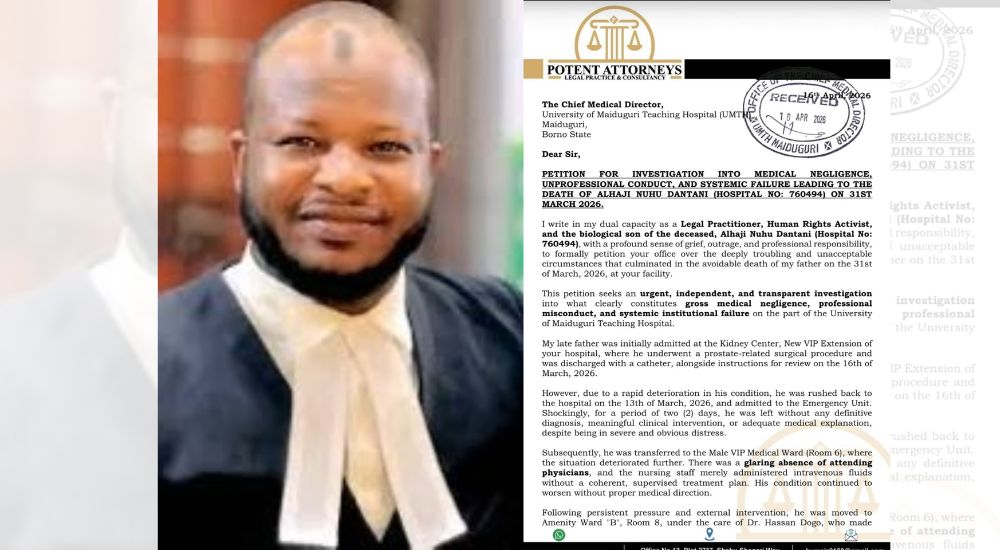
When Alhaji Nuhu Dantani walked into the University of Maiduguri Teaching Hospital’s Kidney Centre for a prostate-related surgery, his family expected the kind of care that a federal tertiary institution is established to provide.
What followed, according to his son, was a harrowing cascade of professional lapses, institutional indifference, and systemic failures — ending in the old man’s death on March 31.
His son, Mr Hamza N. Dantani — a legal practitioner and human rights activist — has since petitioned the hospital’s Chief Medical Director, alleging that a series of avoidable failures killed his father.
Posted on his verified Facebook page (Nuhu Dantani Hamza), his petition is the latest entry in a damning national ledger that continues to grow, year after year, with tragic accounts of patients who check into Nigerian hospitals and never return home.
A Father’s Last Days
Advertisement
The details in the Dantani petition read like a clinical horror story. After being discharged from the Kidney Centre with a catheter and a follow-up appointment for March 16, the patient’s condition deteriorated rapidly.
He was rushed back on March 13 — three days before his scheduled review — and admitted at the Emergency Unit.
For two days, his son alleged, no clear diagnosis was made and no meaningful medical intervention was administered, even as the patient lay in severe distress. Upon transfer to the Male VIP Medical Ward, Dantani alleged there were no attending physicians on duty, while nursing staff confined themselves to administering intravenous fluids — without a coordinated treatment plan in sight.
The petition details more: the patient was eventually moved to Amenity Ward “B” under a consultant who requested the involvement of the Gastroenterology Unit.
The unit, Dantani alleged, failed to respond for over 48 hours. A member of the team reportedly admitted awareness of the referral but failed to act.
Advertisement
The list of alleged lapses continued — mismanagement of a nasogastric tube, failure to conduct timely diagnostic tests, lack of oxygen supply during respiratory distress, delayed detection of chest fluid, and the absence of a functional mobile X-ray machine. On March 31, Alhaji Nuhu Dantani was dead.
“The circumstances surrounding the death,” his son argued in the petition, “constituted a violation of the patient’s right to life as enshrined in the Constitution, and a breach of medical ethics.”
Not an Isolated Incident
What happened in Maiduguri would be shocking if it were exceptional. It is not.
Across Nigeria’s tertiary hospitals, The Whistler has consistently documented an epidemic of medical negligence that cuts across geography, patient demographics, and hospital ownership.
The pattern is depressingly uniform: delayed or absent medical attention, staff absenteeism, poor inter-departmental coordination, and deficient equipment — often culminating in preventable deaths.
Advertisement
In September 2025, the management of the University of Nigeria Teaching Hospital, Enugu, was forced to react to public outrage after Mrs Charity Unachukwu, brought to the hospital following a road accident, allegedly waited over 12 hours for treatment before dying.
The Chief Medical Director cancelled an official foreign trip to personally oversee an investigation that promised to examine emergency admission procedures, laboratory and diagnostic services, and inter-departmental coordination — the very same failures now alleged at UMTH in Maiduguri.
Months earlier, the Abubakar Tafawa Balewa University Teaching Hospital in Bauchi launched its own investigation after a dialysis patient was allegedly abandoned on a blood filter machine while nursing staff socialised outside, her blood spilling to the floor before she died.
Perhaps the most viscerally disturbing episode traced by THE WHISTLER involved a surgical patient in Kano.
On 28 Jan, 2026, The WHISTLER investigated a medical negligence in Kano, where Aishatu Umar, a housewife and mother of five, died after months of excruciating abdominal pain that her family linked to a surgical procedure at Abubakar Imam Urology Centre. It was only two days before her death that detailed tests allegedly revealed a pair of scissors had been left inside her body during the surgery months earlier.
The Kano State Hospitals Management Board subsequently suspended three medical professionals and referred the matter to the Kano State Medical Ethical Committee for disciplinary action.
At the national level, the high-profile case of renowned author Chimamanda Ngozi Adichie brought the crisis into stark relief. Adichie accused Euracare Hospital in Lagos of “criminal negligence” in the death of her 21-month-old son, alleging inadequate monitoring, improper anaesthetic dosing, lack of supplemental oxygen, and delays in responding to his deteriorating condition during a medical procedure.
The Numbers Behind the Deaths
These are not anecdotes against a backdrop of otherwise sound healthcare. They are symptoms of a system in structural collapse.
A 2017 study published in the Archives of Medicine and Health Sciences found a negligence rate of 42.8 per cent among 145 medical practitioners surveyed, with medication prescription errors, laboratory investigation errors, and diagnostic errors as the most prevalent failures — placing medical negligence as the third leading cause of death in Nigeria, behind cancer and cardiovascular disease.
The infrastructure crisis deepens the human one. Nigeria has 66,000 practising doctors — but with a population exceeding 230 million, the country needs at least 400,000 more doctors to meet the World Health Organisation standard of 17 doctors per 10,000 people.
The current ratio stands at one doctor for every 3,474 Nigerians. In 2024 alone, 4,193 doctors and dentists left Nigeria to practice medicine overseas, a brain drain accelerated by poor remuneration and failing conditions — a phenomenon increasingly described as the “Japa Effect.”
The Nigerian health sector received only five per cent of the national budget in 2025 — well below the 15 per cent minimum agreed under the Abuja Declaration.
This year, that share dropped further to 4.2 per cent, even as cholera and diphtheria outbreaks rage. Chronic underfunding keeps salaries low, working conditions poor, and medical professionals abroad.
The consequences are predictable. Nearly 65 per cent of Nigerians have no access to an ambulance during an emergency; families are forced to convey critically ill patients in private cars to hospitals that may turn them away for inability to pay upfront.
The majority of Nigerian hospitals lack basic diagnostic tools, meaning doctors are often forced to make “blind diagnoses” — situations that may technically constitute negligence, but whose root cause is state-induced failure.
A House of Representatives probe launched late last year captured the rot at the apex level: the National Hospital, Abuja — Nigeria’s foremost referral centre — reportedly saw its workforce shrink from 3,000 to 2,500 staff due to brain drain and low morale.
Consultants and doctors were accused of abandoning official duties to moonlight in private clinics during work hours, leading to poor supervision, patient neglect, and preventable deaths.
A Broken Accountability Architecture
What compounds the tragedy is the near-total absence of accountability. Despite the scale of the crisis, many victims remain silent, fearing the complexity and cost of legal action against medical institutions.
To successfully litigate a medical negligence case in Nigeria, a claimant must establish duty of care, breach of duty, causation, and damage — a burden that often requires expensive expert medical testimony and navigating a slow judicial process.
The Dantani petition, in calling for an independent probe and the sanction of culpable personnel, is itself a testament to how rare meaningful accountability is.
Hamza Dantani has warned that failure to act could see him escalate the matter to the Federal Ministry of Health and the Medical and Dental Council of Nigeria (MDCN).
Whether those institutions possess either the will or the capacity to respond decisively is, based on precedent, an open question.
UMTH’s management had not responded to enquiries as of the time of filing this report.
When Hospitals Fail the Living
Nigeria’s medical negligence crisis is not merely a story of bad doctors or rogue nurses. It is the predictable consequence of a healthcare system that has been systematically starved of funding, personnel, and accountability for decades — while political leaders take their own ailments abroad.
For Hamza Dantani, the questions are personal and unambiguous: why was his father left unattended for two days in an emergency unit? Why did a specialist unit ignore a referral for 48 hours? Why was there no oxygen? Why was there no working X-ray machine?
These are not questions unique to Maiduguri. They are the questions that thousands of bereaved Nigerian families ask every year, in corridors from Enugu to Kano, from Bauchi to Lagos — and to which the system, all too often, offers only silence.