
Bakrin Unveils Four-Point Plan To Slash Nigeria’s Production Costs
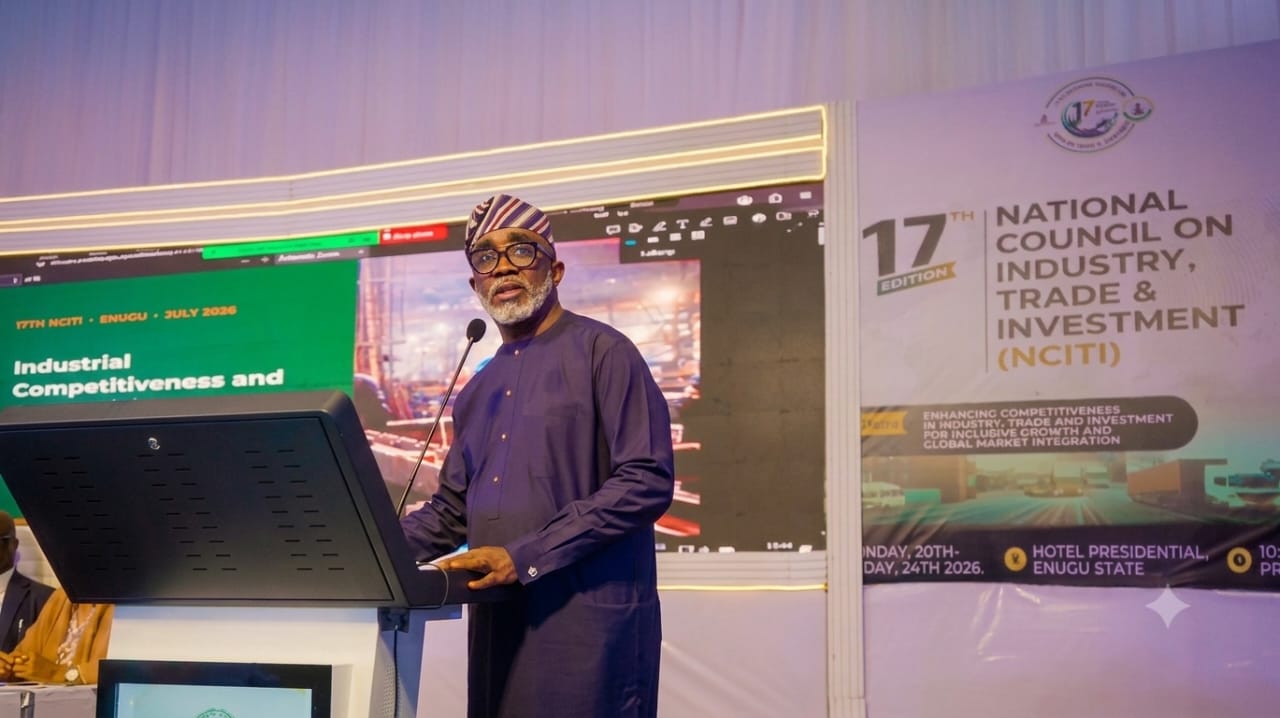
The Executive Secretary of the National Sugar Development Council (NSDC), Mr Kamar Bakrin, has unveiled a four-point plan aimed at reducing Nigeria’s high cost of production, warning that the country must lower the cost of manufacturing or risk losing both domestic and African markets to more competitive economies.
Speaking at the technical session of the 17th National Council on Industry, Trade and Investment (NCITI) in Enugu, Bakrin said Nigeria’s factories currently pay between two and ten times more than competitors in countries such as Vietnam and China for electricity, credit and logistics, making locally manufactured goods less competitive.
He described the situation as a “cost-of-production problem” rather than a demand problem, stressing that the solution lies in deliberate policy actions that lower production costs.
Bakrin illustrated his point by comparing two factory managers—one operating in Aba and another in Ho Chi Minh City—running similar machines with equally skilled workers and targeting the same customers.
According to him, while manufacturers in Vietnam pay about eight US cents per kilowatt-hour for industrial electricity and those in China pay around 10 cents, Nigerian manufacturers pay about 15 cents when connected to the national grid, with costs rising to nearly 30 cents whenever they rely on diesel-powered generators.
He noted that manufacturers spent an estimated ₦1.34tn generating their own electricity last year.
Advertisement
“Every factory in Nigeria is running a second, unwanted business as a private power station,” he said.
Bakrin further disclosed that working capital costs range between 27 and 35 per cent in Nigeria, compared to about nine per cent in Vietnam and three per cent in China.
He also cited the World Bank’s Logistics Performance Index, which ranks Nigeria 88th out of 139 countries, behind Vietnam at 43rd and China at 19th.
According to him, despite having a domestic market of about 230 million people and duty-free access to an additional 1.4 billion consumers under the African Continental Free Trade Area (AfCFTA), manufacturing contributes only about eight per cent to Nigeria’s Gross Domestic Product (GDP), while capacity utilisation has fallen to 57.7 per cent.
“None of this is a demand problem. Nobody on this continent needs persuading to buy what Nigeria makes. It is a cost-of-production problem—and that distinction matters, because costs, unlike demand, are within our power to fix,” he said.
Advertisement
Bakrin argued that the timing for industrial reforms was ideal, noting that recent macroeconomic reforms had restored greater stability, with inflation falling significantly from its peak and external reserves rising to about $51bn, the highest level since 2009.
He said the improved macroeconomic environment gives manufacturers greater confidence to plan and invest, even as global supply chains continue to shift.
He warned that AfCFTA presents both opportunities and risks for Nigeria.
“Either our goods are crossing borders going out, or everyone else’s goods are crossing ours coming in. We are either going to compete, or we are going to concede the market,” he said.
To demonstrate that industrial transformation is achievable, Bakrin pointed to Nigeria’s urea industry, which expanded from about 500,000 tonnes of production capacity in 2005 to 6.5 million tonnes today, making Nigeria one of the world’s top ten exporters of nitrogen fertiliser.
He attributed the success to the decision to price natural gas as an industrial input rather than simply as a revenue source.
Advertisement
“The whole lesson is in one sentence. When a country prices inputs as if it wants industry to live, industry lives,” he said.
He also cited Vietnam’s emergence as a global electronics manufacturing hub and Bangladesh’s garment industry, which generates about $38bn annually, saying neither country relied on natural resources but instead pursued disciplined industrial policies over many years.
Bakrin outlined four measurable targets needed to improve Nigeria’s competitiveness. These include providing uninterrupted electricity to industrial clusters at between eight and 10 US cents per kilowatt-hour, making industrial loans available at single-digit interest rates, reducing port clearance time from the current 18–21 days to less than seven days, and doubling worker productivity by 2030.
“These are not aspirations to admire. They are the line at which a made-in-Nigeria product stops apologising,” he said.
To achieve the targets, he proposed four resolutions for adoption by the Council. He urged every state government to designate at least one industrial cluster for dedicated electricity supply within the next 12 months.
He also called for a federal-state compact to harmonise taxes and levies while removing informal checkpoints along industrial corridors to ease the movement of goods.
Bakrin further proposed the introduction of an annual State Industrial Competitiveness Index that would publicly rank states based on power supply, access to land, levies and logistics performance.
In addition, he advocated strict enforcement of Nigeria First procurement policies at both federal and state levels, supported by quarterly compliance dashboards.
“Every resolution needs a named owner, a date and a way to measure it. Otherwise it becomes another document that gets filed, framed and forgotten,” he said.
He emphasised that government support for industries should be performance-based, arguing that tax incentives, subsidised electricity and government patronage should only be granted where measurable outcomes are independently verified.
He cited the NSDC’s Backward Integration Programme as a model where incentives are tied to verified production outcomes.
“Nothing should be handed out as an entitlement—because once it is, it can never be taken back,” he said.
Bakrin maintained that industrial competitiveness would ultimately be determined at the state level, urging governors to establish electricity markets under the Electricity Act 2023, provide bankable industrial land, consolidate multiple taxes and levies, and align technical education with the needs of industries they seek to attract.
He also backed annual public rankings of states’ investment climates, saying, “We rank our football clubs every weekend. We can manage to rank our investment climates once a year.”
Highlighting the broader economic impact of lower production costs, Bakrin said improved competitiveness would create factory jobs for the estimated four million young Nigerians entering the labour market annually, reduce prices by encouraging local production, strengthen the naira through import substitution and export growth, and spread economic development across all six geopolitical zones.
He described productive employment as the strongest antidote to the growing trend of emigration.
Concluding his presentation, Bakrin urged the Council to begin every future meeting by publicly reviewing six key national industrial indicators: increasing manufacturing’s contribution to GDP to 15 per cent, reducing industrial electricity costs to around 10 US cents per kilowatt-hour, lowering lending rates to manufacturers below 10 per cent, cutting port clearance to under seven days, expanding exports to the 1.4 billion AfCFTA market, and creating productive jobs for the four million Nigerians joining the workforce annually.
“The reform half of Nigeria’s story has been written. The industrial half will be written in kilowatt-hours, lending rates and port days. The window is open. No window stays open forever,” he said.