CSOs Decry “Dangerous Loopholes” In New Electoral Act
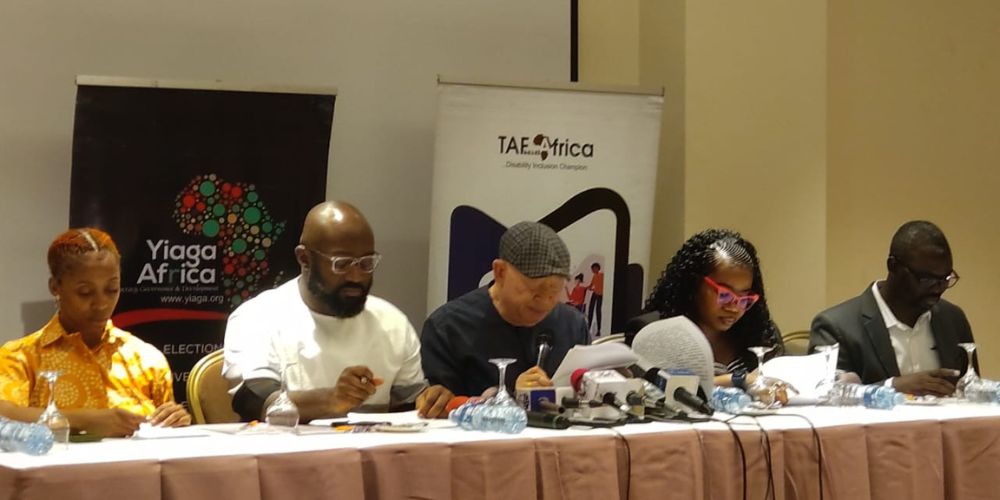
Coalition of Civil Society Organisations (CSOs) have expressed disappointment and concern over the recently passed Electoral Act 2026, describing it as a “missed opportunity” for transformative electoral reform in Nigeria.
Briefing the press on behalf of the CSOs on Thursday, CEO/Founder of TAF Africa, Jake Epelle, condemned the “deeply troubling” manner in which the legislation was processed and passed, citing the speed and opacity of the process.
“We must therefore state clearly and without equivocation: the Electoral Act 2026 that has now been signed into law is a missed opportunity for the transformative electoral reform that Nigeria requires and that Nigerian citizens deserve.
“At a time when public confidence in elections remains fragile, this law should have decisively strengthened transparency, eliminated ambiguities, and deepened safeguards against manipulation. Instead, it creates more vulnerabilities in the electoral process,” he noted.
The CSOs acknowledged some positive provisions in the Act, such as the downloadable voter card, disability-inclusive voter registration, and enhanced penalties for result falsification.
Advertisement
However, they lamented that the law leaves “dangerous loopholes” unaddressed and introduces new barriers to political participation.
Among the concerns raised are the ambiguous language on electronic transmission of results, restrictive provisions on filing reports for election result reviews, a N50 million administrative fee for new political party registration, and limitations on party primaries.
“Electronic transmission of results: Section 60(3) mandates electronic transmission but includes a proviso: if transmission ‘fails as a result of communication failure,’ the physical EC8A form becomes the primary source for collation. This language is unchanged from the version civil society flagged as dangerous. ‘Communication failure’ is undefined. There is no independent verification mechanism. There are no consequences for deliberate sabotage disguised as technical failure. The 2023 elections demonstrated how this ambiguity can be exploited. This loophole will be tested again in 2027 and the Act provides no protection.
“Compressed Timelines for key electoral activities: The review to timelines for the release of notice of elections (300 days), submission of list of candidates (120 days) and INEC publication of list of candidates (60 days) increases logistics risk and puts the electoral system will be under pressure. For instance, shorter timelines for publishing list of candidates will affect production of sensitive materials like ballot papers.
“Restricting the filing of reports to INEC officials to activate the review of election results: Section 65 of the Electoral Act empowers INEC to review election results within seven days where declarations are made under duress or in violation contrary to procedures for result collation prescribed in the Act. The Act provides that all reviews of election shall be conducted only when a report is filed by an INEC official. This provision bars political parties, candidates, accredited observers, and their agents from activating the review process, even where they tender compelling evidence of a manipulated and unlawful results declaration. Restricting the power of review to reports filed by INEC officials, some of whom may be complicit, is against the spirit behind the power of review vested in INEC.
Advertisement
“Section 75(6) imposes a N50m administrative fee for new political party registration. This is not administrative cost recovery; it is a financial moat designed to exclude grassroots movements, youth-led parties, and non-elite political formations from formal competition. It is anti-democratic and anti-constitutional. Political pluralism is a right, not a privilege reserved for those with access to extraordinary capital.
“Mode of party primaries: Section 84 restricts parties to only two options for candidate nomination: direct primaries or consensus. By removing the option of indirect primaries, which, when properly regulated, can offer a more structured and less chaotic selection process, the Act reduces flexibility and pushes parties towards methods that are highly vulnerable to vote-buying (direct primaries) or godfather manipulation (consensus),” the CSOs said.
The CSOs have vowed to vigilantly monitor the implementation of the Electoral Act 2026, calling on the Independent National Electoral Commission (INEC) to immediately release a revised election timetable and conduct a nationwide IReV transmission simulation.
The group also urged political parties to commit publicly to defending electronic transmission and the National Assembly to publish the signed Electoral Act 2026 to ensure public awareness and stakeholder engagement.
Responding to the CSOs’ concerns, House of Representatives spokesperson, Hon Akin Rotimi, said the parliament was intentional about public engagement and involved civil society throughout the review process. He acknowledged that some CSOs were not pleased with the outcome, but assured that the parliamentary process was followed to the letter.
Rotimi welcomed suggestions for INEC to conduct a simulation of the electronic transmission system and noted that Section 63 of the Act mandates electronic transmission of results. He also promised that the National Assembly would publish the Electoral Act 2026 soon, as required by the Acts Authentication Act.
Advertisement
The spokesperson assured that the 10th Assembly would continue to work towards regaining the trust of Nigerians, emphasizing that democratization is a process and there are opportunities for future amendments to the Electoral Act.
The briefing was organised by prominent CSOs; Centre for Media and Society (CEMESO), The Kukah Center, International Press Centre (IPC), ElectHer, Nigerian Women Trust Fund, TAF Africa and Yiaga Africa.