
Despite Farmers-Herders Clashes, Agric Sector Output Hits N211.2tn
…Crop Production Accounts For N163.1tn Amid N10tn Post-Harvest Losses
…Insecurity, Poor Mechanisation Cripple Sector’s Potential —Experts
Nigeria’s agricultural sector contributed over N211.2tn to the Gross Domestic Product (GDP) between 2023 and 2025, despite annual losses estimated at N3.5tn, according to data from the National Bureau of Statistics (NBS).
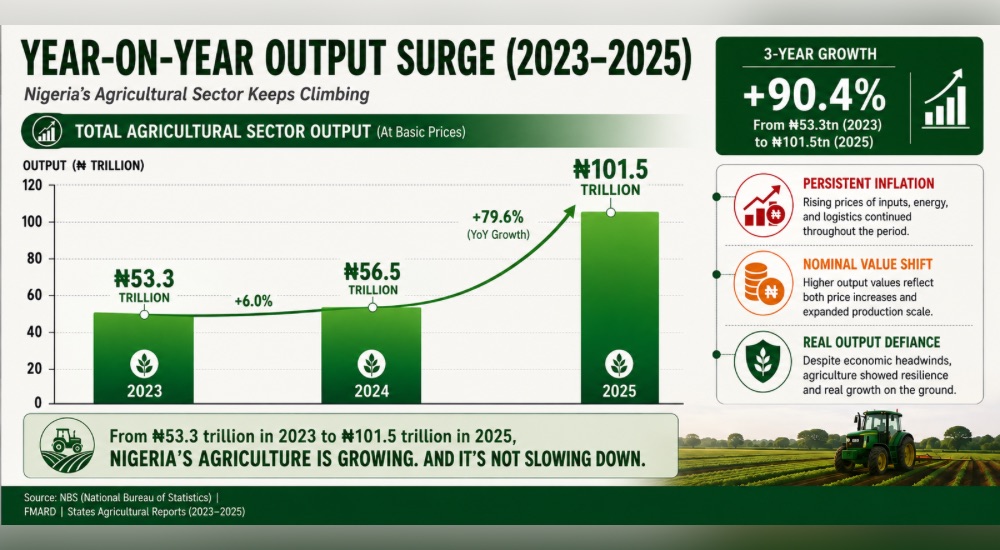
Data obtained from the NBS and analysed by THE WHISTLER showed that the sector contributed N53.3tn in 2023 and N56.5tn in 2024.
The contribution rose sharply in 2025, when the sector recorded N101.5tn across the four quarters.
Further analysis showed that crop production accounted for the largest share of the sector’s contribution throughout the three years, while livestock, fishery and forestry recorded much smaller contributions.
Advertisement
Between 2023 and 2025, crop production contributed N163.1tn, livestock N31.2tn, fishery N9.6tn and forestry N7.4tn.
Crop production accounted for about 77.2 per cent of the combined contribution, followed by livestock at 14.8 per cent, fishery at 4.5 per cent and forestry at 3.5 per cent.
Despite crop production accounting for N163.1tn of the sector’s contribution, Nigeria continues to lose billions of naira annually to crop infestation and post-harvest losses.
In September 2025, the Minister of Agriculture and Food Security, Senator Abubakar Kyari, disclosed that Nigeria lost N3.5tn annually for three years, from 2023 to 2025, amounting to N10.5tn.
According to him, the recurring losses highlight persistent pest attacks on crops and inefficiency in tackling post-harvest losses needed to improve food security.
Advertisement
Similarly, in 2024, the country suffered 70 per cent losses in ginger production due to ginger blight, a disease that attacks ginger.
A report published in the Journal of Agriculture and Economics also disclosed that Kano State lost N157.8bn to crop infestation in 2023.
Seeking an explanation for the continued losses caused by pest infestation and other challenges in the agricultural sector, THE WHISTLER contacted the Chief Executive Officer of the Centre for the Promotion of Private Enterprise (CPPE), Muda Yusuf.
Yusuf said Nigeria’s agricultural sector contributes about 23 per cent to the country’s GDP, making it the largest contributor among the major sectors, but insecurity, poor mechanisation and weak storage infrastructure continue to limit its potential.
He said the sector, which is also one of the country’s largest employers of labour, could contribute more to the economy if longstanding challenges affecting farmers were addressed.
He identified low productivity, insecurity and poor supply chain connectivity as major factors responsible for persistent post-harvest losses and reduced agricultural output.
Advertisement
According to him, many Nigerian farmers still rely on hoes and cutlasses, resulting in low productivity despite the sector’s contribution to the economy.
“What we are getting from agriculture now is even less than what we should be getting. If productivity increases through technology and improved farming methods, output will be much higher,” he said.
Yusuf described insecurity as the biggest threat to agricultural production, noting that many farmers in parts of the Middle Belt, Borno and Kwara states have abandoned their farmlands due to persistent attacks.
“The government should address security. If security improves, more people will return to farming,” he said.
He also urged the government to accelerate agricultural mechanisation by making tractors and other modern farming equipment available to farmers, saying continued dependence on manual farming is limiting productivity.
On post-harvest losses, Yusuf stressed the need for improved storage facilities and stronger support for agricultural research institutes to develop and promote practical storage solutions for farmers.
He noted that inadequate electricity supply has made conventional cold storage difficult, urging research institutions to intensify efforts to educate farmers on alternative preservation methods.
Yusuf also identified limited access to affordable financing as a major challenge confronting farmers, noting that commercial lending rates of about 30 per cent are too high for agricultural businesses.
He urged the government to expand access to cheaper agricultural credit through institutions such as the Bank of Agriculture to enable farmers to invest in production and reduce post-harvest losses.
“The government should also help them with financing, possibly through the Bank of Agriculture and so on,” he added.
Speaking on poor foreign earnings from agricultural produce, Yusuf said Nigeria’s low agricultural productivity and poor mechanisation are major factors limiting the country’s export earnings from the sector.
He said although Nigeria exports cash crops such as cocoa, sesame seeds, cashew nuts and leather products, the volume remains inadequate because most farm produce is consumed locally due to low productivity.
According to him, increasing productivity through improved mechanisation and stronger government support for farmers would boost agricultural exports and foreign exchange earnings.
“The productivity level is still very low. After domestic consumption, there isn’t much left for export because we do not produce enough,” he said.
He further stressed that the government should strengthen the agricultural supply chain by supporting the movement of produce from farms to processors, enabling value addition before export.
“The value chain also needs to be strengthened so that agriculture can contribute more to export revenue,” he added.
On concerns over fertiliser use and complaints that some fertilisers contribute to early spoilage of crops, Yusuf attributed the problem largely to inadequate knowledge among farmers rather than the quality of fertilisers.
He explained that different crops and soil types require different fertilisers, stressing that many farmers lack the technical knowledge to apply them correctly.
“There is a need for a lot of education on the kind of fertiliser to use because different crops and different soils require different fertilisers,” he said.
He called for the revival of agricultural extension services to educate farmers on fertiliser application, improved seedlings, mechanisation and other modern farming practices.
According to him, extension officers previously visited farming communities to train farmers, but such services have largely disappeared.
“We need investment in extension services. They should go round the villages educating farmers on fertiliser use, improved seedlings, tractors and other modern farming techniques,” he said.
Also speaking to THE WHISTLER, Dr Adiya Ode, Country Representative and Political Director of Propcom+, said post-harvest losses occur at virtually every stage of the agricultural value chain, from the farm to the final consumer.
Ode said poor rural roads remain one of the biggest barriers to moving produce from farms to markets.
According to her, Nigeria can reduce its estimated annual post-harvest losses, which account for about two per cent of its GDP, by improving rural roads, transportation, storage, processing and market access.
She said many smallholder farmers lack vehicles and have to wait for transport before evacuating their produce, increasing the risk of deterioration.
She called for greater private-sector investment in agricultural transportation, stating that aggregators who collect produce directly from farms can help reduce losses by moving harvests to markets promptly.
“Rural infrastructure is a public good and it’s something that the government should invest in,” she said.
Beyond transportation, Ode identified multiple checkpoints, taxes, security delays and poor transit infrastructure as major contributors to losses, particularly for perishable commodities.
She said delays along transport routes increase the time produce spends in transit, allowing fruits and vegetables to deteriorate before reaching their destinations.
She also identified inadequate cold-chain facilities as another major cause of post-harvest losses, stressing that perishable produce often sits in markets without proper temperature-controlled storage.
She called for increased investment in cold storage, warehouses and improved preservation techniques to reduce losses and discourage the unsafe use of chemicals by traders attempting to keep produce fresh.
She also stressed the importance of processing facilities located close to farms, saying early processing could extend shelf life, reduce the weight of produce transported and minimise storage-related losses.
Ode further identified inadequate access to electricity as a major constraint to processing and storage investment, urging the government to expand access to solar technology and other alternative energy sources.
Speaking on climate change, which also worsens post-harvest losses, she said agricultural agencies and private-sector organisations should strengthen extension and e-extension services so farmers can receive early warnings about pest outbreaks and information on appropriate crop protection measures.
Ode also said Propcom+ had supported aggregators, processors, seed companies and women’s cooperatives with transportation, mechanisation and solar-powered processing equipment.
She said such interventions had helped farmers process and evacuate produce faster while improving their access to markets.
She further urged investment in quality and climate-smart seeds, saying farmers need access to varieties that are drought- and flood-resistant, early-maturing and less vulnerable to spoilage.
Speaking on the low contribution of the fishery subsector, Prof. Sonnie Oniye of the Department of Biological Sciences, National Open University of Nigeria, said Nigeria produces only about 1.2 million metric tonnes of fish annually, leaving a significant supply gap despite the country’s vast rivers, lakes and coastline.
Oniye said Nigeria spends more than $1bn annually importing fish because local production cannot meet the country’s estimated demand of 3.2 to 3.6 million metric tonnes.
He attributed the poor performance of the sector to pollution, overfishing, insecurity, inadequate fishing technology, expensive inputs, poor infrastructure and weak policy implementation.
According to him, pollution from oil spills and urban and industrial activities has severely depleted fish stocks in parts of the Niger Delta and other inland waters, destroying the livelihoods of fishing communities.
He also said insurgency around Lake Chad had disrupted fishing activities, while illegal fishing by foreign vessels continues to deplete Nigeria’s marine resources.
Oniye said aquaculture, which could help close the production gap, is also constrained by the high cost of fish feed, poor access to quality fingerlings, inadequate water supply, diseases and expensive equipment.
He noted that feed alone accounts for about 60 to 75 per cent of catfish production costs, making fish farming increasingly expensive.
Like other areas of agriculture, the expert identified poor roads and high transportation costs as additional challenges to fish production in rural areas, as produce must travel long distances to reach urban markets.
He also blamed inadequate electricity and processing infrastructure for limiting the development of the sector, particularly in fish drying, preservation, cold storage and packaging.
Oniye urged the government to improve rural roads, provide electricity and storage facilities, reduce duties on essential fishing and aquaculture equipment, and establish modern jetties and processing facilities along the coastline.
He further called for stronger enforcement against illegal fishing and improved surveillance of Nigeria’s territorial waters through modern vessels, aircraft and satellite technology.
On policy, Oniye said Nigeria does not necessarily need more policies but stronger implementation and monitoring of existing ones.
“Policies are documents; they remain documents until they are implemented,” he said.
He added that increased access to affordable credit, improved extension services and greater private-sector investment could help expand local fish production and reduce Nigeria’s dependence on imports.