
How Zuba Traders Generate Millions From ‘Tax’
…LG Makes N5.5m As Revenue
….Market Leaders Seek Local Government Intervention To Rehabilitate Roads.
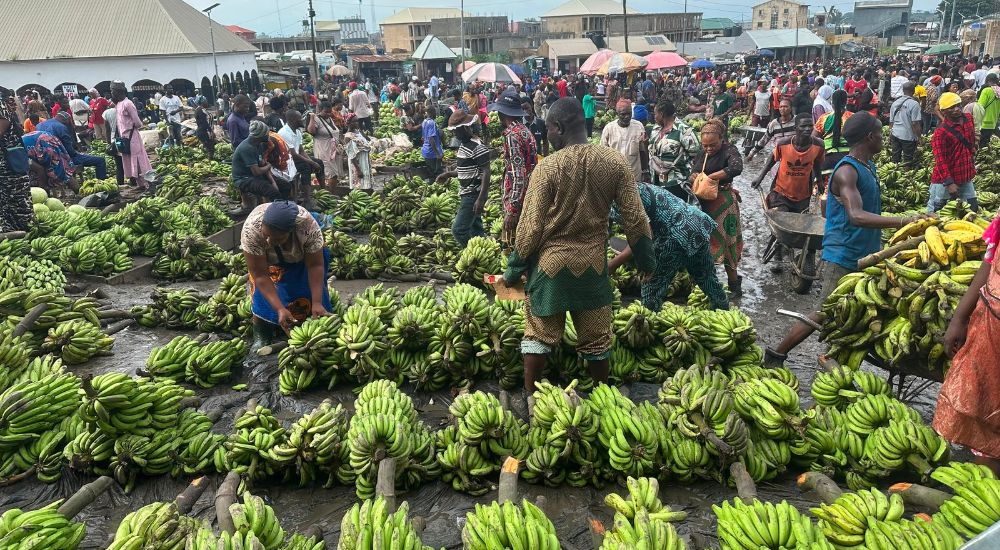
By 6:30 a.m., the Zuba Fruits Market comes alive, not with the arrival of trucks, but with the first bargain of the day.
The fruits are already there.
Every bunch of plantain (arranged in dozens), watermelons, a crate of pineapple, a basket of oranges and a pile of bananas (arranged in sets of three) that would be traded had been delivered and offloaded the previous night. Under the cover of darkness, apprentices work tirelessly to sort the produce into dozens and neatly arrange them for the day’s business.

Advertisement
As dawn breaks over Zuba, a bustling community in the Gwagwalada Area Council that shares a boundary with Madalla in neighbouring Niger State, retailers begin arriving from Abuja and beyond. They walk through the market inspecting the neatly arranged fruits, but no transaction takes place until exactly 6:30 a.m.
Then, almost instantly, the atmosphere changes.
The once calm market erupts into a chorus of bargaining voices. Buyers negotiate prices. Wheelbarrow pushers position themselves to move purchases. Registered dealers dart from one customer to another, striking deals in quick succession as hundreds of transactions begin simultaneously.

To the untrained eye, the men negotiating prices appear to own the towering heaps of fruits spread across the market. But they do not!
Most of them are commission agents, registered dealers informally known as Lali, who neither cultivate the farms nor own the produce they sell. Instead, they act as intermediaries between farmers or suppliers and retailers, earning a commission known as ‘Ladda.’ This practice has quietly sustained livelihoods in one of the Federal Capital Territory’s busiest fruit markets for decades.
Advertisement
It is a business model in which trust is the currency, reputation is the capital, and relationships determine who prospers.

According to a Gwagwalada Council official who did not want his name disclosed, the market remits about N5.5m monthly to the local government, although the exact figure depends on assessments by the market’s consultancy management.
The revenue is generated through ‘tax’ on every truck or van bringing produce into the market. Every truck pays N10,000 each, with as many as 50 trucks and vans entering the market on a busy day.
The market currently has about 360 registered dealers, each working with an average of 20 apprentices, creating thousands of direct and indirect jobs. To be registered as a dealer in the market, a fee of N200,000 is charged, an indication of the volume of business generated in the market.

Advertisement
For Jimoh, one of the market’s registered dealers, every trading day begins long before the market officially opens.
While buyers are still on their way to Zuba, he and his team alongside other traders have already completed hours of work.
Around him are about 15 apprentices, each assigned a role in preparing the produce for sale. Throughout the night, they arrange bunches of plantains into dozens according to size, ensuring the fruits are ready before the first retailer arrives.
“We are agents to our suppliers,” Jimoh told THE WHISTLER. “When they supply us the goods, we help them to make sales and after sales, we don’t collect anything from them. We make our money from the tax we add for the customer.”
Jimoh has about 15 other boys working with him alone. It’s the boys that are in charge of arranging the plantain in dozens of sizes ahead of sales. And it is done overnight.
Unlike conventional traders, Jimoh does not buy the fruits he sells. Instead, farmers and suppliers from different parts of the country consign their produce to him, trusting that he will find buyers, negotiate favourable prices and remit the proceeds after every sale.
His responsibility, he explained, is to ensure the owners do not suffer losses.
“When they supply us, our own responsibility is for us to sell it for them to their satisfaction. So as not to record losses. We are not paid remuneration by the suppliers, but from the buyers.”
That payment is what gives the business its identity.
Known in the market as Ladda, it is a 10 per cent commission paid by retailers after every successful transaction.
“Now when we sell to traders at Zuba, they pay us 10 per cent of the total sum. So, for every N1,000 we are paid N100. That fee is called ‘Ladda’,” Jimoh explained.
The commission does not come from the supplier’s earnings. Rather, it is added to the total cost paid by the retailer. If produce worth N4m is sold, the supplier receives the full value of the goods, while the buyer pays an additional 10 per cent commission to the agent.
“So, if we make roughly N4m from a supply of J5 van, our profit is N400,000 and when sales are good or during scarcity, I sell about two vans at a higher cost.”
Jimoh noted that the commission is not personal income alone but sustains an entire chain of workers whose livelihoods depend on every successful sale.
“So, from that ladda, I settle my workers that help get the work done,” he said.
Running the business also comes with operational costs.
According to another Lali, who identified simply as Udoka, every vehicle bringing produce into the market pays N10,000 to the market management before offloading. The payment, he said, is receipted and used for maintaining the market.
“So, for every J5, we pay N10,000 and the money is remitted to the office. These N10,000 are paid for market maintenance. We have a chairman and we have the executive members who are elected. They run the affairs of the market.”
The cost of moving fruits does not end there. Labourers engaged in offloading are paid N50 for every dozen 12 bunches handled, with the cost sometimes borne by suppliers and, in other instances, by the commission agents themselves.
Wheelbarrow pushers also form an indispensable part of the market’s economy. At times, not all the drivers like to enter the market. This is when the services of wheelbarrow pushers are needed. Each dozen costs N200. A J5 van carries between 40 and 50 dozens, depending on the product’s size.
Beyond clearing waste and maintaining order, the revenue generated within the market also supports routine maintenance.
“The stick of plantain (Peduncle) that is cut after daily sales, the market authority packs them every day and it’s from the revenue we pay,” says Udoka.
“And apart from that, if there’s any place in the market that needs maintenance, the revenue covers it.”
Yet, as the morning rush intensifies and another round of negotiations begins, Udoka insists that the most valuable asset in the market cannot be found on any truck or among the towering stacks of fruits.
It is something far less visible. Trust.
If Ladda is the engine that powers business in Zuba Fruits Market, trust is the fuel that keeps it running.
For Udoka, years in the business have taught him that securing suppliers has little to do with luck and everything to do with integrity. While many assume commission agents spend their days searching for farmers to supply them with produce, he said the opposite is often the case.
Building trust with suppliers, he explained, ensures that business keeps coming.
“Customer sourcing. It used to be by luck. And at the same time, it used to work with connections,” he said.
“Some people are fortunate to have customers. While some, no matter how long they have been in the market, will not have customers. Also, transparency and truth make connection easier. And I have many of them.”
Unlike many conventional businesses where sellers actively pursue customers, Udoka said most of his suppliers now seek him out because of the confidence they have built in his honesty.
“If you are truthful and sincere to these farmers or traders, they source for you, not the other way round. 90 per cent of my customers do not come with the goods; they prefer waybill.”
According to him, once suppliers are convinced that their produce will be sold at the right price and that every naira realised from the sale will be remitted, they continue to entrust more goods to the same dealer.
He said the reputation of a commission agent often determines whether suppliers introduce other farmers and traders to them.
“For instance, a plantain worth N4m is sold and the same amount is remitted to the owner. It can only bring smiles to these traders. Now you have built trust, and that becomes the currency for getting suppliers or goods. There is no way this person will not introduce someone else to you.”
Udoka acknowledged that not every dealer operates with the same level of integrity, saying, “There are some people that will still sell such goods, and the seller on the ground will take out N500,000 or more and remit the balance.
“When you are stealing from your customers or suppliers, there is no way you will enhance your growth. And some people are stealing from their customers.”
He believes honesty, even at personal cost, delivers greater rewards over time.
“In other cases, there are people who will not even steal from their customers. They would rather add from what they have to their customer’s money to please them. So, when that supplier has that maximum trust in you, they will keep referring people to you.
The Risks Behind the Rewards
Despite describing the trade as lucrative, Udoka said the business is not without risks.
One of the biggest challenges, he explained, arises when dealers send money to suppliers outside Abuja to purchase produce.
Without a centralised system that registers and verifies suppliers across states, recovering money lost to fraudulent suppliers can be difficult.
“We often have suppliers who run with our money when we send for them to buy goods for us and, because there is no regulated system with registered members across states, we oftentimes can’t recover our investment.
“So, this has made us limit ourselves to selling for them, rather than incurring losses’ he bemoaned.
The experience has compelled many commission agents to avoid financing purchases directly. Instead, they now prefer that suppliers retain ownership of the goods until after sales are completed.
Moving Fruits Across States
Transporting fruits into Zuba is another carefully coordinated process.
Isa Kabiru, another Lali explained to THE WHISTLER that once a supplier secures produce from the farm and loads it onto a vehicle, the commission agent is contacted to pay part of the transportation cost before the journey begins.
“There are different ways transportation is sorted in this business. If a supplier intends to send goods to you, after loading the van, they call you to offset a 50 per cent deposit to the driver. This method enables commitment to tracking the goods.
“Now after the sale of the goods is made, we deduct the transportation fee and remit the balance.”
Rather than dealing directly with unknown drivers, suppliers often rely on transport coordinators known within the trade as “shattermen”, who serve as intermediaries between farmers and transporters.
For Kebiru, the combination of trust, established relationships and a structured transportation system has enabled the business to flourish despite the absence of formal contracts.
Yet, while the Ladda commission system has become the backbone of plantain and banana trading in Zuba, not every section of the market operates the same way.
The trading model changes with the fruit.
While the Ladda commission system defines transactions in the plantain and banana sections of the Zuba Fruits Market, the model is not universal across the sprawling trading hub.
Different fruits are traded under different arrangements, reflecting the unique nature of their supply chains.
For watermelon dealers, the commission structure does not apply in the same way.
Unlike the plantain and banana sections where registered dealers (Lali) act as intermediaries between suppliers and retailers, watermelon traders assume both the risks and rewards of the business.
In this section, the traders purchase the produce directly from farmers and become the owners of the goods. They bear any losses arising from unsold or damaged produce and keep whatever profit is realised from the sales. As a result, the commission known as Ladda is factored into the cost of the goods rather than charged separately to buyers.
The pineapple section operates differently.
Here, the owner of the produce does not participate in the sale. Instead, the goods are handed over to a registered commission agent, the Lali, who oversees the entire transaction on behalf of the supplier.
At the end of the day’s sales, the agent deducts 10 per cent of the total proceeds as commission and remits the balance to the owner.
For instance, if pineapples worth N1m are sold in a day, the agent retains N100,000 as Ladda and pays the remaining N900,000 to the supplier.
The distinction, THE WHISTLER gathered, lies in how the commission is earned.
In the plantain and banana sections, retailers pay the additional 10 per cent commission separately after purchasing the produce, ensuring the supplier receives the full value of the goods. In the pineapple section, however, the commission is deducted from the total proceeds realised after sales.
More Than A Trading Arrangement
For the leadership of the market, the Ladda system is more than a trading arrangement.
It is a livelihood that has employed hundreds of young Nigerians while sustaining one of the Federal Capital Territory’s busiest agricultural markets.
Prince Aliyu Usman Alade, National Public Relations Officer of the Nigeria Fruit Sellers Association told THE WHISTLER that the commission system has existed almost as long as the market itself and has become an important source of income for many families.
According to him, the market attracts more than 10,000 visitors daily, with Mondays recording the highest volume of activity.
The market’s economic impact extends beyond registered dealers. Wheelbarrow pushers, loaders and apprentices also earn a living from the daily movement of goods.
“For instance, the wheelbarrow pushers make at least N5,000 daily. When you multiply that by 30 days, it’s about N150,000. And they make more than this. So even the jobs that people frown at are a lucrative source of income.”