
Informal Workers Decry Exclusion On May Day
As Nigeria marks another May Day with speeches, parades and banners across the capital, the voices echoing loudest on the streets of Abuja tell a different story. It is not the story of formal contracts, unions or paid holidays. It is the story of survival.
Across Federal Capital Territory and other parts of the country, informal workers opened for business as usual on Workers’ Day, many unaware of the significance attached to May 1, and most unconvinced that the day has anything to do with them.
Ezekiel Obi, a POS operator, told THE WHISTLER he knows nothing about May Day or the government.
“I am not thinking about May or anything. What I want is that people should come and patronise me and go home and sleep. What has government done for me ever since I was born? Nothing! It has been me and me alone. So this is how it is,” he stated while nudging the reporter to move out of his way for a customer who came to withdraw money.
A book seller in Kubwa, Tunde Adioye, gave a similar response, telling THE WHISTLER he has nothing to say about the government of the day.
For him, the date on the calendar meant no change in routine, no respite, and no expectation.
Advertisement
Yet, for others, the silence of May Day was a reminder of exclusion rather than indifference.
Peter Ugwu, who sells wears at the Kubwa Market, said the informal sector makes up the bulk of the country’s workforce but is treated shabbily.
“Every May Day is always about those working in the formal sector but they forget that the bulk of the populations are informal sector. For many years, it has happened that way. I believe it needs to change at some point,” he said.
Ugwu, a graduate of Economics from the University of Nigeria, Nsukka, explained that he started selling wears at the Kubwa Market when he could not get any formal job.
“So if I had gotten a job, I would have been part of the formal sector but I didn’t and that does not mean that I am not a worker so when the celebration of the May Day is done, informal workers should be remembered and the government should do everything possible to make life better for us too,” he said.
Advertisement
He added that government can make life better for traders by creating a good environment for business to grow.
“All these taxes is not helping our business. The lack of it incessant power supply is not helping us. The hike in fuel price, is not helping. Government should do something,” he said.
In Dutse, a scavenger, Muri Adamu complained that despite the work he and his colleagues do, they remain invisible to authorities.
He said the government is supposed to recognise them and ensure that they are equipped to dispose refuses.
“With the work we are doing, the government is supposed to recognise us and make sure we are equipped to dispose refuses properly,” he said.
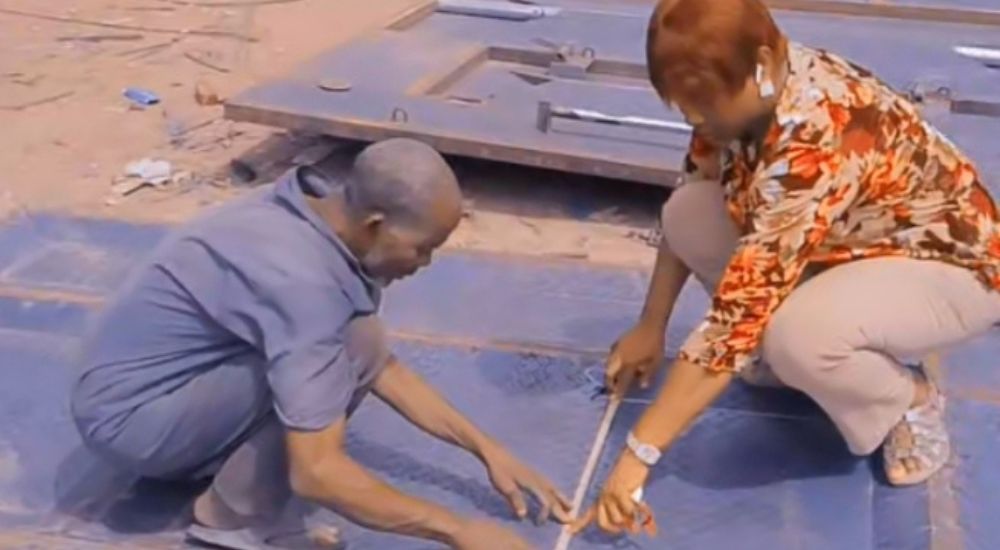
Adaeze Ezenduka, a welder, spoke about the financial strain that defines her trade.
Advertisement
She said the major issue is funds and financial shortage. “If the government can help us with funds, maybe in the form of loans, or even provide amenities and equipment for us, even though the government cannot just give it to us as help, they can also give it to us as loans.
“In fact, the major problem there is that finance, because Igbo people say, ‘Aku na-esi obi ike’ which means literarily, ‘money makes the heart strong”,”she said.
Ezenduka also explained the responsibility she carries toward the young apprentices who come to learn.
“There are many youth that want to learn the work. But sometimes you have to also think of the fact that when you keep them to teach them work, we have to feed them. We have to feed them, provide certain things they will use, like their uniforms, their wares, other things that are needed.
Sometimes we provide money for them to buy things And we also feed them,” she said.
She said feeding and supporting them is not only about care but also about protecting the work.
“The advantage of feeding them and giving them all those things we do is that it makes them not to steal. And another thing, it makes them to relax and learn the work, because they see it as a double opportunity. They are learning work, they are being fed, in a month they get something. In addition to after learning the work, they have had work and they can still be employed to continue,” she explained.
The gap between the formal celebration and the reality on the ground is reflected in national data. Nigeria’s economy is running on a ‘survivalist’ mode, as 93 percent of the nation’s workforce is trapped in informal employment, according to a 2025 report by the Nigerian Economic Summit Group titled ‘From Hustle to Decent Work: Unlocking Jobs and Productivity for Economic Transformation in Nigeria’.
The report highlighted that there is an overwhelming reliance on informal, often ‘survivalist’ activities which are actively hindering national development and poverty reduction.
Analysis reveals that 81 percent of Nigerian workers are concentrated in sectors like subsistence agriculture and retail trade, which offers very low productivity.
For Ezekiel, Peter, Adaeze, Muri, Tunde and countless others, May Day passed without speeches or rest.
Their work continued, powered by the same reason it always has; the need to fend for themselves, feed others, and keep moving until tomorrow.