Only 2% Of Buildings In Nigeria Are Accessible To Persons With Disabilities – Agbo
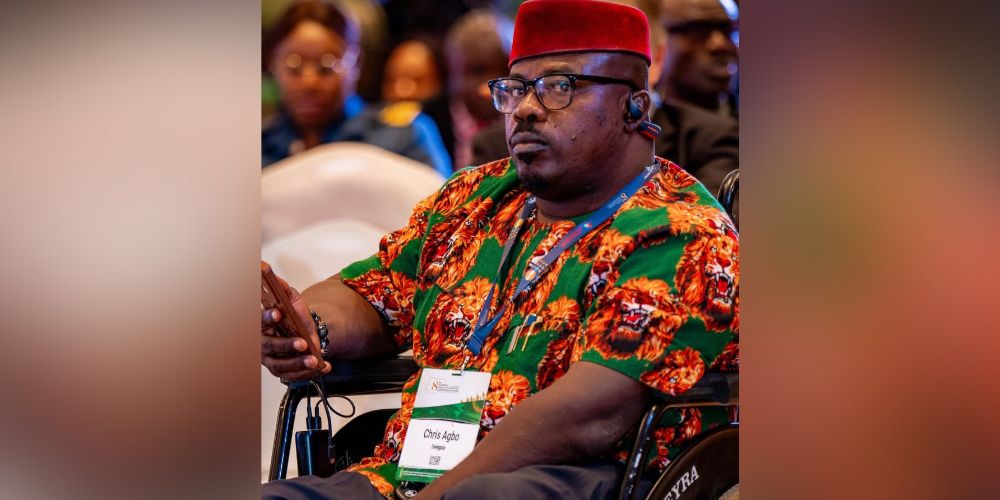
After five years plus since the transition period for the Discrimination Against Persons with Disabilities Act ended, accessibility challenges persist in Nigeria’s public spaces. Chris Agbo, Chairman of the National Association of Persons with Physical Disability (NAPWPD) FCT Chapter and Publisher of Qualitative Magazine, spoke with THE WHISTLER‘s CHIKA MEFOR-NWACHUKWU on the current state of accessibility, the challenges faced by persons with disabilities, and what needs to be done to improve inclusivity.
What is your take on the progress of the Disability Act, especially with building accessibility?
All I can say is that we are not where we used to be, but we have not gotten where we want to be. And the Act is not actually moving at the speed of light the way we wanted. We wanted a situation that by now, almost every Ministry, Department and Agency ( MDA) must have understood what the Act is talking about, their roles, and how to actually implement to comply with the Act.
That particular five years monetarium is focussing basically on physical structures. Owners of existing buildings were given time of grace to make them accessible for persons with disability.
Within that time frame, they should be able to make those adjustments. Unfortunately, we still have about 98 percent of buildings in Nigeria, especially FCT, that is still not accessible.
And this is without doing accessibility audits because by the time you go to some of these buildings to actually do accessibility audits, you will come to find out that even the ones that people have actually think are accessible are not really accessible.
What exactly makes a building accessible?
For a building to be accessible, if it is an uprising building, it must have a ramp. There are many things that need to be put in place. There are national accessibility regulations developed by the National Commission for Persons with Disabilities. Many persons with disabilities contributed to developing the regulations because access involves different aspects. Access for me isn’t the same as for a blind person, a deaf person, or a person with albinism. A person with albinism has to contend with colours and lighting in the building and needs a colour code that differentiates different layers of the steps due to their low vision.
For a blind person, you need to have some Tactile Paving Systems in some corridors to enable them to know where they are going. Also, you need braille buttons, especially in elevators, to enable the person to press the floor they are going to. The lift should also have audio announcements at each floor so the person won’t miss their floor. Most of our buildings have tiles and since they are slippery, it is a challenge for someone using crutches. Therefore, the building isn’t accessible for that person.
When you do a proper accessibility audit, you’ll find that buildings we say are accessible aren’t. Let me give you an example: the National Assembly has a good ramp at the door, but it is still not accessible because there are no wheelchair-accessible toilets. There are several other things that make the National Assembly inaccessible because access starts with creating a parking lot for a person with a disability. If you have a building and there’s no parking lot, you’ve failed accessibility tests. There should be a well-marked parking lot for persons with disabilities. Also, all buildings should be well-marked. Toilets need to be large enough for a person in a wheelchair to do a 360-degree turn, and they must have grab bars placed at a level the person can easily grab.
Accessibility also includes positioning switches (like light switches) where a person can reach them. Wardrobes in hotels need to be placed where a wheelchair user can hang their clothes comfortably without needing someone to help. When you talk about access, a lot is involved.
Advertisement
So how can these accessibility measures be achieved in buildings?
It can be achieved in two ways. One, government needs to rise to its responsibility. We have the National Commission for Persons with Disabilities. They have a responsibility to ensure people comply. They have authority to seal off non-accessible buildings but aren’t doing it. The Act gave them this power.
So why aren’t they?
Maybe they have challenges. But they need to act. The second part is awareness creation, which is the Ministry of Information’s responsibility (Section 2 of the Act). The ministry should create more awareness so people know non-compliance has consequences.
Apart from government, MDAs (Ministries, Departments, and Agencies) also have roles. Disability issues are cross-cutting, affecting every sector. Section 29 of the Act requires 5% employment for persons with disabilities. Have MDAs met this? They must make buildings accessible, provide reasonable accommodation, and make workplaces conducive for persons with disabilities, including budgeting for sign language interpreters and accessible materials (like Braille).
Every programme should include disability content. For example, public events should have sign language interpreters, and materials in accessible formats. These should be budgeted for.
Individuals also have responsibilities under the Act. Don’t discriminate against persons with disabilities – ignorance isn’t an excuse. Make public places (businesses, offices, mosques, churches, schools, etc.) accessible. If a person with a disability can’t access your business and you ignore their complaint, you could face court action and damages from the day they complained.
Do we have any such cases?
Advertisement
Some people are taking institutions to court over disability rights violations, but many cases are settled out of court. I know of a case involving a blind person denied an ATM card by a bank, citing security risks. The individual argues the bank should provide accessible ATMs with braille buttons, enabling independent use. He is seeking an apology, damages, and policy changes to promote financial inclusion. The case is ongoing.
Can you share the challenges you have faced accessing public spaces?
The challenges I encountered have been on a daily basis. On our own part, what we continue to talk to them for now. I was at an event centre here in Abuja. The place is quite accessible because they have parking lots. But there was one place that there was a minus. They have a disability toilet but the toilet has gone bad for a long time and they refuse to fix it. When some of us come to that particular place, we will not see any toilet to use. So, it is a violation to our rights. I raised that issue. I warned them that the next time I would come and it is not repaired, I may not necessarily take it lightly on that. There are a lot of them, but what we have resorted to is to talk to them. Some people will tell you that they are not aware of it.
Banks often fall short on accessibility. Sales points should have a lower counter or section for wheelchair users or people with dwarfism, alongside standard-height counters. This is actually a requirement by the National Disability Regulation, ensuring everyone can access services comfortably.
What about Airport?
Airports in Nigeria have a lot of accessibility issues, especially for wheelchair users. They’re often carried onto flights, which isn’t right. Airports should have ambulifts to lift wheelchair users onto planes smoothly. The law also says people with disabilities should get priority boarding – boarding first and disembarking last, to avoid unnecessary attention or stress.
People will say these are extra cost…?
Advertisement
It is what the law says. There is nothing like extra cost. International airlines use ramps for boarding – every passenger uses them. That can work for local flights, too. We’re not asking for something tough. We’re promoting universal design. Engineers should apply it to all buildings. Design inclusively, and nobody complains.
March 1st was International Wheelchair Day. What is the day about?
It was a day of awareness about wheelchairs and the challenges users face – mainly about societal perception and exclusion. Inaccessible buildings mean wheelchair users can’t get jobs; people say, “Why hire you if you can’t access the building?” This contributes to job scarcity. Most Nigerian public transport isn’t wheelchair-friendly; Lagos has some BRT buses, but Abuja’s CNG buses aren’t accessible. This creates financial burdens – wheelchair maintenance, aides, and transport costs are high. Government support is lacking. Anyone looking “fresh” on a wheelchair is likely spending a lot. Health insurance doesn’t cover wheelchairs like in other countries.
What steps can the government take to economically empower persons with disabilities and reduce discrimination?
The government should include disability extra costs, introduce social security allowance, make health insurance cover assistive devices, provide jobs or business support, and create markets for persons with disability. Economically empowering them reduces discrimination.