
Repentant Terrorists: Inside Nigeria’s Decade-Long Bet On De-radicalisation
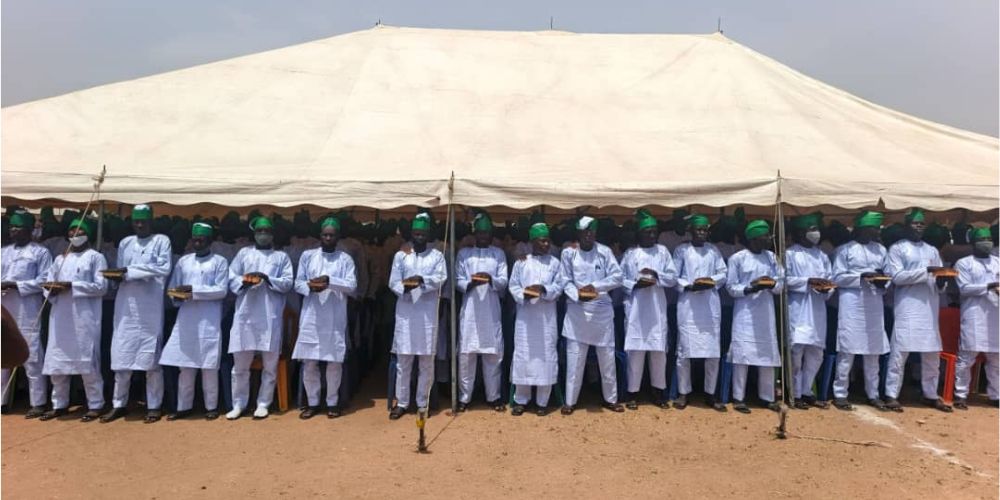
When 744 former terrorists and victims of violent extremism marched out of the Federal Government’s De-radicalisation, Rehabilitation and Reintegration camp in Gombe on Thursday, they became the latest chapter in a story Nigeria has been telling itself for nearly a decade, that bombs and bullets alone cannot end the insurgency that has ravaged the North-East.
The ceremony, held under the auspices of Operation Safe Corridor (OPSC), was both a celebration and a statement of doctrine. Chief of Defence Staff General Olufemi Oluyede, represented by Rear Admiral Kabiru Tanimu, made the government’s position explicit: “Lasting peace can only be achieved when we address the underlying drivers of de-radicalisation, disengagement and reintegration.”
But as the applause faded in Gombe, a more uncomfortable question hung in the air one that analysts, researchers, and affected communities have been asking since the programme launched: is it working?
The Numbers Tell Part of the Story
The 744 graduates are drawn from 17 Nigerian states and four neighbouring countries, with Borno accounting for 597 nearly 80 per cent of the total cohort a figure that reflects the state’s status as the epicentre of the Boko Haram conflict. Yobe contributed 58 graduates, Kano 15, Bauchi 12, and Adamawa 10.
Advertisement
Eight foreign nationals from the Niger Republic, Chad, Cameroon, and Burkina Faso were also among the graduates, underscoring the transnational dimensions of extremism in the Lake Chad Basin.
Since its establishment, Operation Safe Corridor has rehabilitated approximately 2,190 repentant terrorists and reintegrated them back into society, built around five pillars: disarmament, demobilisation, de-radicalisation, rehabilitation, and reintegration.
Thursday’s 744 graduates represent a significant single-batch addition to that cumulative figure.
The programme is a restricted custodial initiative through which approximately 900 ex-combatants passed in its first years since 2015, before scaling significantly.
The curriculum encompasses psychosocial support, vocational training, religious reorientation, educational reform, civic education, and behavioural transformation a holistic model designed to address the ideological, psychological, and economic conditions that fuel radicalisation.
Advertisement
The Strategic Logic
Programme Coordinator Brigadier General Yusuf Ali acknowledged that not all those who passed through the programme were ideologically committed fighters.
Many, he said, were coerced. “Some were abducted, others were forced, and many were drawn into the conflict due to circumstances beyond their control,” he said a point that underlines one of the most difficult classification challenges the programme faces: distinguishing between willing combatants and victims of circumstance.
The Nigerian government adopted Operation Safe Corridor in a bid to de-radicalise, rehabilitate and reintegrate former Boko Haram combatants who voluntarily surrender to the government, in recognition of the limits of military strategy.
Studies have demonstrated that terrorism cannot be defeated solely by military force, with analysts arguing that non-military strategies are seen as a more viable means of eradicating terrorism’s fundamental causes and achieving a long-term peaceful end.
The International Crisis Group has noted that Operation Safe Corridor reflects Nigerian authorities’ growing recognition that they cannot beat Boko Haram by military means alone, and that the programme has had some success — providing an incentive for Boko Haram recruits to defect from a fight that many considered futile.
Advertisement
The Fault Lines
Yet for all its strategic soundness, the programme has never been without controversy and the concerns are substantial.
While the programme has been relatively successful in the North East region, concerns have been raised about recidivism, with reports of some rehabilitated individuals returning to terror groups.
Community resistance remains a persistent obstacle. Most residents of the affected communities oppose the resettlement of so-called repentant terrorists in the communities they had terrorised in the past without any form of punishment.
This sentiment has been so strong that it has, at times, blocked the practical reintegration of graduates, rendering the programme’s final and most critical phase effectively stalled.
The lack of a legal framework, issues of public perception and trust, and host communities’ reluctance to accept former Boko Haram combatants have undermined successful implementation of the programme.
Research has also flagged design flaws. A study found that Operation Safe Corridor tends to mix Boko Haram defectors and released Boko Haram captives for screening, which provides opportunity for further radicalisation within the programme itself.
The same study noted that this, combined with human rights concerns and inadequate management, has resulted in donor dissatisfaction and eroded public confidence in the programme’s effectiveness.
Some graduates questioned the commitment and expertise of religious specialists often military chaplains — who came to teach, while others thought the de-radicalisation classes pointless given that they had already defected and abandoned Boko Haram thinking.
Expanding to the North-West: A Different Beast
The Federal Government’s decision to expand Operation Safe Corridor to the North-West has generated fresh analytical concern. Analysts have raised questions about Operation Safe Corridor’s effectiveness in the North-West because the banditry there is largely driven by financial incentives ransom payments, cattle rustling, and illegal mining rather than ideology.
Security analyst Baka Kabir, told THE WHISTLER that the problem with Safe Corridor is that it was developed for terror groups who share extreme views, and the government cannot afford to copy and paste what it did in the North-East and replicate the same in the North-West.
Counter-terrorism researcher Dengiyefa Angalapu, however, pushed back against those who dismiss the programme entirely.
Critics of Operation Safe Corridor have said the programme is perpetrator-centred and risks being seen as a reward system for terrorists an argument Angalapu described as reductionist.
The Coordination Problem
A September 2025 policy brief by the German Institute for International and Security Affairs identified a deeper structural challenge. Nigeria’s de-radicalisation, rehabilitation and reintegration efforts are entangled in institutional rivalries, struggles, and legitimacy contests that gravely undermine DDRR efforts, with interconnected consequences.
The country now runs at least four parallel programmes: Operation Safe Corridor, the Kuje prison-based programme, the clandestine Sulhu programme run by the DSS, and the Borno Model — with limited coordination between them.
A Collective Responsibility
Despite the scepticism, CDS Oluyede’s message at Thursday’s ceremony reflected a government that is not retreating from the approach.
His call for state governments, community leaders, and families to take shared ownership of reintegration is, analysts say, the right instinct and the area where the programme has historically been weakest.
“Reception, monitoring, and community acceptance remain critical to sustaining the gains achieved today. This must be a collective effort,” Oluyede said.
For the 744 men and women who walked out of the camp in Gombe on Thursday, the question of whether Nigeria’s bet on de-radicalisation will pay off is not abstract.
It is the condition under which they will now attempt to rebuild their lives in communities that, in many cases, still bear the scars of the violence from which they have, officially at least, turned away.