
States Allocate Billions On Paper, Leave Poverty-Fighting Projects Largely Unfunded—Investigation
..Jigawa, Kebbi, Borno, Adamawa, Yobe Execute Less Than One-Third Of Key Poverty-Reduction Budgets
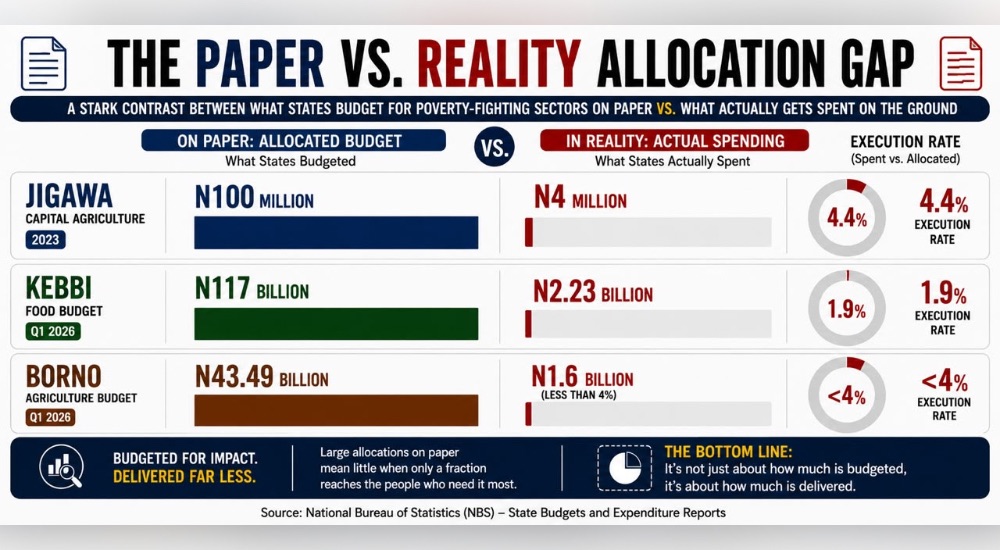
…Borno Spends Less Than 4% Of N43.49bn Agriculture Budget Amid Hunger Crisis
…Adamawa Spends N709m On Officials’ Allowances, N275m On Agriculture
…Poor Budget Execution Leaves Millions Trapped In Hunger, Unemployment—Experts
Nine out of every ten people in Sokoto State live in poverty, according to Nigeria’s most comprehensive poverty survey. Bayelsa is close behind at 88.5 per cent, followed by Gombe, Jigawa and Plateau. Together, the five poorest states in the country carry more than 14 million impoverished people between them, according to the National Bureau of Statistics’ 2022 Multidimensional Poverty Index (MPI), the first survey of its kind and the most recent official measure of poverty across Nigeria’s 36 states.
The MPI, developed with the Oxford Poverty and Human Development Initiative and international partners, found that 133 million Nigerians which is 63 percent of the population are multidimensional poor, deprived across health, education, living standards, and work and shocks. Sixty-five per cent of the country’s poor, about 86 million people, live in the North, against 35 per cent in the South, exposing a stark regional divide that has persisted for years.
Advertisement
An analysis by THE WHISTLER of approved state budgets, citizens’ budgets, budget performance reports and independent fiscal audits for Sokoto, Jigawa, Kebbi, Zamfara, Yobe, Adamawa and Borno among the states worst hit by poverty and, in the northeast, acute hunger — shows a familiar and troubling pattern: modest allocations to the sectors that matter most for lifting people out of poverty, followed by chronically poor execution of even those modest sums.
Sokoto, the country’s poorest state by the NBS measure, presented a N758.7bn budget for the 2026 fiscal year, tagged the “Budget of Socio-Economic Expansion.” Of that sum, agriculture received N18.7bn which is about 2.5 percent of the total budget while N33.9bn, roughly 4.5 percent, was earmarked jointly for water resources, poverty reduction and youth empowerment programmes combined.
Governor Ahmed Aliyu’s administration says 72 percent of the budget goes to capital expenditure and that nearly 70 percent of the 2025 budget was implemented, a relatively strong performance by Nigerian subnational standards, though the sums directed specifically at agriculture and poverty reduction remain a small slice of the total pie for a state where roughly nine in ten residents are poor.
In Jigawa, where the poverty rate stands above 84 per cent, an independent review by the Centre for Social Justice and the Small Scale Women Farmers Organisation in Nigeria found that the state allocated only 5.76 percent of its total budget to agriculture on average between 2020 and 2024, well short of the 10 percent benchmark set by the African Union’s Maputo Declaration, which Nigeria has endorsed. The variance between what was allocated and what the Maputo benchmark required came to more than N44 billion over that five-year window.
The bigger problem, the review found, was execution. Jigawa’s agriculture capital budget showed how much of the money allocated was actually spent on the ground — stood at just 11.7 per cent in 2022 and fell further to 4.4 percent in 2023, before improving to 16.2 per cent in the first quarter of 2024. In other words, for every N100 budgeted for agriculture capital projects in 2023, the state government spent roughly N4.
Advertisement
The state’s 2025 budget of N698.3bn allocated N69.3bn, or 9.92 percent, to agriculture, a marked improvement in the paper allocation, though it remains to be seen whether implementation will follow.
Perhaps the starkest figure uncovered in this analysis comes from Zamfara State, where the approved budget for 2023 to 2025 shows the Directorate of Poverty Alleviation Agency was allocated just N5.2m annually for its out-year estimates in 2024 and 2025, a figure that would not cover a single urban civil servant’s annual salary, in a state grappling with some of the country’s highest poverty and insecurity indicators.
By contrast, the state’s Ministry of Agriculture and Natural Resources received N1.69bn in the same budget cycle.
Zamfara’s 2025 budget of N545bn allocated 6 percent, or roughly N34.7bn, to agriculture, alongside 11 percent for health and 14 percent for education.
Governor Dauda Lawal’s administration has since proposed a significant jump for 2026: an N861bn budget with N86bn for agriculture, close to the 10 percent Maputo threshold, alongside a newly launched 10-year development plan built with KPMG Advisory that promises to expand mechanised farming, agro-processing and poverty-focused value chains. Whether the leap from N34.7bn to N86bn in a single budget cycle survives implementation is a question only next year’s performance reports can answer.
Kebbi State offers perhaps the clearest evidence that allocation is only half the story. Kebbi spent only 32.4 per cent of its N93.04bn allocation to agriculture, forestry, fishing and hunting throughout 2025 which is about N16.14bn.
Advertisement
In the first quarter of 2026, the picture worsened: the state spent just 1.9 per cent, or N2.23bn, of the N117bn allocated to feeding its population, even as it found N5.5bn for road transportation in the same three months.
The same investigation found that Kebbi received donated food baskets from Saudi Arabia’s King Salman Humanitarian Aid and Relief Centre in both March 2025 and June 2026 — in each case during years when the state’s own agriculture funding went largely unspent.
Kebbi’s 2025 budget of N580.3bn had allocated close to 17.8 percent of total spending toward agriculture on paper, one of the more generous allocations among the poorest states; the gap between that promise and the 32.4 percent execution rate is where the state’s food security strategy appears to have broken down.
The pattern is sharper still in the three northeastern states projected by the UN Office for the Coordination of Humanitarian Affairs to see a combined 5.8 million people facing crisis-level hunger between June and September 2026.
THE WHISTLER’s review of first-quarter 2026 budget performance reports found that Yobe and Adamawa combined spent N1.65bn on agriculture against N1.99bn on honorarium and sitting allowances for government officials in the same period meaning both states, projected to face worsening hunger, spent more keeping officials paid for meetings than on the sector meant to grow their own food supply.
Individually, Yobe had budgeted N30bn for agriculture in 2025 but spent only N1.37bn, or 4.6 per cent, in the first quarter of 2026.
Adamawa budgeted N5.69bn and spent N275m, or 4.8 per cent while spending N709m on honorarium and sitting allowances over the same three months, more than double what went to agriculture. Borno, also facing a hunger emergency, spent just N1.6bn of its N43.49bn agriculture budget in the first quarter of 2026, under 4 per cent.
These state-level findings mirror a broader trend documented by the civic budget-tracking organisation BudgIT in its analysis of the 2025 approved budgets of all 36 states. Many states, including several among the poorest, allocate 60 to 80 per cent of their total budgets to capital expenditure on paper is a policy stance that looks impressive in a budget speech.
But BudgIT’s separate 2026 review found that roughly 70 per cent of capital projects budgeted nationally in 2025 rolled over unexecuted, as rising debt servicing costs N15.91tn in the federal government’s 2026 budget proposal alone which crowd out the resources needed to fund the infrastructure, agriculture and social protection projects that state governments promise on paper.
The experts also point to the revenue structure of the states.
Economist Celestine Okeke of the International Labour Organisation previously argued that governors need to move beyond dependence on federal allocations and develop the productive potential of their states. He said states should be run in ways that encourage wealth creation rather than remain dependent on Federation Account transfers.
This is particularly relevant to the poorest states because a government that depends heavily on FAAC has limited control over the resources available to it.
But dependence on federal allocations also creates a second accountability question: when revenue increases, where does the additional money go?
If higher FAAC receipts primarily finance salaries, overheads and other recurrent obligations, the state may have little left for investments capable of expanding its productive economy.
Economist Paul Alaje has raised a similar concern, arguing that many states devote substantial resources to recurrent expenditure while too little is invested in activities capable of expanding economic opportunities. He specifically highlighted the need for states to invest in storage and preservation of agricultural produce and other productive infrastructure.
Dr. Umar Abdullahi, an economist, told THE WHISTLER that state governments should not be assessed on poverty alleviation based solely on how much they allocate to agriculture or other poverty-related programmes.
He said the effectiveness of state spending should instead be measured by its impact on household incomes, employment, human capital, access to basic services and the ability of poor households to build sustainable livelihoods.
According to him, agriculture remains critical, particularly in states where a large proportion of the population depends on farming, but agricultural spending alone cannot lift people out of multidimensional poverty.
“Government must look at poverty from a multidimensional perspective. You cannot say because you allocated billions to agriculture, you have reduced poverty. The question is: what happened to the income of the farmer? What happened to food security? What happened to employment and access to markets?” Abdullahi told THE WHISTLER.
He said states should prioritise investments that create sustainable economic opportunities rather than programmes that provide temporary relief without changing the productive capacity of beneficiaries.
Abdullahi identified employment creation, education, healthcare, agricultural productivity, infrastructure, access to finance, social protection and support for small businesses as key areas that should form part of any serious state poverty-reduction strategy.
He said governments should also assess whether their interventions are reaching the poorest households and producing measurable improvements in their living conditions.
“Budget allocation is only the beginning. What matters is implementation and the outcome. If a state budgets N20bn for agriculture and spends N5bn, you already have an implementation problem. But even if it spends the entire N20bn, you still have to ask what impact that money has made on the people,” he said.
The economist said state governments should therefore publish clear indicators showing how many jobs were created, how many households benefited, how farmers’ incomes changed, how many businesses were supported and how access to education, healthcare, water and other basic services improved.
He also warned against relying heavily on one-off empowerment schemes as a substitute for broader economic development.
“Giving people money or items may provide temporary relief, but poverty reduction requires building the capacity of people to earn sustainable incomes. Government should be asking: after this intervention, can the beneficiary continue to earn without coming back to government for another intervention?” he said.
Abdullahi said the NBS Multidimensional Poverty Index provides a useful basis for assessing state governments because it goes beyond income poverty and examines deprivation in areas such as education, health and living standards.
He argued that state budgets should consequently be mapped against the specific areas of deprivation identified in their respective states.
“If education is one of the major sources of deprivation in a state, the government must show what percentage of its budget is addressing education and whether school attendance and completion are improving. If health is a major deprivation, then we should look at access to healthcare and health outcomes,” he said.
The economist said the same approach should apply to water, sanitation, housing, electricity, employment and food security.
Based on Abdullahi’s assessment, THE WHISTLER’s analysis considers four broad measures in assessing whether the poorest states are adequately addressing poverty.
First is budget commitment: how much each state allocates to sectors linked to poverty reduction, including agriculture, education, health, water, social protection, skills development and employment.
Second is budget execution: how much of the approved funds are actually released and spent, particularly on capital and poverty-focused programmes.
Third is economic impact: whether government spending is creating jobs, improving productivity, supporting small businesses and increasing household incomes.
Fourth is human development and basic services: whether residents are gaining better access to education, healthcare, water, sanitation, social protection and other services that determine whether poverty remains entrenched.
The assessment therefore moves beyond the size of agriculture allocations to examine whether government spending is addressing the multiple dimensions of deprivation identified by the NBS.
This is important because a state can increase its agriculture budget without significantly reducing poverty if farmers continue to face insecurity, high input costs, poor roads, inadequate storage, limited access to credit and weak markets.
Similarly, a state can spend billions on empowerment programmes without substantially reducing poverty if beneficiaries receive one-off support without sustainable businesses, jobs or access to markets.
The concern is reinforced by Nigeria’s continuing cost-of-living crisis.
If Sokoto increases its agriculture budget but farmers face rising input costs, poor roads and insecurity, the nominal increase may not translate into higher farm income.
If Jigawa spends more on skills acquisition but graduates cannot access finance, electricity or markets, training alone may have limited effect.
If Bayelsa allocates large sums to empowerment but beneficiaries are not connected to sustainable enterprises, the programme may produce beneficiaries without producing wealth.
And if Kebbi and Gombe increase social spending without improving education, health and productive employment, multidimensional poverty can remain entrenched.
The evidence therefore suggests that the appropriate benchmark is not simply budget size, but poverty-reduction efficiency.
A state spending N20bn on agriculture should be asked how many households benefited and what changed. A state spending N10bn on skills acquisition should be able to show how many trainees became economically active. A state spending N30bn on poverty reduction should be able to demonstrate whether beneficiaries became less dependent on government support.
As Nigeria moves toward more evidence-based poverty planning, the challenge for the poorest states is increasingly clear: convert budgetary allocations into measurable reductions in deprivation.
The NBS has already provided a framework for identifying where deprivation is concentrated. The next step is for state governments to demonstrate, year after year, that their budgets are addressing those specific deprivations and that the money is producing results.
Taken together, the figures point to a nuanced answer rather than a simple yes or no. On paper, most of the poorest states have moved their agriculture allocations closer to, though in most cases still below the 10 per cent Maputo Declaration benchmark that agricultural economists and civil society groups argue is the minimum needed to meaningfully reduce rural poverty in farming-dependent economies. Zamfara’s leap from 6 to roughly 10 percent for 2026, and Jigawa’s climb to 9.92 percent in 2025, suggest political attention to the sector is increasing, at least in budget documents.
But allocation without execution delivers nothing to a farmer whose fertiliser subsidy never arrives or a family whose promised feeding programme never reaches their community.
The pattern across Jigawa, Kebbi, Yobe, Adamawa and Borno poverty-alleviation and agriculture budgets executed at rates ranging from under 5 per cent to just above 30 percent, while other expenditure lines, including sitting allowances and road contracts, are funded more reliably suggests that within-resource capacity is not always the constraint. In several of these cases, the money was appropriated; it simply was not released, spent, or prioritised once the budget year began.
For residents of the communities these budgets are meant to serve, the distinction between a shortage of resources and a failure to deploy the resources available may not matter in practice. But it matters for accountability.
A state that allocates too little to agriculture faces a funding problem. A state that allocates a reasonable sum and spends less than five per cent of it, while fully funding honorarium payments to officials, faces a governance problem, one that budget documents alone can flag, but that only sustained public scrutiny and legislative oversight can fix.