Dangote Refinery Designed For Global Markets, Not Domestic Crude — CEO
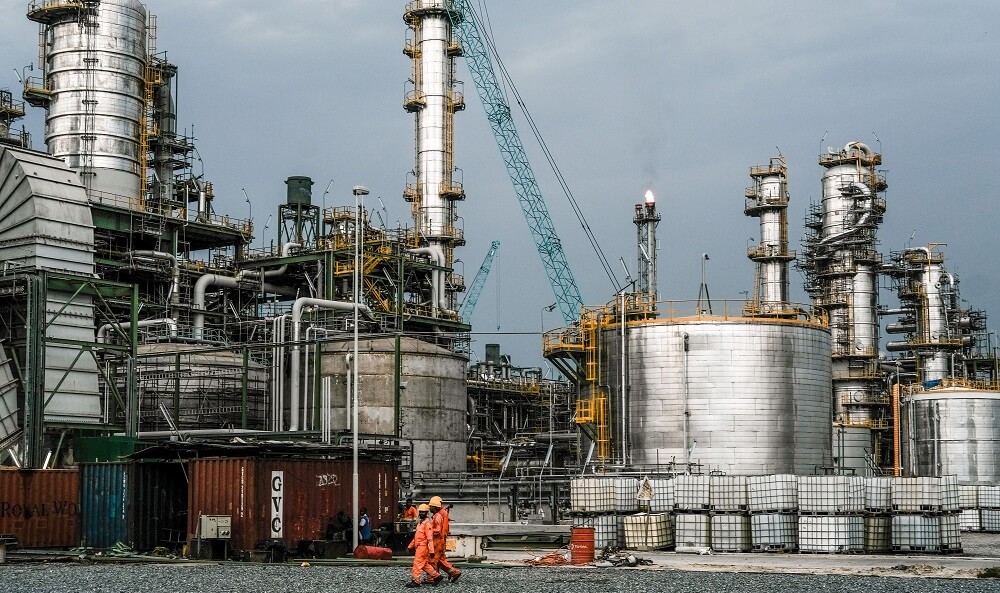
The Dangote Refinery sources about 40 per cent of its feedstock from international markets as part of a deliberately structured “fully flexible, trading-led merchant refinery” model, its Chief Executive Officer, David Bird, has said.
Speaking during a media engagement, Bird disclosed that the $20bn facility was designed to operate not as a traditional pipeline-fed refinery processing a single domestic crude stream, but as a globally integrated refining hub capable of adjusting its crude slate and product output in response to market dynamics.
According to him, roughly 30 per cent of the refinery’s feedstock is Nigerian crude purchased under the naira-for-crude framework, another 30 per cent consists of opportunistic Nigerian grades acquired on commercial terms, while the remaining 40 per cent is sourced internationally.
“What we are is not a refinery sitting at the end of a crude pipeline processing one crude,” Bird said. “We are a fully flexible trading-led merchant refinery. All of our feedstocks are brought in by sea, and our products can be evacuated domestically or exported into the global market.”
Bird explained that the refinery was intentionally structured along the lines of major international refining hubs such as Rotterdam and Singapore, centres known for maritime access, diversified crude sourcing and extensive export networks.
Unlike vertically integrated oil companies that own upstream production assets and feed crude directly into their refineries, the Dangote facility does not control oil fields. Instead, it procures crude and intermediate feedstocks from multiple sources, both local and foreign, based on commercial considerations.
Advertisement
This structure, he said, differentiates it from what he described as “tramline refineries” commonly found in oil-producing countries—facilities typically situated at the end of domestic pipelines and configured to process a narrow range of local crude grades.
Dangote’s model, by contrast, allows it to process a wide variety of crude types and intermediate products. Bird revealed that the refinery has processed more than 25 different crude grades and about 10 intermediate feedstocks since commencing operations.
“Every day we are processing a different crude,” he said. “We are agnostic about whether that molecule comes from crude or from an intermediate product. It’s about maximising utilisation and margin.”
As a merchant refinery operating without dedicated upstream supply, the facility is directly exposed to fluctuations in global crude prices, exchange rate movements and refining margins, commonly measured by the crack spread—the differential between crude input costs and refined product prices.
This exposure means that its pricing behaviour is closely aligned with global oil market trends, particularly in Nigeria’s post-subsidy environment where domestic fuel prices are increasingly market-determined.
Advertisement
Industry analysts note that the refinery’s commercial structure places it squarely within the competitive global trading ecosystem, where profitability depends not only on refining efficiency but also on strategic crude selection, logistics management and market timing.
Bird stressed that refining is a capital-intensive business in which profitability hinges on keeping processing units running at optimal capacity.
“Utilisation is everything in our business,” he said. “If one of our downstream units is underutilised because the crude mix doesn’t produce enough of a particular fraction, we will import intermediate feedstock to load that unit up. It’s no different from an airline wanting every seat filled.”
The refinery’s configuration includes a large crude distillation unit complemented by multiple upgrading and treatment units—such as hydrocrackers, reformers and catalytic crackers—designed to convert heavier fractions and intermediate materials into finished petroleum products.
This complex configuration allows the plant to adjust its product slate depending on market demand and feedstock economics, enhancing operational flexibility and margin optimisation.
According to Bird, the merchant model also requires significant investment in tank storage, marine terminals and logistics infrastructure to enable both import and export flexibility.
Advertisement
“A merchant refinery is more about tanks, logistics and trading capability than simply processing crude,” he said.
Addressing public scrutiny over the importation of blending components, Bird said there had been misconceptions about the refinery’s operations.
He clarified that while certain intermediate products, such as high-sulphur blendstocks, may be imported, they are not sold directly into the market. Instead, they are further processed and upgraded within the refinery before being released as finished products.
“The only gasoline leaving this refinery is Euro 5, 50 parts-per-million sulphur gasoline,” he stated.
Bird argued that West Africa had historically been a destination for lower-quality fuel imports and maintained that the refinery’s operations mark a shift toward higher product standards.
However, he emphasised the need for consistent regulatory enforcement to ensure fair competition in the domestic market.
“We are willing to compete on import parity pricing,” he said. “But there must be a level playing field on product quality. Inferior products are cheaper, and that distorts the market.”
The refinery’s operating model represents a significant shift in Nigeria’s downstream petroleum structure, moving away from state-controlled, subsidy-driven supply frameworks toward a market-linked, globally integrated system.
By sourcing crude from diverse origins and exporting products when commercially viable, the refinery positions itself as both a domestic supplier and an international trading player.
With 40 per cent of feedstock sourced internationally and over 35 crude and intermediate inputs already processed, the $20bn facility underscores its strategic intent to function as a globally competitive merchant refinery rather than a domestically confined processing plant.
Industry observers say the success of this model will ultimately depend on sustained operational efficiency, regulatory clarity and the stability of Nigeria’s evolving post-subsidy fuel market.