FACT-CHECK: Did VeryDarkMan Legally Seize ‘BLORD’ Brand?

The trademark dispute between activist Martins Vincent Otse (VeryDarkMan/VDM) and businessman Linus Williams (Blord) has escalated into a complex battle over brand ownership. Following a dispute where Blord attempted to trademark “Ratel”, VDM counter-responded by targeting Blord’s professional moniker.
VDM claimed to have legally seized the “BLORD” brand by filing in 43 classes, however, his strategy faces many legal hurdles rooted in statutory barriers and judicial precedents regarding prior use and bad faith registration.
Claim
VDM asserted that he is the legal owner and “founder” of the “BLORD” trademark because the registry was “empty” when he applied for it across 43 classes. He argued that his registration of “BLORD” (all caps) gives him exclusive rights to the name in categories like Class 35 (Marketing) and Class 39 (Logistics), effectively prohibiting Linus Williams from using the name for his electric vehicle business.
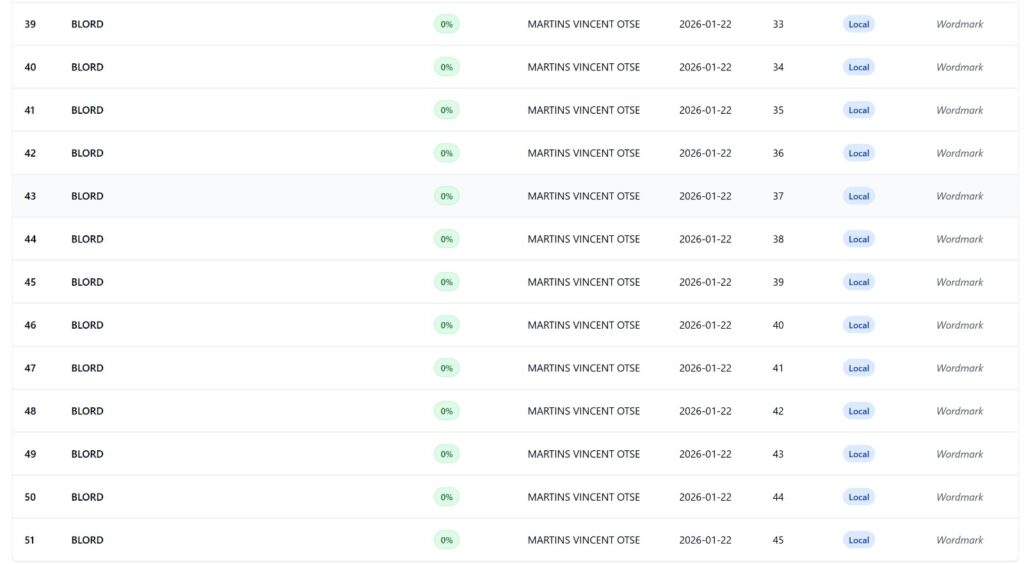
VDM’s claim implies that the specific casing of his filing distinguishes it from earlier entries on the registry and that he can legally stop any commercial transportation involving vehicles branded with that name.
Advertisement
Findings
Official registry records and Nigerian law contradict VDM’s assertion. Under Section 13(1) of the Trade Marks Act, a mark cannot be registered if it is “identical with or so nearly resembling” an existing mark for the same goods or services.
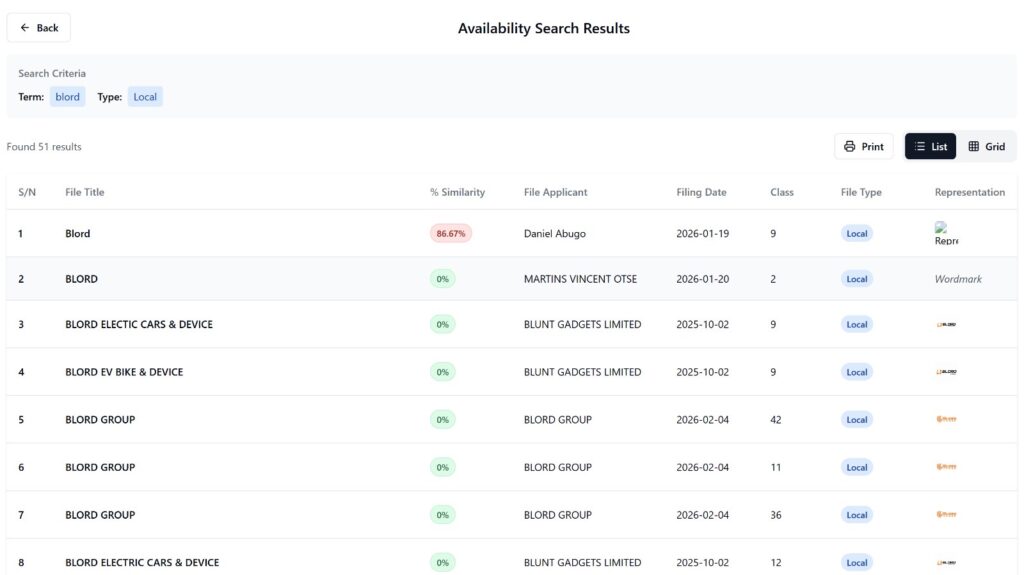
Because Nigerian law treats wordmarks as case-insensitive, VDM’s “BLORD” is legally identical to the “Blord” filed by Daniel Abugo on January 19, one day before VDM’s first application.
Abugo’s filing holds priority for Class 9, and the phonetic identity of the words creates a “confusing similarity” that blocks VDM’s subsequent filings in overlapping classes.
Advertisement
“Subject to the provisions of subsection (2) of this section, no trade mark shall be registered in respect of any goods or description of goods that is identical with a trade mark belonging to a different proprietor and already on the register in respect of the same goods or description of goods, or that so nearly resembles such a trade mark as to be likely to deceive or cause confusion.”
VDM’s claim to have found the registry “empty” ignores the rights of Blunt Gadgets Limited, a subsidiary of the Blord Group. This company filed for “BLORD ELECTRIC CARS & DEVICE” in Classes 9 and 12 in October 2025, providing them with a “priority date” that predates VDM by several months.
Even if VDM’s applications proceed, Section 7 of the Trade Marks Act protects “vested rights,” ensuring that a later registration cannot interfere with a person who has been continuously using an identical mark from a date prior to the new registration.
“Nothing in this Act shall entitle the proprietor or a registered user of a registered trade mark to interfere with or restrain the use by any person of a trade mark identical with or nearly resembling it in relation to goods in relation to which that person or a predecessor in title of his has continuously used that trade mark from a date previous to-
(a) the use of the first-mentioned trade mark in relation to those goods by the proprietor or a predecessor in title of his; or
(b) the registration of the first-mentioned trade mark in respect of those goods in the name of the proprietor or a predecessor in title of his, whichever first occurred, or (where such use is proved) to object to that person being put on the register for that identical or nearly resembling trade mark in respect of those goods under section 13 (2) of this Act.”
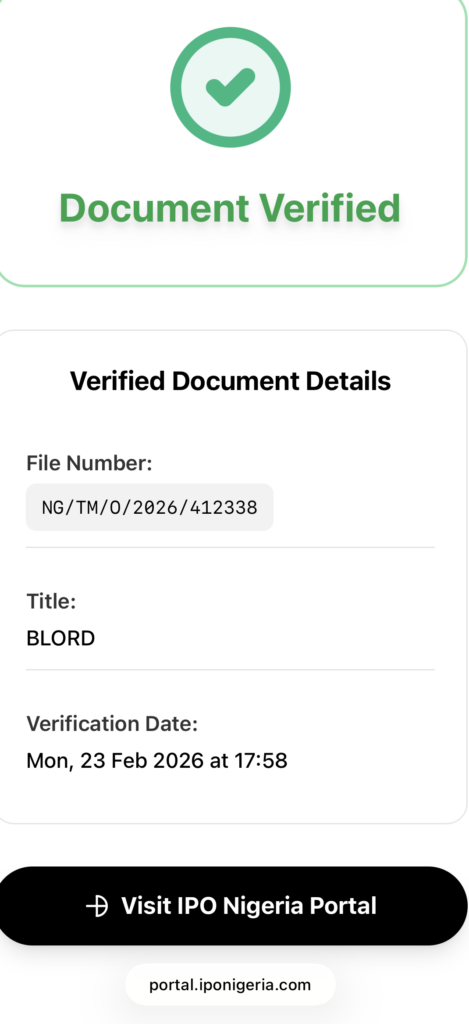
In his video, VDM shared a screenshot of a “Notice of Acceptance” from the Nigerian Trademark Registry to validate his claim. This document indicates that his application for “BLORD” in Class 39 (Transport and Logistics) was formally accepted by the Registrar and slated for publication. Official Trademarks Journal records list VDM’s application (NG/TM/O/2026/412338) as a wordmark.
Advertisement
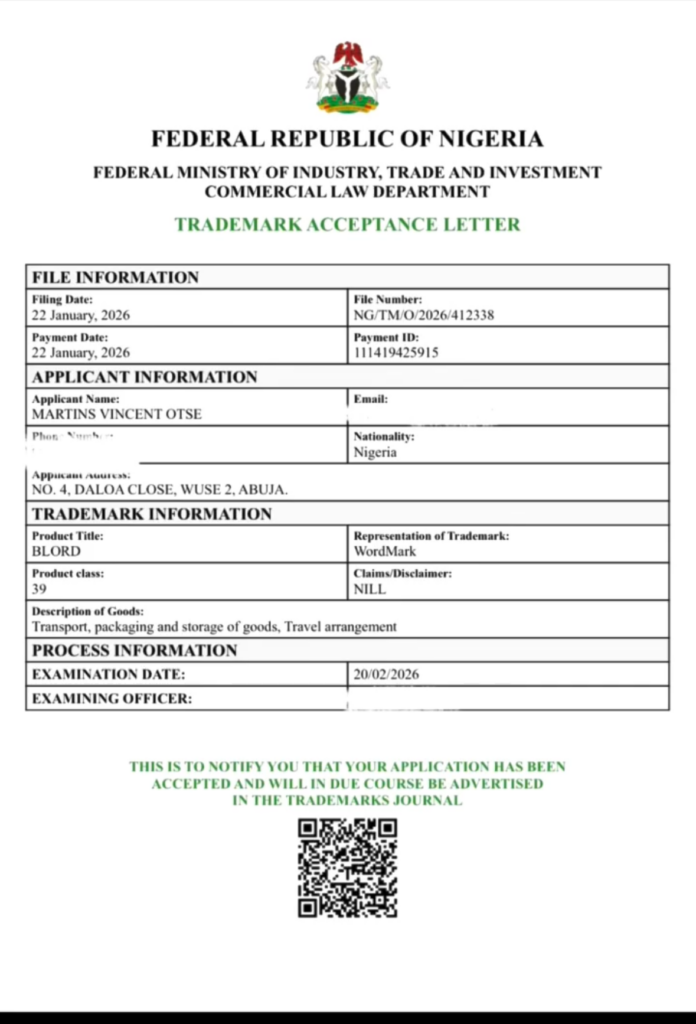
The legal process for registration follows strict stages under the Act: an availability search, formal application under Section 18, and examination for distinctiveness under Sections 9 and 10. If accepted, the mark must be published in the Trade Marks Journal per Section 19, followed by a two-month window for third-party opposition under Section 20. Only if these stages are passed can a Certificate of Registration be issued under Section 22. Because VDM’s filings are still in the early stages and face clear conflicts with prior filers, his claim of full “ownership” is premature and legally incomplete.
Verdict: FALSE
VDM’s claim that he “owns” the name and can stop Blord from using it is false. Although he filed paperwork in 43 classes, he is not the first to the registry in key categories, and his filings are legally blocked by the prior applications of Daniel Abugo and Blunt Gadgets Limited under the “first-to-file” rule of Section 13.
Because Nigerian law ignores case sensitivity and protects established prior use under Section 7, VDM’s lack of commercial history with the name makes his trademarks unenforceable against the actual Blord Group.