
Interview: Africa Had Philosophers, Varsities Before Europe – Al-Bishak
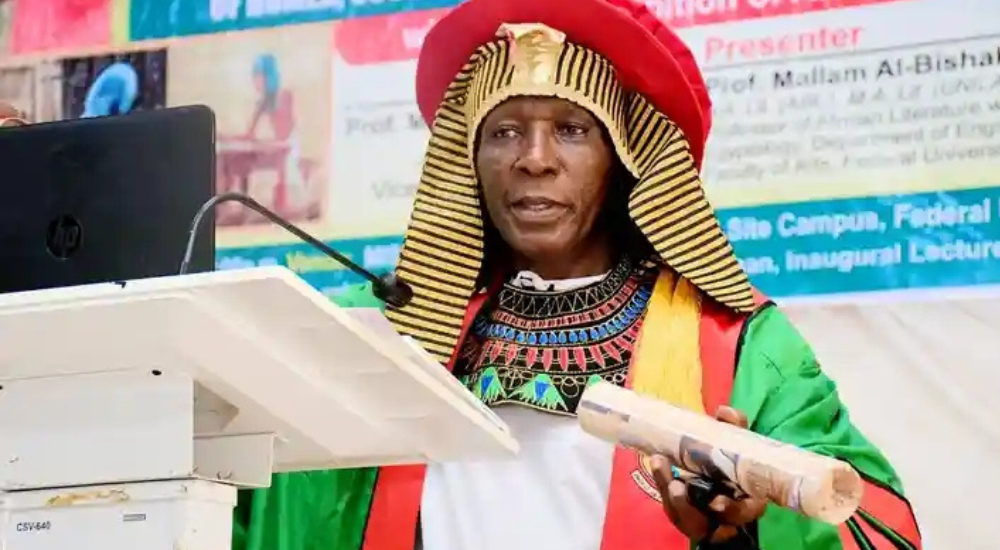
Mallam Al-Bishak, a Professor of African Literature with specialisation in Literary Egyptology, caused a sensation at the 44th Inaugural Lecture of the Federal University of Lafia, Nasarawa State, on June 24, 2026 where he spoke on the topic, “Egyptology, Egyptomania and Khemetology: Literature and the Black African Literary Masters of Homer, Socrates, Plato, Aristotle, Etc”. Al-Bishak, who holds a chair at the Department of English and Literary Studies of the university, held his audience spellbound with a gallery of pictorial artifacts in addition to his appearance in ancient Egyptian costumes together with his female companion. Their cultural appearance re-enacted the past when the black Egyptians wore clothes and lived in decent homes before their encounter with the Europeans and Arabs, who falsely claim to have civilized them. He explained that contrary to Eurocentric claims, civilization began in Africa over 5000 BCE, and exported it to Eurasia prior to both the trans-Saharan and trans-Atlantic slave trades and colonization of the black Africans. He said the modern African schools are mere agencies for foisting mental slavery on the black Africans by the Eurasians, and urged black Africans to emancipate themselves from mental slavery. The excerpts.
Briefly explain your claim that civilization started in Africa.
Civilization began with the black Africans in ancient Egypt over 7,000 years ago. Egypt is the first and oldest country in the world since over 5000 BCE, and the aboriginal black Egyptians migrated from the south of the River Nile or along the Nile Valley. It established the first world empire known as the Egyptian Empire by conquering countries in Europe, Asia and Africa, ahead of the Palestinian (Hyksos), Persian (Iranian), Macedonian (Greek), Roman/Byzantine, Arabian, Ottoman (Turkish), French, British empires, etc. Egypt is the Greek translation of the Egyptian name, Khemet, which means, “land of black people” just as the Arabs called Africa “bilad-as-Sudan” also “land of black people”. The monumental achievements of Egypt such as the Pyramids, Sphinxes, Temples, schools/universities, and two of the seven wonders of the ancient world, namely the Gizah Pyramid and the Lighthouse of Pharos, were mostly constructed by the black Pharaohs. This is notwithstanding the fact that the Arabs have occupied Egypt since 639 CE, seven years after the death of Prophet Muhammad (PBUH), and had no hand in the great civilization of Egypt in antiquity.
Did the black Egyptians go into extinction?
No, they did not go into extinction. The black Egyptians moved down south to especially the Aswan Region of Egypt. They are not black Arabs but genuine black Africans called Nubians. They share almost the same culture as other black Africans in the rest of Africa. They speak the Nubian language but use Arabic as the official language.
Do they constitute a minority of today’s Egypt?
Advertisement
Yes, I think so. When the Arabs conquered North Africa in 639 CE the aboriginal black inhabitants left there for down south of Africa. That’s why some African tribes like Wolof, Hausa, Yoruba, etc have some linguistic affinity with Nubian because they will tell you that their ancestors migrated from North Africa. But, people will be surprised, thinking that North Africa is occupied by Arabs. How can some black tribes claim to have originated from there? The truth is that North Africa was originally inhabited by the blacks but left there after Arab occupation. Aside from the Arabs, there are descendants of the Palestinians, Persians, Greeks, Romans, Turks, French, British, etc
who once invaded Egypt.
Intermarriages among the different whites and blacks have also created some unique admixture of the Egyptian population. Still, the aboriginal inhabitants were blacks because the earliest rulers of Egypt that bore the title ‘Pharaoh’ were all black Africans.
What was the core message of your lecture?
Quite often the kind of knowledge our students are being taught is that there was no civilization in Africa; in fact, that there was no education in Africa. They are taught that it was when the Europeans or the Arabs came to Africa that the blacks began to acquire formal knowledge. In virtually all the subjects taught at the university, you will always hear about Aristotle, Socrates, Plato, etc. These are the people that are thought to be the founders of knowledge or education. But, those Greek philosophers existed less than 500 years before Jesus Christ came to this world. Whereas we had ancient black Africans who had been in existence and had written books nearly 3,000 years before the emergence of Jesus Christ. That was the time Africa had the first world empire. Egypt had the first world empire at the time of Pharaoh Thutmose III, who conquered almost 110 countries across Europe, Asia, and Africa to establish the first world empire. That was before we had the Persian Empire, which is the Iranian Empire; Macedonian Empire of the Greeks, Roman Empire, British Empire, French Empire and Ottoman Empire, etc. Egypt had civilization before any other country or people.
Your lecture explored the concepts of Egyptology, Egyptomania and Khemetology. What do they mean?
Egyptology means the study of Ancient Egypt. However, the people who dominate the field are the Europeans. They always want to project the history of Egypt from the white-man’s point of view. The Arabs took over Egypt since 639 CE or AD. If you check the internet, you will be misled. You are likely to see the picture of Pharaoh as a white man. But, there has been no pharaoh as a white man despite the fact that the Greek conqueror, ‘Alexander, the Great’, sought some form of legitimacy in Egypt from the Oracle at the Siwa Island. All the pharaohs of Egypt were black people including men and women. When you hear of the Pharaoh in the Bible, or in the Koran, they are not Europeans or Arabs. Most, not all, white scholars of Egyptology try to change that history by painting it as a white man’s civilization. It is like Christianity – a lot of people think that Christianity is a white man’s religion. The white man didn’t bring Christianity to Africa. On the contrary, it was the black man that took Christianity to Europe. The first church in the world is the Abyssinian Church of Ethiopia. Ethiopia is the oldest Christian country in the world. The second church is the Coptic Church of Alexandria in Egypt. These churches existed for over 300 years before there was any church in Britain or even Rome. Today, people go to Rome to see the Pope. However, even the title ‘Pope’ was first borne by the Archbishop of Alexandria in Egypt. Furthermore, the ‘Old Testament’ and the ‘New Testament’ of The Bible were both written in Egypt by the black Hebrews. Historically, many factors that led to the institutionalization of Christianity took place in Africa. You may have heard of St. Augustine of Hippo from somewhere around Algeria. He too is one of the foremost propounders of Christianity in Europe. Africa took Christianity to Europe.
Advertisement
You mean the Christianity we have today is a re-brand?
Yes. After the slave trades and colonization of Africa, the whites brought Western Christianity. It is a re-branded form of Christianity. They will tell you that Jesus Christ and his mother are white; God is white; Angels are white; the Prophets are white. They don’t talk about any prophet that is black. It is the black man’s Christianity that was taken to Europe but was re-branded, and brought back to Africa with white images.
What about education?
It is the same. Everybody believes that schools started in Europe; that Africa never had schools. It is not true. We started school buildings. What we do in universities today is what they did in the ancient times in Egypt, and transmitted it. After all, Aristotle, Socrates, Plato, all went to Egypt to study in one way or the other. The Teachings of Ptah Hotep is the oldest book in the world. No white man has written a book that is older than that. I am not saying that Ptah Hotep was the first man to write a book. He had his black forebears like Imhotep. Imhotep wrote his books on papyrus but, they are not extant. It is like Socrates whom you can’t find any book written by him yet, we know he was a scholar, and cited by Plato. The same thing with Imotep. But, Ptah Hotep, who came later than Imhotep, fortunately had his works survive till date. Both of them were black Egyptians, and there are many others. The white Egyptologists will change their pictures, and project them as white. That is why I took the pain to publish their pictures in my inaugural lecture booklet. So, Egyptology can be said to be the depiction of the history of Egypt from the white man’s perspective.
Egyptomania talks about a particular time around 18th and 19th centuries when Europeans got to know about the history of ancient Egypt by deciphering the hieroglyphs. Before then, they had never associated civilization with the black man except Eurasia. But, following their ability to peruse the Egyptian hieroglyphs, they got to learn a lot about the great civilization of ancient Egypt. The hieroglyphs are like pictures or pictograms, but they are letters of the Egyptian alphabet representing phonological sounds. Incidentally, even the Arabs took their script from the ancient Egyptian Hieratic writing. The A-B-C of the Romans emanated from the Egyptian Coptic writing.
Tell us about Khemetology
The ancient Egyptians call their country Khemet, which means ‘land of black people’. When Greeks came, they translated it into their language, which is ‘land of black people’. The Arabs did the same. When they came to Africa they called it Bilad-as-Sudan. When you hear Sudan, it means black people. Both Greeks and Arabs attest to the fact that Egypt was black. So Khemetology is the equivalent of Egyptology but from the Africanist perspective
Writing about ancient Egypt is not a straightforward thing. You can’t talk about Egyptology without talking about other relevant aspects of civilization. The black Egyptians were a creative or talented people. To prove that ancient Egyptians were educated, you first have to establish their humanity.
Advertisement
How have you deconstructed the Eurocentric portrayal of blacks as animals?
Europeans and Arabs have claimed that blacks were animals. They said the blacks were living naked on tree-tops or inside caves with wide animals. Ironically, however, we civilized the Europeans. When the black Pharaohs conquered them they civilized them. We took civilization to them. Instead of bringing civilization to us, they did the opposite. They brutalized us. They committed all sorts of atrocities against us. The Arabs castrated our men so that they would become domestic slaves in Arabia. Yet, the first paper in the world was produced in Egypt from the papyrus plant; the same with the pen and ink.
Why did you think that the Africanist perspective is important to the study of ancient African history?
The perspective is important so that those of us who are black should fight mental slavery, which is holding us back. I always remember Bob Marley in his ‘Redemption Song’ where he said, “Emancipate yourselves from mental slavery/None but ourselves can free our minds.” Mental slavery has kept us back, so that we can’t develop on our own but continue to look up to the whites in Eurasia for development.
In what way do you think that mental slavery has affected our understanding of religion?
My problem with the Christian and Muslim preachers is that they interpret the scriptures (The Bible and The Qur’an) from the white man’s viewpoint. They see the black personages in the scriptures as only slaves. They don’t see any of the prophets as black. If you tell the blacks that Jesus Christ is a black man, many of them will denounce Christianity. But if I say that devil is a black man, they will say it is true. Psychologically, mental slavery has affected us. As such, we can’t think. We can’t progress because if we want to develop, we say we should go to Europe or America to learn how to develop, whereas we have development with us.
How do you react to the claim that the whites civilized us by bringing mirror and other fancy articles of commerce?
It’s a lie. We had mirror, our own brand of gin or beer, and other things before the white man came to Africa. If you see my inaugural lecture booklet, I have published our artifacts including mirror, beer, pants, camisole, cover shoes, bed carved from wood, clothes, schools, temples, books, etc. We were simply brainwashed by the whites. You see, in the history of warfare, when a people is conquered, its history is destroyed, and replaced with that of the conqueror. They destroyed our history, and started propagating falsehood.
What would you say is the impact of your inaugural lecture?
The response was phenomenal. Even though I planned very well for the lecture, I didn’t expect the acceptance was going to be as impressive as it turned out to be. In fact, one of the recommendations during the inaugural lecture is the establishment of the Institute of Ancient African Studies at the Federal University of Lafia (FULafia) so that the university will have a museum and archives of ancient materials that talk about the history of Africa and its dominance in the ancient world. The Vice Chancellor appears to be interested in it. If my university establishes the institute, it will bring a lot of glory to it and also Nasarawa State. Tourists will be attracted. Fortunately, Governor Abdullahi A. Sule has made everything easy by building both the overpass and underpass in strategic parts of the state for easy access or transportation. The institute will generate revenue. There is no such institute in Nigeria devoted to ancient history traced to Egypt. If the university establishes it, I will donate my Egyptian artifacts and costumes. If I die, of what use will all these things be to me? If they are there in the museum or archives, people will see them, and learn from them. The ancient blacks had clothes, cover shoes, beds, pants, mirrors, and factories making alcoholic drinks. They had clepsidrae (water clock), which the black Egyptian physicists used to determine the concept of 60 seconds per minute; 60 minutes per hour, 24 hours per day, 30 days a month, 365 days per year, etc. What we have today is just the modernization of those things. When I went into the chamber or bedroom of Queen Nefertiti, I couldn’t believe it. Her cosmetics, mirror, comb, jewelry, costumes, etc were there. I used to think that they were modern things but, I was told at the Egyptian Museum that they had existed over 5,000 years before Christ.
Most students, including me, came to know about Egyptology from you. More curious is the fact that aside from Nasarawa State University, Keffi (NSUK); Federal University of Lafia (FULafia), Nasarawa State, and other institutions where you have taught, I doubt if Egyptology is studied anywhere among the Nigerian universities.
What attracted you to Egyptology?
I’m not sure if any Nigerian university, including the institutions where I have taught, offers Egyptology as a course. However, when you are familiar with some compelling historical facts or knowledge, it’s difficult not to share it with your students and colleagues in the classroom or at conferences or in academic journals and platforms. My field is African literature. It’s difficult to accept or keep quiet when the academic authority claims that Eurasians (Europeans and Arabs) introduced to the black Africans formal education based on literacy and numeracy whereas it’s the Africans that had actually taught the Eurasians literacy and numeracy because they had a much older enlightened civilization than the duo, and had conquered them.
I came across Egyptology by accident in the mid-1970s. As a secondary school student, I had a passion for reading. I lived with my parents in Kaduna, and frequented the Kaduna State Library. One day I was strolling in the library looking for any book of interest to read when my eyes fell on Africa Before They Came by Gabriel Welch. I asked myself who could “they” refer to, and how did Africa live before “they” came? I read the blurb, and was quite fascinated. So I grabbed the book, and read it. I was shocked by the positive things written about Africa which contradicted the negative things said about Africa. Then when I worked with the Daily Times of Nigeria newspaper in Lagos in the late 1980s, I also saw in its library a book, The Splendor That Was Egypt, by Margaret A. Murray, which corroborated Welch’s book in greater detail. From there, I began to research into the history of ancient Egypt and Africa as a whole in many university libraries and archives. That was how I developed my interest in Egyptology, and wrote both my Master’s and doctorate degrees’ theses on some literary aspects of Egyptology. Eventually, I travelled to Egypt in 2016 and 2025 to see things for myself, and gather some historical materials for my inaugural lecture.
Can you be said to be the propounder of Afro-Egyptology?
What you mean is Afrocentric Egyptology; in other words, Khemetology. There are some scholars in America, Britain, Germany and some other parts of Europe that portray ancient Egypt as a black African civilization, and celebrate its dominance over the white race in the Mediterranean, Middle East and Asia instead of downgrading it. However, I described myself as a Khemetologist, one that believes in the black dominance of ancient Egypt before I got to know that some African-American scholars like Yosef ben-Jochannan and Molefi Kete Asante also called themselves Khemetologists. It’s a mere coincidence.
What is your message to the blacks of this world?
Black people should believe in themselves. They should reject false history about Africa. They should always remember, and work consciously towards actualizing legendary Jamaican pan-Africanist, Marcus Mosiah Garvey’s prophecy that, “Black men, you were once great; you shall be great again”!