
Kanu’s Lawyer Questions Legal Basis For Supreme Court’s Remittal Order
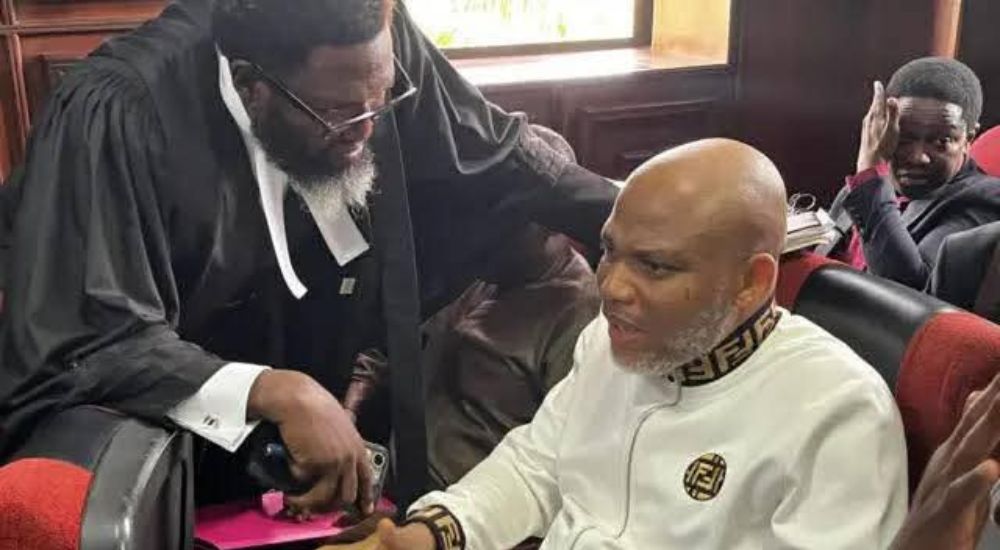
A lawyer representing convicted leader of the Indigenous People of Biafra (IPOB), Nnamdi Kanu, has questioned the legal basis upon which the Supreme Court ordered the continuation of his trial after the Court of Appeal had earlier quashed the charges against him.
The lawyer, Onyedikachi Ifedi, who’s a member of the Label Consortium representing Kanu raised the questions on Sunday arguing that the Supreme Court’s appellate jurisdiction did not, by itself, empower it to revive charges that had been quashed by the Court of Appeal.
The Court of Appeal had, on October 13, 2022, quashed the charges and discharged Kanu. However, the Supreme Court, on December 15, 2023, set aside the appellate court’s decision and ordered that Kanu’s trial should “continue.”
According to Ifedi, the subsequent recusal of Justice Binta Nyako and the transfer of the proceedings to another judge could explain procedural changes, including a fresh plea, but did not resolve what he described as the legal status of the quashed counts.
“Recusal can change the judge and restart procedure. It cannot answer a more fundamental question: what was the legal status of the counts to which the accused was asked to plead?” he said.
The lawyer also challenged the Supreme Court’s treatment of Count 15, which was later numbered Count 7 at the Federal High Court.
Advertisement
He said the count originally cited Section 47(2)(a) of the Criminal Code Act, Cap C45, but Justice Lawal Garba held that the citation was a mistake and that the facts disclosed an offence under Section 47(2)(a) of the Customs and Excise Management Act (CEMA), Cap C45.
Ifedi questioned the legal authority for the Supreme Court to substitute the statutory basis of a criminal charge.
“The Supreme Court is not the prosecutor. It is a neutral arbiter. If the law gives it the power to substitute the statutory foundation of a criminal accusation, show us the law,” he said.
He further disputed the judgment’s description of CEMA Cap C45 as an “extant and existing law” in December 2023, arguing that it had been repealed by the Nigeria Customs Service Act 2023 on April 20, 2023.
The lawyer therefore asked what legal provision, if any, preserved CEMA after its repeal.
Advertisement
“If such a law exists, identify it. Show us the law,” he said.
Ifedi maintained that the Federal High Court’s general jurisdiction over terrorism offences should be distinguished from the existence of a valid charge against a particular defendant.
His argument was that the legal sequence should be “law, charge, jurisdiction, trial,” rather than a court order creating the basis for a charge and subsequent trial.
He cited the Supreme Court’s decision in Onu Okafor v The State (1976), arguing that the decision underscored the importance of a valid legal foundation for criminal proceedings.
The lawyer concluded that the Supreme Court’s final authority within Nigeria’s judicial hierarchy did not mean it could create criminal law or exercise powers not granted by legislation.
“The Supreme Court’s finality does not mean that law becomes unnecessary,” Ifedi said.
Advertisement
He urged the legal community to identify the statutory provisions supporting the revival of the quashed counts, the substitution of Count 15’s statutory foundation and the continued applicability of CEMA Cap C45 after its alleged repeal.