
OPINION: Two Generals, Double Tragedy: Are Nigeria’s Battlefields Technologically Outdated?
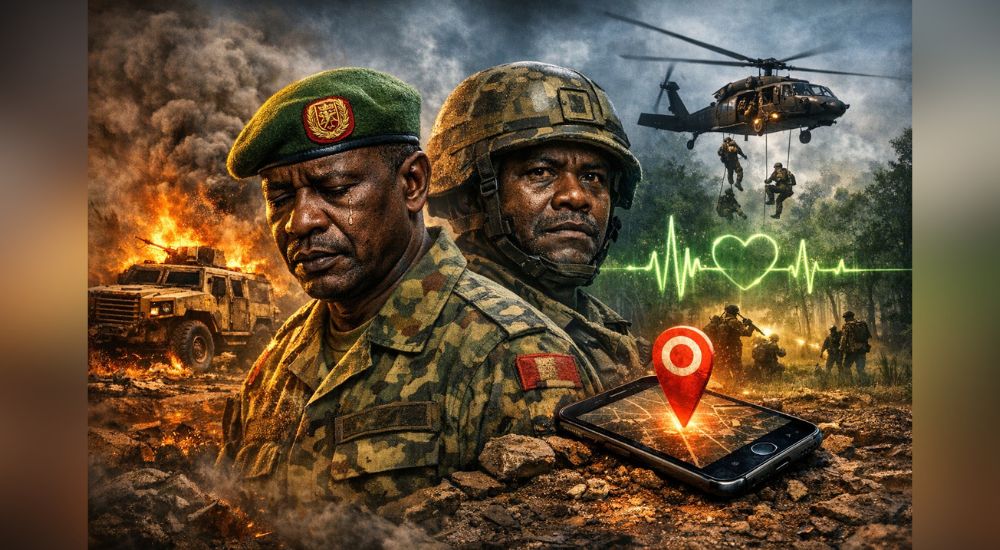
I have been troubled for days. Not just by the news of Brigadier General Oseni Braimah, another senior military officer killed in Borno, but by what these repeated losses are quietly telling us.
Before the grief from the most recent death could settle, I remembered Brigadier General Musa Uba, who died in equally disturbing circumstances in late 2025. He was separated from his team in Damboa, hiding in the forest, using WhatsApp to send his live location and proof-of-life video, hoping rescue would come. It never did.
When I reflect on that incident, something about it keeps bothering me. A senior commander, alone in hostile terrain, forced to depend on a smartphone signal for survival. In today’s battlefield, that is like lighting a lantern in the middle of a dark bush. You want your people to find you, but you may also guide the enemy straight to your hiding place.
Contrast this with the recent tragedy of General Braimah in Benisheikh. Reports suggest his end came not from a digital signal, but from a mechanical failure, an armored vehicle that reportedly failed to start at the critical moment of escape.
Whether it is a smartphone signal that gives away a location or an engine that fails in the heat of an ambush, the root cause is the same: our finest men are being sent into battle with tools that are either too “loud” or too unreliable for the modern theater of war.
Advertisement
Around the same time, news broke of a miracle extraction in Iran. A US airman was pulled from a mountain crevice without saying a word. No WhatsApp, no radio, no signal. The CIA reportedly used a tool called “Ghost Murmur.” They did not look for his phone. They looked for the rhythm of his life. They filtered out the desert heat and the mineral-rich rocks until they found one thing: the steady thump-thump of a human heart. They found their man because he was alive. His biology was his broadcast.
Whether exaggerated or not, the idea behind it struck me. It suggests a future where rescue happens quietly, without exposing the person in danger.
Then I looked back at our own reality. In Damboa, General Uba had to share his location to be saved. Every digital move meant to rescue him may have also increased his vulnerability. If reports about tracking or internal leaks are even partly true, then the tragedy becomes even harder to ignore.
Where I come from, elders say that when you shout in the forest, you must be ready for whoever answers. It may be a friend; it may also be a predator. That is exactly what modern warfare has become. Signals are no longer neutral. They are footprints. Similarly, an armored vehicle that cannot move is not a shield; it is a cage.
I do not believe this is simply about bravery. Our officers lead from the front. They take risks many of us cannot imagine. But courage alone cannot defeat a changing battlefield. War is no longer only about bullets; it is about information, reliability, and silence.
Advertisement
What worries me most is the pattern. When senior officers are lost, the cost is not just emotional. We lose experience, leadership, and institutional memory. Troops feel it. The public feels it. And insurgents exploit it for propaganda.
I am also concerned about the information gap that follows these incidents. Initial denials, followed by conflicting reports, and then confirmation through insurgent propaganda. In communication, credibility is everything. As the proverb goes, the man who hides the truth today may not be believed tomorrow.
To me, the lesson is clear. We are fighting a loud war in what has become a silent battlefield. Our movements are visible. Our signals are audible. Our equipment is aging. Meanwhile, the enemy thrives in the shadows, exploiting every weakness in our hardware and our communication.
I believe we must start thinking differently. Communication discipline must improve. Smartphones are not designed for battlefield secrecy. Furthermore, our hardware, the APCs and engines our leaders rely on, must be as reliable as their courage. In my village, we say the secret that passes through many mouths soon loses its owner. We might also say that a warrior is only as fast as the horse beneath him.
The officers we have lost did not fail. They were doing their duty under difficult conditions. The real failure would be if we do not learn from their sacrifice. War has changed. It has moved from noise to data, from open confrontation to hidden detection.
My heart breaks for General Braimah and General Uba. These were not just names on a map; they were shields of our nation. But bravery alone cannot fight a ghost.
Advertisement
The lesson from “Ghost Murmur” is simple: The human body itself may now be a signal. If we do not learn how to manage that reality, how to protect it, hide it, and provide the mechanical reliability to move it; we will keep sending our heroes into the forest with nothing but a prayer and tools the enemy has already mastered.
It is time we stopped looking for signals and started listening to the heartbeat. We owe the fallen more than mourning. I believe we owe them a smarter fight.
Young Ozogwu is an Abuja-based public commentator. You can contact him on [email protected]