
FG, States Grow Debts By N147.16tn In 10 Years
Data Show 1,214% Increase
Total debt balloons from N87.38tn to N159.28tn In 30 Months
Nigeria’s public debt rose by N147.15tn in the last 10 years, data obtained from the Debt Management Office on Sunday have shown.
According to the data obtained by The Whistler, Nigeria’s total debt as of December, 31, 2025 stood at N159.28tn. This is N147.16tn higher than Nigeria’s debt as of June 30, 2015.
The period under review corresponds with the management of the nation’s economy by the All Progressives Congress. The late APC leader, General Muhammadu Buhari took over the reins of government on May 29, 2015.
Advertisement
As of June 30, 2015, the nation’s public debt stood at N12.12tn. However, this had ballooned to N159.28tn by the end 2025. This means that within the last 10 years, the country’s public debt rose by 1,214 per cent.
Although the public debt represents the indebtedness of both the Federal Government and the subnational governments, analyses of data obtained from the DMO showed that much of the debts were owed by the Federal Government.
A breakdown of the total public debt shows that Federal Government’s domestic debt make up 50.53 per cent or N80.49tn, while the 36 states of the federation and the Federal Capital Territory owe N3.08tn or 2.74 per cent of the total public debt.
On the other hand, the foreign debt of the Federal Government makes up 41.61 per cent or N66.27tn. The 36 states and the FCT owe N8.16tn in foreign debt. This accounts for 4.12 per cent of the total public debt.
Advertisement
Therefore, of the total public debt, the Federal Government accounts for N146.76tn or 92.14 per cent. The subnational governments account for N12.52tn or 7.86 per cent.
Some have attributed the sharp rise in the country’s debts to the recent devaluation of the naira. However, this may hold for the foreign debt component but domestic debt accounts for more than 50 per cent of the total public debt.
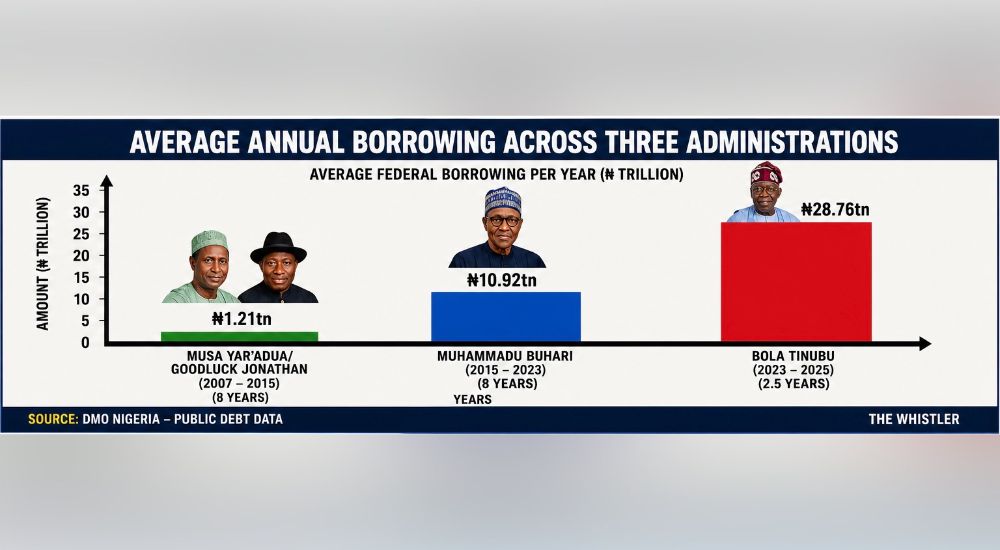
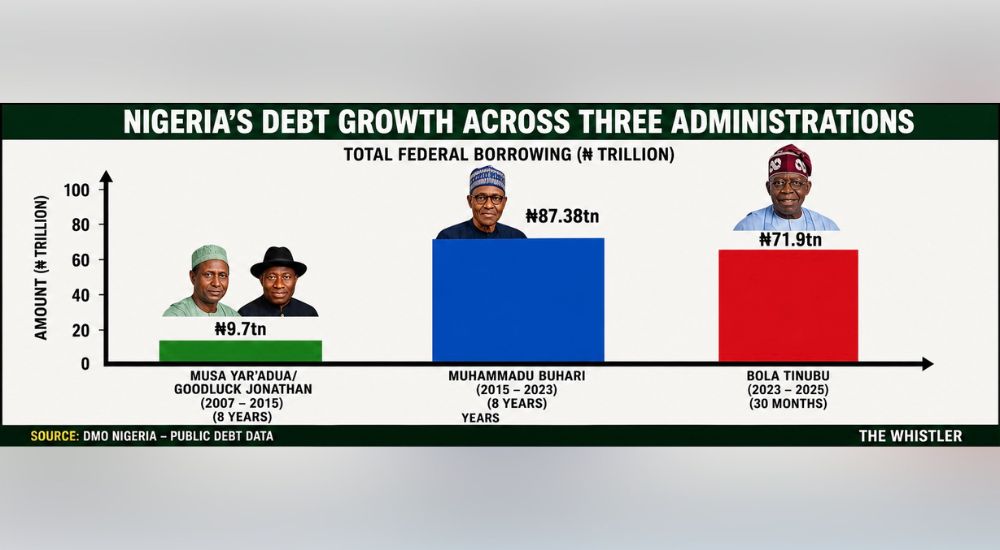
As of June 30, 2023, Nigeria’s public debt stood at N87.38tn. Buhari handed over the reins of government to President Bola Tinubu on May 29, 2023.
Thus, within the first two and half years of Tinubu, the country’s total debt ballooned from N87.38tn to N159.28tn.
This shows a difference of N71.9tn. In percentage terms, the country’s debt rose by 82.28 per cent in two and half years – July 1, 2023 to December 31, 2025.
Advertisement
As of June 30, 2015, the domestic debt of the Federal Government stood at N8.4tn while the domestic debt of the 36 states and the FCT stood at N1.69tn. The external debt component of both tiers of government stood at N2.03tn.
During the Buhari era, the domestic debt was accentuated by the Ways and Means Advances which the Central Bank of Nigeria under Mr. Godwin Emefiele granted to the government.
The National Assembly in May 2023 approved the securitisation of the Ways and Means Advances amounting to N22.7tn, thus raising the domestic debt component of the Federal Government to N62.72tn.
However, the current government has grown the domestic debt from N62.72tn to N80.49tn. This means that the within a period of two and half years, the domestic debt of the Federal Government rose by N17.77tn. This is an increase of 28.33 per cent.
On the external scene, the Federal Government’s debt rose from N29.9tn as of June 30, 2023 to N66.27tn, giving a difference of N36.37tn.
Thus, between June 30, 2023 and December 31, 2025, the Federal Government’s external debt rose by 121.64 per cent.
One of the consequences of the nation’s rising debts is that the country spends much of its income in servicing debts that many citizens think were not spent wisely.
In the last quarter of 2025, for instance, the government spent a total of N2.28tn in domestic debt servicing. Within the three-month window, it spent $1.8bn in foreign debt servicing.
Between 2022 and 2023, the country spent more than 90 per cent of its revenue in debt servicing. This has significant reduced with revenue rising following the removal fuel subsidy by President Tinubu in May 2023.
However, as of late 2025, the country spent about 72 per cent of its revenue on debt servicing. This is still much higher than the threshold of 22.5 per cent recommended by the World Bank.
As a result of the nation’s high debt servicing to revenue ratio, not much is left for infrastructure development where the country is in high deficit.
Beside high recurrent budget, the country struggles with corruption which is suspected to gulp significant portions of both recurring and capital expenditures.
Faced with high debt servicing which gulped considerable proportion of the nation’s revenue, former president, Chief Olusegun Obasanjo working with Dr. Ngozi Okonjo-Iweala as finance minister, had negotiated a debt relief with the Paris Club of creditors. This saw about $18bn of the country’s debt wiped off after payment of $12bn.
As of the time Obasanjo handed over in May 2007, the country’s debt stood at about N2.42tn in both foreign and local debts. This figure rose within the tenures of his successors, the late Alhaji Umaru Yar’Adua and Dr. Goodluck Jonathan.
By the time Jonathan handed over to Buhari in May 2015, the debt stood at about N12.12tn, local and foreign.
Economic analysts expressed concern over the rapid increase in Nigeria’s total public debt, which surged from N87.38tn to N159.28tn by the end of 2025.
They raised issues about fiscal sustainability, high servicing costs, and the risks of a debt trap.
The Group Managing Director, Crane Securities Limited, Mr. Mike Eze, in an interview with THE WHISTLER said the pace of debt accumulation was becoming a major macroeconomic concern, especially when compared with the growth rate of government revenue and productive investment.
According to him a debt stock of over N159tn is not necessarily bad for a large economy, but the main issue is the debt-service-to-revenue ratio.
He added that when a country spends over 70 per cent of its revenue servicing debt, fiscal sustainability comes under pressure.
Eze also blamed a significant portion of the increase to exchange rate depreciation, because external debts are converted into naira terms. He noted, however, that this reason could not fully account for the sharp growth in domestic borrowing.
He called on the government to prioritise aggressive revenue reforms, reduction in the cost of governance, and stronger accountability for borrowed funds.
He said, “Borrowing should be tied strictly to projects that can stimulate growth, exports, and productivity.
“What these numbers reveal is not just a debt problem, but a governance and productivity crisis.
“Nations can borrow responsibly if the funds are invested in sectors that expand economic capacity and improve citizens’ welfare.
“The concern in Nigeria is that despite the rapid rise in public debt over the last decade, infrastructure deficits, poverty, unemployment, and insecurity have continued to worsen.”
A financial analyst, Mr. Dele Johnson, said that the increase was alarming, but added that part of the expansion was due to naira devaluation after the exchange rate reforms.
Johnson noted that once the naira weakened, the local currency value of external obligations naturally surged.
He said, “The underlying fiscal vulnerabilities remain serious because debt servicing continues to absorb a disproportionately high share of government revenue.”
According to him, the bigger risk is not just the size of the debt, but whether the economy can generate enough growth and foreign exchange earnings to sustain repayments without crowding out critical investments.
Johnson added, “Nigeria needs stronger export earnings, higher oil production, improved tax efficiency, and disciplined spending.
“Without faster economic growth, rising debt could continue to weaken investor confidence and constrain development financing.”
In an interview with one of our correspondents, the National Publicity Secretary of the African Democratic Congress, Bolaji Abdullahi, lampooned the APC government for irresponsible borrowing.
Abdullahi said, ‘The problem is not that Nigeria has borrowed. The problem is that APC has been borrowing without any visible transformation. They expanded our debt profile, but did not expand the productive capacity of the economy.
“The ADC does not believe all borrowing is bad. The issue is not borrowing itself, it is what the borrowing is used for. Borrowing for consumption is irresponsible. Borrowing for inflated contracts is reckless. Borrowing without transparency is dangerous. Borrowing that leaves citizens poorer is unacceptable.
“Under the APC, Nigeria is borrowing like a development state, but delivering like a consumption government.
Other countries have borrowed heavily too, but the difference is in their output.”
The ADC Spokesman said Nigeria cannot continue borrowing to fund inefficiency.
He said an ADC would reduce borrowing by reducing waste first.
He said, “Our documents already commit to cutting the cost of governance, implementing the Oronsaye Report, capping excessive appointments, digitising public service, reducing non-essential travel, and publishing quarterly revenue and expenditure reports so citizens can track spending.
“Specifically, the ADC will target a 40% reduction in the cost of governance, reduce recurrent expenditure to below 60% of the budget, save an estimated N3tn to N5tn yearly through governance and procurement reforms, raise the tax-to-GDP ratio from about 6% toward 15%, and bring debt service below 40% of revenue.”
He added that the ADC would finance infrastructure by shifting from debt-led projects to investment-led projects.
When contacted for reaction, the National Publicity Secretary of the All Progressives Congress, Felix Morka, was unable to grant an interview at the moment due to the ongoing party screening exercise.
He, however, assured that he would respond to questions after the screening process, which is expected to conclude on Tuesday.