Fuel Price Hike: Commuters Walk Long Distances To Beat High Transport Costs
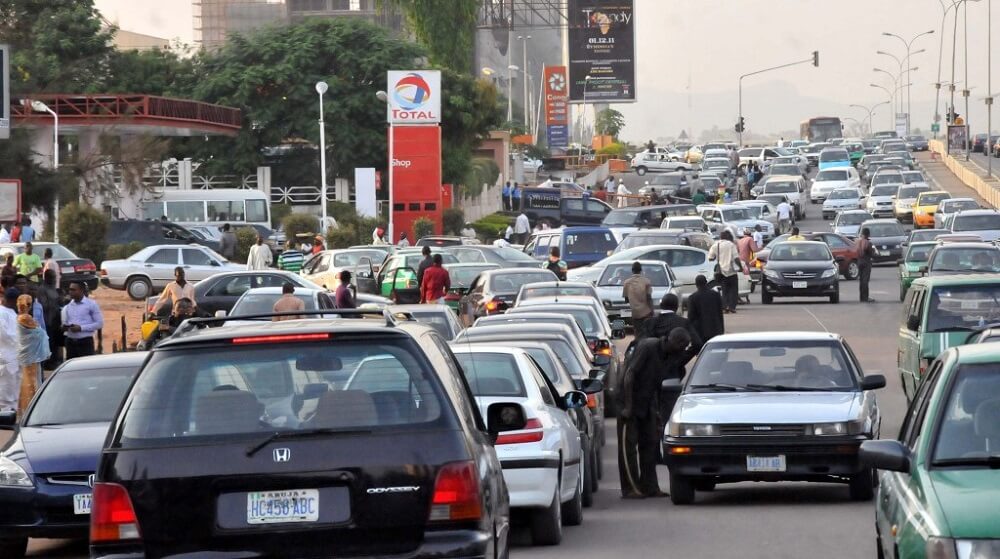
For many residents of the Federal Capital Territory, the daily journey to work is becoming more exhausting and expensive as the recent surge in petrol prices has driven up transport fares across major routes.
Across Abuja’s busy corridors, from Nyanya and Mararaba to Kubwa, Lugbe and Gwarinpa, commuters say they are increasingly forced to walk long distances or cut back on trips as transport operators adjust fares following the latest increase in fuel prices.
Many filling stations across the Federal Capital Territory have adjusted pump prices to about N1,330 per litre, up from about N835 just a week earlier, worsening the financial strain on workers who depend on public transportation to move around the city.
For daily commuters travelling from satellite towns into Abuja’s city centre, the hike has translated into steep increases in transport fares.
Operators of taxis, minibuses and coaster buses have raised fares by between 20 and 50 per cent, which has forced many workers to spend a larger portion of their income on transportation.
Workers who previously spent between N1,500 and N3,000 daily on transportation now say their expenses have climbed to N5,000 or more.
Advertisement
“I used to enter from NNPC Kubwa to Setraco in Gwarinpa for N500, but since Monday it has increased to N800,” said Nkechinyere Ogbonna, a commuter who works in the Gwarinpa area of Abuja.
For others, the impact goes beyond the extra money spent on transportation.
Cleopatra Newman, who also works in Gwarinpa but lives in Guzape, said the rising fares are pushing many residents to the brink.
“I used to take N700 to Apo Bridge, but since this week, it has become N1,000,” she told THE WHISTLER. adding that “The pressure is getting worse. The annoying part is that the government doesn’t even care. I see people walking longer distances to reduce transport costs.”
The ripple effect is also being felt among traders whose businesses depend on moving goods across the city.
Advertisement
Ibrahim Adamu, a trader in Gudu Market, said the increase in fuel price has raised his daily commuting costs.
“From Sunnyvale Junction to Gudu Market used to be N500, but it is now N800,” he said.
Similarly, Favour Uche, another commuter, described how transport fares have surged across several major routes in the city.
“From Nyanya Bridge to A.Y.A used to be N400, but as of Tuesday it became N700,” she said.
“From Nyanya Bridge to Appeal Court that used to be N700 is now N1,000 in coaster buses, while the smaller taxis charge N1,200 for the same distance.
“Even from Nyanya Bridge to Zuba that used to be N1,500 is now N2,500 since Tuesday. And from Nyanya Bridge to Wuse that used to be N700 or N800 is now N1,000,” she added.
Advertisement
According to her, the situation is particularly difficult for low-income earners, as transport costs now take up a significant portion of their daily income.
Beyond commuters, analysts say the increase in fuel prices could also trigger a broader rise in the cost of living.
Traders transporting goods into major Abuja markets such as Wuse Market, Garki Market and Utako Market have increase prices to offset higher transport expenses, which will further worsen the economic burden on residents who are both commuters and consumers.
The recent fuel price hike in Nigeria comes amid rising global crude oil prices linked to escalating tensions in the Middle East.
The conflict involving Iran, Israel and the United States has disrupted global energy markets, pushing oil prices higher as fears grow over potential supply disruptions.
Analysts said the global oil market is particularly sensitive because the Strait of Hormuz, a strategic shipping route through the Persian Gulf, handles nearly 20 per cent of the world’s oil supply. Any threat to shipping in the region often triggers sharp increases in crude prices.
Over the past week, crude oil prices surged above $90 per barrel at one point as military tensions intensified across the region, which has further raised concerns about disruptions to oil production and transportation.
While the surge in oil prices may appear beneficial to Nigeria as an oil-producing country, economists said the reality is more complex.
Nigeria built its 2026 national budget of about N58.4tn on an oil price benchmark of $64.85 per barrel, meaning the current spike could potentially generate additional revenue for the government.
However, experts noted that oil windfalls historically present both opportunities and challenges for the country.
A similar situation occurred during the 1973 Middle East crisis, also known as the Yom Kippur War, when oil prices quadrupled from about $3 to $12 per barrel after Arab oil producers imposed an embargo on countries supporting Israel.