
How Rising Heat Is Killing Wheat Farming In Kano
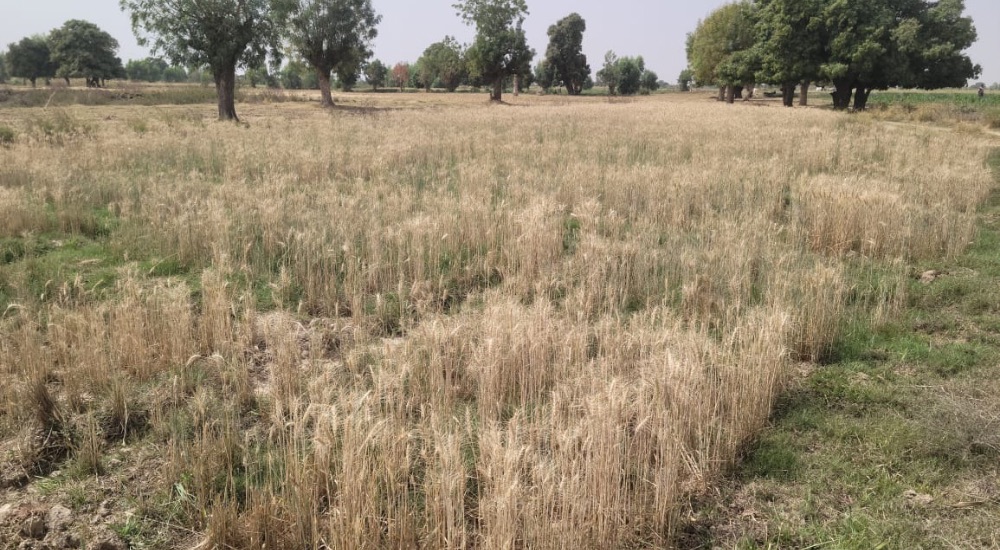
Musa Abdullahi stretches through the uneven fields of his wheat farm in Kura, running back and forth to rub his fingers against the rock.
For more than three decades, he has been farming on his land, and recalled that the cold months turned these fields green and perfected into a rolling landscape, with harvest time devoted to stacking grain bags after finishing it.
That world feels distant now. Stunted, yellow and minuscule stalks appear before him but nothing seems to fix them.
With his fingers, he tosses a fistfull of pale, powdery soil into his mouth and drops it.
He whispered, “this crop requires cold weather,” but the temperature has risen.
The situation in Kura, an agricultural area located on the southern edge of Kano, is not due to bad luck or poor technique.
Advertisement
A visible manifestation of a slow-moving crisis is the assertion made by scientists and agricultural officers that climate change is slowly changing the conditions in northern Nigeria’s fragile wheat belt.
A farm fashioned to endure extreme coldness.
In tropical regions, wheat has never been a popular crop.
Unlike maize or sorghum, it needs to be kept cool to develop properly, especially during germination and flowering.
Dry Saharan winds that drop night temperatures below 15 degrees Celsius during the harmattan season in northern Nigeria resulted in a small window of opportunity for wheat farming to resume between November and February.
Advertisement
Before the heat set in, wheat will be able to germinate easily with firm stems and fill out grain heads under those conditions.
That window is shrinking.
Throughout Nigeria, the Meteorological Agency has noted a steady increase in temperatures throughout the northern region over an extended period.
The average minimum night temperature in Kano during the 1980s and 1990s was between 13 and 15 degrees Celsius, but it has now risen to over 18 degrees, which is devastating for crops that are sensitive to cold weather.
This may seem like a small change. Wheat yields are estimated to decrease by approximately 6% for every one degree Celsius rise in average temperature, as per the Intergovernmental Panel on Climate Change.
Ibrahim Shehu, an agronomist who has researched how temperature changes can affect small-scale agriculture across the Sahel said “the
nights are warmer, the cold season is shorter. This is only thing that can disrupt wheat production in Kano.”
Advertisement
“We Used to Harvest Bags, Now It’s Losses.”
The seasonal decline has been observed by Zainab Bello, an agricultural extension officer who works with farmers in Kura and Bunkure.
She said, “the harmattan is getting shorter. It takes a cold stress period for the heat to develop.”
“If not there, you will have poor germination, weak stems, and low grain yield. The farmers are seeing exactly that.”
The human cost is clearly visible to those who are dependent on the crop.
At Garun Malam, Zainab Sani, 30, sits beside a modest wheat pile that is barely enough to load five sacks.
The same plot of her family’s farm yielded more than 20 bags five years ago.
She said: “Last year we harvested only 9 bags but this year it was just five.
“We had the option of eating wheat during the dry season.”
But Aisha and her husband are uncertain about whether to switch to rice or vegetables as a family.
She disclosed that the issue is that the knowledge of climate from inherited calendars and seasonal cues has become unreliable, leading to farmers following traditional practices instead.
This is unfortunate. “What has always been effective is no longer functional.”
To adapt to the climate, Kabiru Aminu, 66, has been increasing his irrigation routine in Kura, with the aim of reducing the surface temperature of the soil.
“It’s an imperfect solution. Water is scarce. The cost of diesel for the pumps is increasing and rising,” he said.
The unpredictable nature of the harmattan’s arrival has led farmers to push earlier into their planting schedules to avoid colds. What changes? The effectiveness of this method is infrequent.
According to Aminu, the timing has become unreliable. “If you plant a seed early, it may still experience heat.
“Late planting is not an option, as the cold window has already passed.”
Local soil: A national issue
Kano’s farms are not the only ones affected by the implications.
Among Africa’s largest wheat importers, Nigeria spends billions of dollars annually on the grain.
THE WHISTLER documented that domestic production in northern states like Kano, Katsina and Jigawa has always met a fraction of the national demand, it still provides price stability and food security that millions of households depend on.
If the production base is destroyed by climate, Nigeria’s vulnerability to the volatile wheat markets of the global market would be further weakened due to unstable global wheat prices, as demonstrated by the Russia-Ukraine war in 2022.
Dr Shehu Musa, an agriculturalist in Bayero University Kano noted that “this is not a farming issue.”
He asserted that the issue of national food security is a concern.
“The lack of wheat production due to the climate has an adverse impact on bread prices and household stability.
The majority of solutions are not accessible to smallholder farmers.”
THE WHISTLER found out that the International Maize and Wheat Improvement Centre and other international research centers are actively engaged in breeding heat-tolerant wheat varieties that can withstand harsh climates.
The challenge of delivering improved seeds from research stations to farmers like Musa at scale is still present.
According to Zainab, the most pressing requirement for extension officers is access to information that can help farmers understand the changes and why their inherited seasons have disappeared.
Musa, at the edge of his field in Kura’s rear, is seen brushing away dust from his hands. His job involves planting, irrigating, waiting and adapting; it’s the way farmers do it.
As a farmer, he said: “I know this, gazing down at the field, praying for cold.
“It is necessary for the wheat to remain alive, and neither will we.”
-This report was published under HumanAngle’s SCOJA Fellowship.