INTERVIEW: I Wanted To Die When I Went Blind – Visually Impaired Teacher
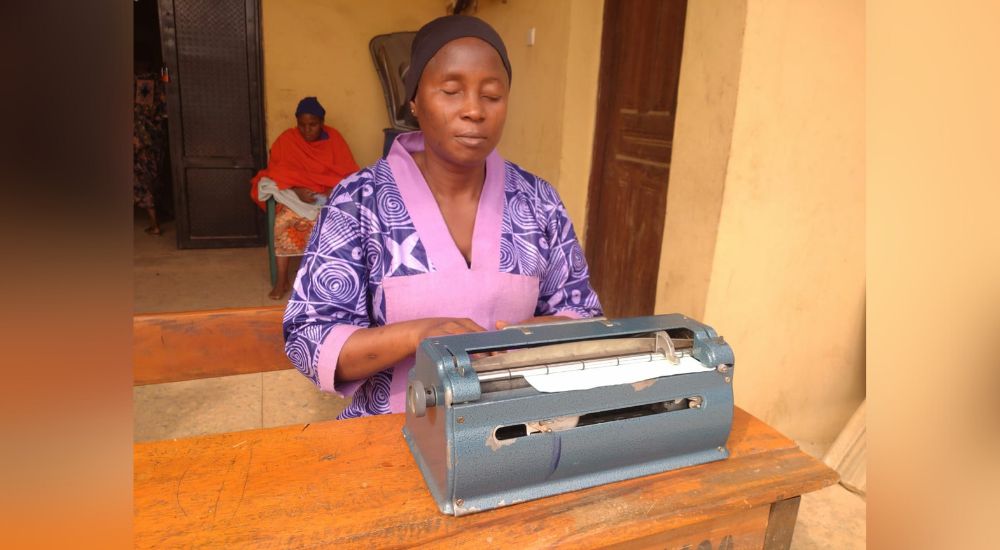
Priscilla Ladi Ben is a 43-year-old visually impaired teacher at the FCT School for the Blind Children. In an interview with THE WHISTLER, shares her inspiring journey of overcoming adversity and pursuing education despite her condition. She also opened up about her challenges as a teacher, her experiences with vision loss, and her determination to empower blind students like herself.
When did you lose your sight?
So, I grew to know that I was having a little eye problem. Then my mom took me to the hospital. I was diagnosed with cataract initially. They were treating me, but it was not getting better. This was when I was in primary school. I was eight or nine then. So, that was how it continued. I was schooling like that, sitting at the front seat, struggling to read from the board, but I couldn’t read from the board. I was depending on friends to copy notes.
Sometimes, if it was near closing time, I would wait until everyone left. I would tell the class monitor to leave the board untouched. Then, I would stand up, move to the board, and copy the notes undisturbed. That’s how I got through secondary school.
But even at that, I was still taking first position all through. I was the best in the class.
So how did you study for the examination then?
I would bring the book very close to my eye before I could see.
Advertisement
Did you go further to seek medical help?
After secondary school, I was taken to one hospital in Kano. The hospital that was managing it in Kogi State referred us to another hospital in Kano. They told us that I will undergo surgery. So, the operation was done on both eyes. After the surgery, it was not getting better. We went to another hospital which is a military hospital in Lagos. There, I still undergo another surgery in the two eyes. Then, after that surgery, it got worse because they said there was a mistake in the surgery.
Was it the first hospital that caused the mistake?
No, it was the second hospital. So, they said there was a mistake that they were supposed to put a lens on and they did not put it. It was after their own surgery that it got worse and I came back to the first hospital. I was seeing just about 5 percent. They tried to correct the operation, but it did not work.
So, I was advised to look for a school for the blind and have rehabilitation so that I can be able to cope and move on with my life. Initially, it was not easy. I attempted to take my life, but God saw me through. I now search for where I will find school for the blind. I found one in Jabi where I am now.
Can you tell us more about what happened after your condition worsened and how you continued your education?
Advertisement
So, after the first surgery, my eye condition worsened, and I told my parents I wanted to further my education despite my situation. I couldn’t read anything without a thick lens glass, which helped me see up close but wasn’t useful for walking.
I got admission to Kogi State College of Education with that thick glass. I struggled to see people from afar and relied on the glass to read textbooks and lecture handouts. I’d wear the glasses to write exams, but remove them to submit my papers, as I couldn’t see my way otherwise.
After finishing NCE, I wanted to study further and got into Obafemi Awolowo University, Ile Ife.
I didn’t mind the stress; I loved studying. I wrote JAMB, and gained admission to the university. By then, I was teaching in a school in Masaka, living with my elder sister.
One Friday, I went to school, arriving before 7:30 am. By 9 am, my eyes were red and painful, like needles were inside them. My head teacher sent me home, advising me to rest and return on Monday.
Back home, the pain intensified, and my vision blurred. I called my sister and my younger brother. Before they even came around, everywhere had become blank. I was thinking, I’m not seeing anything. Is it night already? I thought I was still dreaming. On Saturday morning, they rushed me to an eye clinic, a missionary hospital in Kano. The doctors said they’d try one last operation, with a 50-50 chance of success. It didn’t work.
I went through a lot of pain. I wanted to die. I called two girls and gave them all my clothes. I just left one…in my mind, I said, that is the one they will bury me with and stopped eating. I decided it was my last day. I asked to be buried with my dad, who had passed away.
That night, I dreamt of Dr. Pastor Paul Enenche from Dunamis. So, he now told me in the dream that I will not die. I woke up, and I received strength, and I received joy, and I started thanking God. I felt guilty. I was asking myself if I am the one who gave life that I wanted to take. I started telling God that I was sorry. So, my joy was restored. God always used people to talk to me when I feel down…I behave as if I’m not blind, and people around me feel happy. I’ve learned that with life, there’s hope. When someone’s in the grave, there’s no hope, but as long as I’m alive, God has a purpose for me.
That was how I found FCT School for the Blind. I came for rehabilitation, and they said I’d learn Braille – a means of reading and writing for the blind. I learned Braille and within three to six months, I was reading and writing it. I also learned typing on a typing machine and using a mobility cane to move around.
It was 2014 when I started, and by July 2015, I’d learned all these skills and graduated. In September 2015, I got employed to teach blind children at the FCT School of the Blind, where I’d done my rehabilitation.
That’s where I met my husband, and we got married in a traditional church wedding in Kogi State in 2016. He is a businessman from Plateau State.
Can you share how you manage teaching at the school, and what challenges do you face?
You know, I teach blind children like me. We use Braille books with the same syllabus as regular schools. I teach social studies, civic education, and other subjects. Sometimes, I face challenges with topics not available in Braille. To prepare lessons, I Google questions on my phone using voice typing or typing. However, I struggle with unfamiliar words or accents, like American voices.
The school lacks provisions for visually impaired teachers. Like now, the computers that we have, we cannot successfully access it because we are not trained on how to use it.
Although it is normal laptops that everybody uses, they need configuration with JAWS software that reads out content for us.
So are they already configured?
Yes, even with configured computers, we need training on how to use them effectively. The JAWS software reads out instructions, but it’s not intuitive without guidance. Sighted people can follow online instructions easily, but we need specific training to navigate.
My rehabilitation focused on Braille, mobility, and typing, but not ICT skills for visually impaired individuals. Many of my colleagues also lack this knowledge, so training is essential to enhance our teaching and learning.
So how do you cope?
Advertisement
I often rely on improvising or using existing knowledge. For example, if I don’t know something and can’t search online, I’ll use what I already know to create a makeshift solution.
What is your proudest moment of being a teacher?
I’m proud to be a teacher, especially in a blind school like this, because I see young people with this challenge, and they’re not stranded under me. As I give my best to them, they have hope. I give them hope. Some students I’ve taught have graduated and are doing well – one is in Nassarawa University, and I call him my son. He was 10 years old when I met him, and he taught me ABCD in Braille. I kept connecting with him throughout his secondary school, and now he’s in year two at university.
When I see them succeeding, I’m overjoyed, knowing my effort isn’t in vain. They see me, a blind person, teaching them, and they quickly assimilate. They know there’s a future for them, and they can become anything – even more than me.
We have graduates who are lawyers, barristers, journalists… When I see the results of what I’m doing, I have joy and I’m proud to continue. I haven’t stopped studying, and I hope to become a senior lecturer in one of these universities. I started a course, Early Childhood Education in National Open University of Nigeria(NOUN). But I did it for one year. The second year, I had to stop. It was so stressful for me, coupled with my children’s school also. I just had to stop for some time. Later I’ll continue.
Is there provision for visually impaired people in Open University?
Yes, actually. They are on it anyway. I used to collect my course materials on my laptop and JAW will be reading it out for me. When it is time for the exam, somebody will read it for me, and I will choose the answer, they will click it for me.
What specific support can the government provide to improve education for visually impaired students and teachers?
The first thing I would say the government should do for the visually impaired students first is that education down to any level they want to study should be free. Because, honestly, it is not easy with visually impaired students. Some of them dropped out of school because of financial challenges. We even have some of them, as I’m talking to you now, that couldn’t go further after secondary school to the university. They struggle.
Some of them don’t even have parents and some their parents are not buoyant enough to cater for them. You know, visually impaired people, we spend times two of what the people that have eyes spend on anything, not only in school.
And for teachers…
And to the visually impaired teachers, their welfare should be considered, I mean, more than other workers. For example, some visually impaired teachers do not even have quarters to stay. They don’t have a good house to live in.
There was a time when I was not living in the school quarters. I was paying somebody to bring me to school. It was not easy. Sometimes we enter the gutter. Sometimes I would even have to enter a pool on the road. There was a time the person leading me took me close to where someone was roasting suya and fire burnt me at the back of my hand.
Last week, my husband was not around to pick children up from school. I know what I spent, and the school is just close to our place. My four-year-old baby can trek to the school and come back, but I can’t without assistance.
I have to rent a driver that will carry them, go, and come back. We spend more and yet we are collecting the same salary from our co-workers.
If I want to go to market, I spend more than what they spend, because I must look for somebody that I will pay to take me to market. If I had a good pay, I would not even bother myself. I can easily call a driver to take me anywhere I want to.
As a visually impaired teacher, we need specific tools like a Braille machine, Braille papers, and a laptop with a joystick loaded with data that will be able to browse our subject matter to be able to write our lesson notes.
Without these, it’s hard to work effectively. My salary isn’t enough to cover these costs, so the government should provide these tools for visually impaired workers.
Did you face any challenges with antenatal care during your pregnancy?
It was a lot of work. I desired to have like three babies, but because of that stuff of going for antenatal and the stress as a visually impaired pregnant woman, my husband and I now agreed to stop at these two. It was not easy at all.
During antenatal, sometimes I used to cry before I leave the hospital because you will queue for long. There was a day when I almost fainted as I stood in the line. It was even a government hospital. Nobody cares whether they are visually impaired, come, let’s attend to you first.
Also, where I work, we are not under the National Health Insurance Scheme (NHIS). It is difficult.