
INTERVIEW:We Import $1bn Fish While Foreign Trawlers Plunder Nigeria’s Waters — Expert
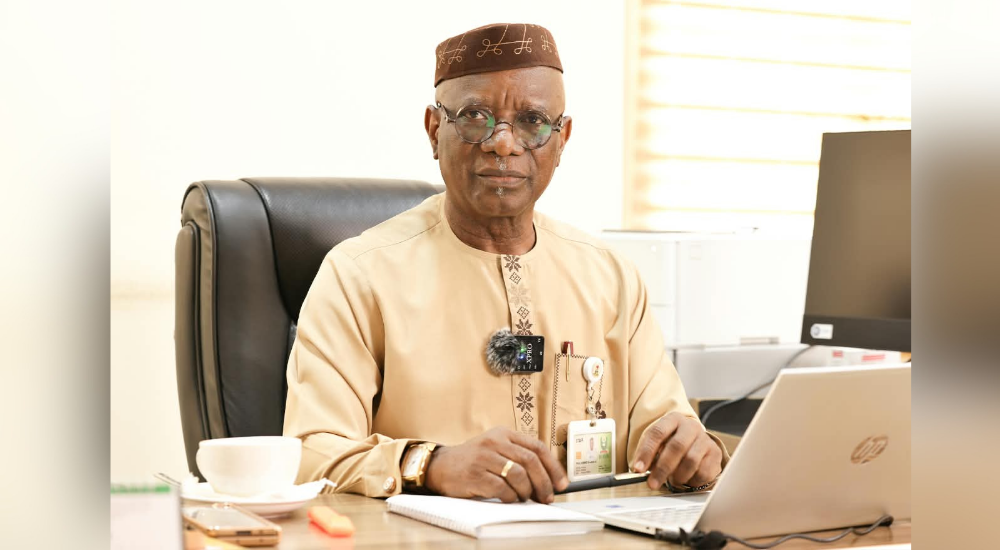
Prof. Sonnie Oniye is a professor of biological sciences and Dean of the School of Postgraduate Studies at the National Open University of Nigeria (NOUN), with expertise in fisheries and aquatic resource management.
Despite Nigeria’s vast aquatic resources, the fisheries sector contributes only a small share of the country’s agricultural Gross Domestic Product (GDP), according to data from the National Bureau of Statistics (NBS) covering 2023 to 2025. Fishing accounted for 4.38% of agricultural GDP in 2023 (N2.34tn out of N53.27tn) and roughly 4.35% in 2024, before edging up to about 4.85% in 2025 (N4.92tn out of N101.46tn). The figures remain far below crop production, which accounted for between 87% to 92% of nominal agricultural output during the period.
In this interview with THE WHISTLER’s Nneka ASOGWA, Oniye explains why Nigeria spends more than $1bn annually to bridge the gap between local fish production and demand. He also discussed the challenges facing the sector and the interventions needed to boost fishing, processing and packaging, while reducing fish prices and the country’s reliance on imports. Excerpts…
Why Does Fishing Contribute So Little Compared With Crop Production In Nigeria’s Agricultural GDP?
Fisheries is a complex operation because it requires multidimensional inputs and experts before a kilogram of fish is caught or produced. Given the country’s diversity and the diversity of fisheries resources, each sector requires a certain level of expertise, which, on its own, is creating what is perceived as a drop in fisheries’ GDP contribution to the national economy.
You can’t look at fisheries from just fish only. It is a complex scenario. For instance, in this country, we have fisheries and aquaculture. And these are divided into inland fisheries as well as ocean or marine fisheries. Each has its own specialisations as far as catching and the infrastructure required are concerned.
Advertisement
For instance, in inland fisheries, you have to think of it from capture fisheries, rivers and lakes. We have a lot of rivers and lakes in Nigeria, spread all over the country, like Rivers Niger, Benue, Sokoto, Ogun, Osun, Calabar, Akwa Ibom and several others.
The issue is that those rivers have their own specific fisheries, and the fishes within the riverine environment are absent from the lagoons and, of course, completely different from what’s obtainable in the oceans. So, each has its own peculiarities in terms of capturing, processing, preservation and marketing.
In the northeastern part of this country, where we have Lake Chad, which had varieties of fish species, insurgency around Lake Chad disrupted once-thriving fisheries, eliminating jobs for fishermen and associated trades (net repairers, sellers of fishing accessories, drivers, middlemen and several others along the value-addition chain), leading to dwindled GDP.
Then, if you look at the riverine environment, the lakes and dams in Nigeria, a lot have been overfished over the years. Some rivers are polluted as a result of urbanisation, and, in some cases, industrial pollution has led to complete degradation of fish stocks. If you go to the South-South, the delta region of River Niger, pollution via spillage has led to tremendous degradation of rivers and depleted fish stocks. The main sources of livelihood of the people are destroyed, leading to social vices and insecurity.
Generally, when there is heavy pollution from petrol or petroleum by-products, there is zero fish availability in that environment, leading to young boys and girls losing their jobs or their daily needs. This also reduces fisheries’ contribution to the GDP.
Advertisement
Looking at the next environment, which is the Atlantic or marine fishes, the marine environment in Nigeria is huge, from Badagry all the way to Calabar, and quite some distance, over 1,000 kilometres or thereabout, and then we have about over 200 nautical miles into the Atlantic Ocean, but we don’t have the technical know-how to harvest the vast natural resources. So, the contribution from that marine fish to the GDP is next to zero.
Again, fish poaching or stealing by international organisations within our territorial waters, which we as a country cannot monitor. They come, fish and cart away, or they fish and sell to us on the sea at international rates.
The last problem is aquaculture, which is the raising of fish or any other marine organisms in a restricted environment, and that has placed Nigerian fish production, in terms of production of catfish, called Clarias gariepinus, as the number one producer in Africa. But the catfish we are producing are fundamentally consumed internally; it is not even enough for internal consumption, and that is why catfish consumption still attracts high prices in Nigeria.
The input into aquaculture is extremely expensive. For instance, the ingredients associated with feed are so expensive; they have to be imported, and the feed cost is about 60 to 75 per cent of catfish production in Nigeria.
Again, fingerlings production is not even enough to satisfy the fishermen and the aquaculture environment, coupled with the problem of water quality with aquaculture. Water and feed are extremely expensive in certain parts of the country in the dry season. It discourages aquaculturists. All these make the contribution to the GDP very minimal or negative.
What Investment Model Will Make The Sector More Profitable To Small Producers?
Advertisement
Generally, in a microeconomic production of fish or any animal production system, I always advise my clients to start small and grow, rather than investing millions. Start small; as you become perfect in the system, you can keep on expanding your operations.
For instance, you may keep 200 fingerlings in 1,000 litres of water, and after the production cycle of about maybe five months maximum or six months, you may start another cycle with 500, then 1,000, in which case your pond will be increasing gradually over time. But again, if you don’t have serious availability of water, you cannot produce fish.
Water must be there 24 hours, and that’s a very important limiting factor in fish production, irrespective of the model you want to incorporate. Water, quality of fingerlings and feed availability are very critical. For me, it all depends on your pocket, your interests and what you intend to do.
If you’re not an expert, you can start as a novice, but you always need an expert, someone who knows it more than you, to guide you. Security is equally important if you are starting a small fish pond production system. If you don’t have any security, then you are producing your fish for the public.
Are These Challenges Due Mainly To Production, Processing Or Market Access?
Farming, processing, marketing, distribution, they all have problems. In terms of farming, there are all sorts of encumbrances associated with farming. I told you about water, feed, the seed, diseases, which are biosecurity issues. Then insincerity of farmhands and then finance, those are also problems related to farming.
For processing, we need electricity to process if you want a faster semi-industrialised processing system and not firewood all the time, and not spreading fish on the ground. You need electricity. Where is electricity in this country? What is the cost of electricity? Where is the dryer and what is the cost of a dryer?
I’m happy that dryers could be produced locally, but you need to use electricity. What is the cost of electricity as far as processing is concerned? Then packaging is very important too. If you want your processed fish to have international acceptability or even local acceptability, you must process and package in a manner that will entice the public.
Marketing; there is a huge market that will consume fish in this country now and in the next 10 years, given the population of this country. We have over 220 million Nigerians. But unfortunately, the market is there, fish is expected to be cheaper than beef ordinarily, but there are interventions by middlemen.
The middlemen have been adding uncomfortable profits to fish purchased from producers. By the time it gets to the consumer, the value must have doubled or tripled in several instances.
Distribution; I must tell you that our roads are bad. The fish are not produced in cities. They are produced in the villages or suburban environment. And the fish must travel some distance before it gets to the market.
Let me take an example of transporting frozen fish from Lagos to Kano: how good are our roads? How secure are the roads? The cost of transportation, the cost of diesel, bad roads, all add to the cost of the fish on arrival. All these are part of the problem, but they can be improved upon if our feeder roads to villages are improved. The breakdown of vehicles, trailers and trucks will be reduced if the roads are good.
The cost of fish as we have them now in this country can be reduced tremendously if the facilities are put in place. There’s a need for government intervention.
There’s a need for a reduction in Customs and Excise duties on imported fish, frozen fish, fishing equipment, including special diesel, special allocation to sea craft. Can you imagine, you have fish in Nigerian territorial waters, and you want to bring it in, you are paying Customs duties on fish caught in my territory. If fish is coming from Norway, for instance, Sweden, Norway, Peru, Brazil, Argentina, I will understand if there’s Customs duty on it.
Why Does Nigeria Still Import So Much Fish Despite Its Water Resources And Market Size?
We import because the internal production system cannot satisfy the demand. An average annual demand for fish in this country is about 3.2 to about 3.6 million metric tons annually. But we are producing only about 1.2 million metric tons annually.
Even though that has dwindled as a result of insurgencies in various parts of northern Nigeria, that has also dwindled as a result of urbanisation, pollution and so on. But at the same time, we have to import because we need more fish to satisfy protein demand in our country.
And fish is supposed to be one of the cheapest sources of protein that contains all the necessary amino acids which are meant for good growth of humans. So, if we cannot produce internally, we have to resort to importing. Unfortunately, the cost of importation over the years is astronomical.
We have spent over $1 billion annually in the recent five years to import fish into this country. For me, that is foreign exchange flight. So, if half of that amount of money is reinvested into the internal fish production system, who will be complaining? So, there is a need for an enabling environment.
But let me quickly add, I must give credit to this government for reintroducing the Blue Revolution, or blue economy, whereby the government has introduced a policy to explore our unlimited marine resources.
When I’m talking about marine resources, I’m not talking about fish only. We have shrimps, crabs, prawns and several others which are underexploited, but some people are exploiting them and selling them overseas.
Again, the banks are not giving adequate credit because the banks themselves do not understand the technicalities involved in the fishery sector of the country. If I may ask, how much is the Bank of Agriculture allocating to the internal fisheries or aquaculture? Of course, they will give us statistics. How relevant are those statistics? Who manages the use of that money or those loans for adequate fisheries production?
There was a document several years ago whereby fishermen that were given loans diverted the loans to something else.
Are Current Policies Encouraging Local Fish Farming Enough?
Policies are documents; they remain as documents until they are implemented. If they are not implemented, they remain on the shelf. There are one million and one policies in the agricultural sector of this country existing, but they are gathering dust. Implementation of those policies is the issue. And these have created a lot of problems.
Who implements the policies? How successful are the policies implemented? Who is monitoring the policy implementation? Who is re-evaluating the monitoring? For me, there’s a need for a change mantra. Not only in adding policies, but rather making sure the policy implemented works. Within the fishery sector, there are several well-written intended policies. There is a need for the government to change the style and approach to fishing production systems, especially to the population of the country and international politics associated with food production and distribution in the country, even to the Third World.
For instance, the war in Ukraine affected food distribution in Africa, also in Nigeria. Take wheat as an example. It led to the increase in the cost of producing bread all over Africa, including Nigeria. If there’s war, for instance, in the Scandinavian countries, where we get quite a number of fish from, or from South American countries, like Peru, Brazil and Argentina, if there’s war in those countries, then we’re in trouble. We’ll be unable to have the quantity of frozen fish we are having now.
Like in the case of petrol now, as a result of the U.S.-Iran war, it has affected the economy, and it’s a chain reaction. So, the same thing is applicable to fisheries. We have to redesign and find a way of implementing policy.
There must be a task force to implement policies, evaluate policies and make sure the policies get to the target persons. And it isn’t an issue to be handled by the federal government only. The state and local governments must be proactive.
You Mentioned Illegal Fishing Within Our Territorial Waters. To What Extent Does It Affect Fish Production?
I don’t have the data at my fingertips now, but I know that a lot of international countries or crews, generally, have motherships, which we call mother trawlers, on our coast or within our territorial waters. They have smaller trawlers that go to fish in our territorial waters and feed the mothership, and they take it away.
That is depleting the quality of fish or the quantity of fish within our territorial waters. You may not see the effects now. If poaching continues, it becomes more disturbing or destabilises the ecosystem in terms of fish availability that can be harvested in the future.
We have no adequate facilities to monitor our territorial waters. We need satellites, ships or naval and aircraft. We also need fast-moving ocean vessels, maybe from the Navy, the coastline or Coast Guard, to intervene.
If we cannot police our territorial waters, then poaching or stealing continues. But I must give credit to the Nigerian Navy. They have, over the years, caught quite a number of trawlers, illegal trawlers, fishing illegally in our territorial waters. But can the Navy patrol over 250 miles into the Atlantic Ocean by 1,000-kilometre stretch-wise? It’s very difficult, but it is possible if we have the technology.
Which States Have Strongest Potential For Fish Production?
I have taken my time in the last three years to look at the geography and the landscape with regard to the aquatic environment of the coastal region of this country. Given the problems associated with either pollution, urbanisation, and insurgencies along the coastline, for me, Ondo State seems to be the best, and that’s because Ondo State has a lot of inland lakes and lagoons, and a lot of them are not polluted.
A lot of them are still in their pristine state. So, those inland lakes and lagoons, which are found along the coastal part of Ondo State, can feed at least a good sector of this country if well monitored, technically improved and utilised effectively for fish production systems. Ondo is not industrialised as Ogun or Lagos State, and the coastline is not as polluted as those of Rivers and Delta states.
Two other states are likely to be Akwa Ibom and Cross River states. They have a nice environment for what we generally call crayfish or shrimps. Those three states, I would suggest, can change the dynamics of fish production, as far as the states are concerned.
Adamawa State would have been another state because of Lake Chad, but Lake Chad has been undergoing a lot of problems, with the exception of insurgencies. There is climate change that has affected Lake Chad. And not only climate change, the volume of water available to Lake Chad has reduced tremendously to less than 20 or 25 per cent in the recent 50 years.
Kano State has a lot of dams that could produce a lot of inland fisheries if those aquatic environments are seriously looked into and utilised. Niger State is also a wonderful land for fish production systems, but it has to be developed.
The Kainji Lake Research Institute is there to assist fish production within the Niger Lake environment. But who will bail the cat? We have a lot of resources, but we are not utilising them to our benefit.
What Should Government, Private Investors and Cooperatives Do Differently To Close The Production Gap?
I believe in this adage that says unusual problems deserve unusual solutions. So, we have to be proactive because we know the problems. Solving the problems involves a lot of actions.
For instance, each production system requires different types of approach. If I take either aquaculture production, the approach to reducing the inherent problems in aquaculture is different from marine culture or from the capture of fisheries from internal river systems. So, each of those production systems has its own particularities.
In aquaculture, there’s a need for more training of extension officers. There are few extension officers in aquaculture. A lot of experts in aquaculture are ageing, and we have fake aquaculturists that are deceiving entrepreneurs. With good training, we can start thinking of good seed production, fry production, fingerlings production that are biocompatible in terms of the biosecurity aspect, less diseases, and then we also need feed.
The ingredients in making feed, some are available, but there are interesting ingredients that must be there for production systems. Maybe the federal government should allow free importation or zero Customs and Excise duties on the importation of some of these inputs.
In aquaculture systems, for instance, there’s a need for aerators, an equipment that sends oxygen into an aquatic environment. We need it, but the cost of imported aerators for large aquatic ecosystems is very high.
In transportation to the market, we need to fix the roads and reduce fuel costs. Doing so will lower transport expenses to make fish affordable.
At the extreme marine fisheries, we need terminals for fish vessels. At the terminals, we need storage facilities, and the storage facilities need 24-hour electricity so that the fish that cannot be sent out on the spot can be frozen and kept in a manner that is acceptable to the consumer when it gets to the consumers.
In addition to that, if the storage facilities are not there, you need a fish processing sector within the harbour, within the jetties, to enable a fisherman or a ship to conveniently deliver its goods.
Along our coastline, we have about eight coastal states, but we don’t have enough jetties in each of those coastal states that will handle the harvested fish from the oceans effectively. The government should make provision for that.
The aspect of marine fisheries deserves not only national input in terms of finance, but also international input. For us to develop those jetties and the necessary associated infrastructure required, we need vessels to capture the fish itself. Nigerian vessels manned by Nigerian workers are required.
Then we need modern vessels, not old vessels that consume diesel like water. The consumption of diesel by modern ocean vessels has to be economical in terms of fuel consumption. But again, these are huge and long-term investments, and we need international investors to assist us here.
Nigeria’s fisheries sector holds immense untapped potential and capacity to employ millions of Nigerians. With over $1 billion spent annually on the importation of fish and unexploited marine resources, the opportunity for transformation is clear. However, realising this potential requires targeted investment, policy implementation, infrastructure development and security.
By addressing constraints across production, processing and distribution, and by empowering local communities and entrepreneurs, Nigeria can turn its aquatic wealth into a cornerstone of food security and economic growth.